Aucun message portant le libellé B&W. Afficher tous les messages

12 février 2020

In color or black and white? A personal bias before everything else.


With the introduction of the digital cameras, many will said that it is now possible to work simultiniously in color and black and white (with the option to edit your final picture output). But for the "ex-analog" photographers like me, this choice between the two traditional photographic rendering have a lot more to do with our preliminary vision, color or black and white, you try to transmit from your original image content.

This one of the reason that I have chosen to work with digital cameras that have the ability to switch on a specialized monochrome rendering. All these cameras are versatile and allow you to further configure them by using internal filter setting (Yellow, Red, Green) to bias the gray distribution  from the original image colors.

Shooting in black and white (B&W) is not necessarily easy and predictable for everybody but with the now commun electronic viewfinder (EVF) among many mirorless cameras, you can see in real time your final result which is a dramatic advancement from the dark ages of  the analog (film) photographic era.  By having access to this magnificent viewing tool, there is no reason to prevent yourself in switching to the monochrome setting. You can always register your picture in both JPEG and RAW files, this last one allowing you to get a "none-altered" color basic picture to edit further if you want to do do so.

Doing B&W photography can help you to enhance your ability to organize more specially your subject arrangement in terms of graphic positions, of light distribution and space importance of it.All these factors are also fondamental in color photography but monochrome may be an excellent exercice that can help you to better sense them.

As it is now very convenient to produce an overwhelming number of photographs and it is becoming a major flaw in our visual consumerist society. What the point to submerge people with such an abuse  total amount of pictures that will simply vanish the moment after in profit of another one? We have to be more selective and assume our choice to register an image or for viewing a particular one. In that sense monochrome photography can help to be more attentive about our subjects and spend a greater and more producing time to analyse and select the right composition, the right moment of exposure. We have to get away from the "cinematic" tendency of today photography. Let's keep animated (sequence) images for the videography where it should be kept in first place.

Some may ask why B&W is still a pertinent photographic rendering in your world of colors. Posing the question is easy but answering to it is more complex. We could pretend that it is a matter of photographer's emotions and feelings. Even for documentary purposes, it appears that some of the very renowned photographers are still preferring the B&W format over the actual very easy trend to reproduce colorful counterpart.

"The color of B&W" is may be a contradiction by itself but in some ways it can appear to be a second level of visual perception. And perhaps because of the fact that color reproduction process has been historically based from different layers of B&W support that we have  added the basic colors (RGB, CMYK, etc). That B&W technical approach for resolving the color representation (that many have a tendency to forget or simply not knowing it) is inducing that there is many colors which are present into a gray tonal scale. We know that some color combinations will generate more contrasty perception. In B&W photography, the colored lens filters will discriminate specific color frequencies in favor of other ones.

In  our present "color educated" society as we usually see through our different visual media, B&W has been generally associated with the past testimonies of time or with old photography even considering its more recent uses. Press photography has been also almost exclusively done and printed in B&W and the color pictures were reserved for magazine formats. The actual Internet culture has imposed an almost exclusively full color visual presentation. It is only more recently that B&W seems to resurrect often on a marginal way.

Strangely, the psychologic perception for authenticity appears to be influenced by B&W versus color, may be because it has been associated by the ancient analog way to produce pictures on negatives and prints. Sure it didn't prevent photo alterations and montages in the past as we are able to do today when we post-process a registered image. The initial introduction of the television exclusively in B&W could have been also a influencer in this thinking. However, the new generations dont have that tendency to overrate the "realistic" value of B&W pictures.

When I have started to do (analog) photography, black and white was consider the basic school of the fundamentals to master in that visual field. Color photography was the next step. So, in that perspective, our photographic training have prioritized the study of the composition (the subject spatial arrangement in two dimensions), the role of the contrast, of the gray scale and even of the film granulation, the importance of the subject (moment) expression, the control of the deep of field (the era of net subject-object versus the blurry context zones), the time and the amount of exposure required to registrer your taking picture the film  support. In one phrase, it was technical, it was instinctive, it was formative and progressive, it was creative.

Doing digital black and white photography should ask you the same personal involvement as we used to do during the days of film photography. And it is especially true if you have completed the whole photo process by printing your picture on a paper support.

You don't need to ask me if I am a (lifetime) advocate for B&W photography because, frankly, it is my intuitive and natural way to do it. But that "gray" and "contrasty" passion is now resugencing everywhere strongly than ever. So, just follow the "new"past trend!


24 novembre 2018

The Olympus Pen-F: Compact, classic and competent!

The love of rangefinder style camera

The Olympus Pen-F with the M.Zuiko 17mm F1.8 as a fine all-around combination. 
It is true to say that I always have a special crush for any rangefinder style film or digital camera. It has and still represents the traditional way of seeing a (real) compact camera in my sense. All those models are usually fun to work with and can generate very original photo material. When Olympus had introduced the Pen-F I was charmed by the look of the product and now I began to discover its special abilities as a strong but funny photo device to experiment. The Olympus Pen-F has its own standards and cannot be assimilated or compare to other D-SLR style (or centered viewfinder) models.


There is that modern camera style debate regarding SLR versus rangefinder categories that you can translate today by the choice of on-axis and off-axis (from the taking lens) viewfinder. Moreover rangefinder style cameras tend to be assimilated to compact and discrete devices nor that DSLR style camera have been associated as the center element of a complete and extended photographic system which is using longer telephoto and wider lenses and faster motorized advance film options.

The best illustrations of those two “schools” are present in all major line of mirrorless products available from Fujifilm, Olympus or Panasonic cameras and lenses. It replicate in this digital era the same pattern observed in the past with the Leica film camera offer with the M and the R lines.

With Olympus you can choose between the Pen and the OM-D lines. Accordingly their Premium and standard zoom lenses fit perfectly with the Pen models and their larger zoom and Pro lenses combine well with the OM-D series.

Olympus EP-3 Pen series predecessor 
During the past decade I have the chance to use both Olympus series models including the earlier EP models with the add-on viewfinder (a bit similar to the ancient Leica film I-G series). You can refer with my previous blog-notes on these models such as the EP-3 or the OM-D E-M5 (first version) or the most recent ones concerning the OM-D E-M5 Mark II and the OM-D E-M1 Mark II.

Both rangefinder and SLR styles have their own advantages. OM-D E-M1 and OM-D E-M5 are really all-weather devices with enhanced grips useful when combined with bigger faster lenses or external bigger flash units. The battery autonomy is greater and the viewfinder in the case of the E-M1 Mark II is clearly more confortable with its wider view. For many assignation works the OM-D series will get my preference. But for urban, travel or everyday spontaneous subjects the Olympus Pen-F is a perfect on-hand camera.

The Olympus Pen-F

Doing on the spot photography with the Olympus Pen-F is unbeatable because of its compactness and its own discretion. On travel and urban surrounding it is a strong advantage. And the Olympus Pen-F is far less intimidating regarding people or animal (domestic) photography. Using the silent mode option (electronic shutter) represent another strong advantage of the Pen-F if you are facing more quiet or calm conditions and subjects.

It is already said that the Olympus Pen-F replicates many aspects of the ancient rangefinder film cameras. But in that sense the past ergonomic solutions of the analog film era may also apply to the actual digital devices. On the Olympus Pen-F some traditional dial functionalities have been transformed such as the On/Off interrupter that simulate the traditional film rewind knob and the front special effect dial which is recalling the old slow shutter speed selector of the time. You can also use the traditional screw-in shutter release cable as a remote trigger unit.

The Olympus Pen-F is a slim and compact camera. Its “Pavé” design (like a slender decorative brick size) will dictate a less confortable and secure sense of handling. In three words there is “no protuberant grip” to rely and the use of a wrist or shoulder strap seem to be an obligation for the everyday user. There is also the possibility to add the Olympus ECG-4 optional grip. The slim design of the Pen-F is especially suitable for the combine use of the small Olympus (or Panasonic) fix or variable focal lenses. Examples of these fine optics are the Olympus M.Zuiko lenses such as the 12mm F2.0, the17mm F1.8, the 25mm F1.8 and the 45mm F1.8 lenses or the 14-42mm F3.5-5.6 zoom as an all-around optic. A lot of bigger lenses are fully compatible with the Pen-F but the handling of the camera will suffer a bit accordantly.

Except for the On/Off interrupter all the important dials and function buttons are located on the back & front of the Olympus Pen-F right hand side. This disposition facilities greatly the right hand control of the camera and liberate your left hand for a better handling of the taking lens especially in regard of the manual focusing (and zooming if available) option. As usual for Olympus cameras many functionalities may be directly available after prior setting (via menu interface) of the control knobs and push buttons. Most manufacturer default setting are logical and nicely presented although it may be altered at will in regard of your specific requirements.

EVF / Back live screen
The “look through” electronic viewfinder (EVF) will give a well definite picture with a very short time lag not really noticeable if you are concentrate on your subject. As usual the more high contrast rendering compare to the final image output registered has to be considered.  The Live/Review back screen is also very well definite and can be relied as a good reviewing tool.  It has also the great versatility of pivoting in almost every way.

Interface and Quick menu
Olympus interfaces are by tradition very extended and complete but the numerous accesses to the different setting options can be confusing and will ask you to invest on the learning curve of the menu. Many default setting are excellent and can be use right from the start. Furthermore the quick menu mode synthetize the most important factors usually chosen for the camera setting. There are also the Custom modes setting (C1; C2; C3; C4) that are very handy for the photographer who want to switch on the spot to a complete different setting. My suggestion is to experiment gradually the Olympus Pen-F and get use to its multi-possibilities. On a short note I have found that in many cases the multiple way (by going through the menu or the quick mode or even the direct dials and function buttons) of doing the same adjustment can be a bit confusing.

As for many other Olympus models, it is suggested to bring an extra battery considering the limited autonomy of the BLN-1 battery pack. Shooting by using only the EVF can extend significantly the life of your battery pack charge.  You just have to reverse the LCD screen to use this option.

Flash options
No in-board flash has been incorporated to the Pen-F. A small external Olympus FM-LM3 optional flash is included with the camera package and can be used as an emergency fill-in flash or as a commander unit of a multi external Olympus flashes arrangement. Otherwise you can rely on a more powerful and versatile unit such as the Olympus FL-600R that is powered by its own 4 size AA batteries.

Image Output 
By using the 20MP image captor similar to the OM-D E-M1 Mark II or to the Panasonic Lumix GX8 the image quality has been optimized on the Olympus Pen-F. The extra resolution compared to the previous 16MP sensor will give an additional marge of manoeuvre for post treatment ability with a less visible lost of definition. In some case like monochrome picture taken on high ISO setting the difference can be notably appreciated.
If monochrome represents most of your photo projects the Olympus Pen-F (like many Olympus M4/3 format models) will fulfil your tasks very nicely.
The Pen-F offers you a lot of different pre-program color configurations plus the possibility to create your own color bias and record it into its different custom menu. Using the Art filter options is another way to experiment different picture renderings.  In that sense there are no real limitations for the photographer creativity. The whole M4/3 format digital system has reached a great maturity.

Action photography with the Olympus Pen-F ?
Spontaneous photography as street or urban or travel subjects are well deserved by the Pen-F as everybody seem to agree easily but that perception differs a lot when you are speaking of action or sport photography. Many just points out a restricted ability of the camera to properly autofocus on moving subjects. Moving (often erratic) targets present a challenge to all autofocusing system and there are only a very limited camera models that can properly answer that demand like the Olympus OM-D E-M1 Mark II. So in the case of the Pen-F action photography is not the ideal situation to use it… but it can be done by setting for example a pre-focus area on manual position. For sure anticipation is fully required to do so but it got the advantage to more carefully plan our final picture composition. So with certain restrictions and more skill asked from the photographer part the Pen-F can fulfil the bill. At the end the Olympus Pen-F can be rightly assimilated as a perfect second very compact camera on hand for the sporty photographer.

(Conclusion)
In brief the Olympus Pen-F may represent the summit of their Pen series evolution simply by the fact that it reunite the slim design with the electronic viewfinder (EVF) like the ancient rangefinder film cameras. The Olympus Pen-F is complete in its features and performs very competently with the latest 20MP image captor. Although I did not intent to use the video aspect of the model the Olympus Pen-F is a very competent and compact still digital camera. Because of the compact size of the camera and the lenses that suit this volume (like the 12mm, 17mm, 25mm or 45mm) the Olympus Pen-F is very easy to bring all-around with you and is a very fine picture generator. It can fulfil many different photo projects on an everyday basis.  Its 20MP image sensor will give very high quality output at the same level of the “Pro” OM-D E-M1 Mark II.

The versatility of the Olympus Pen-F is on the side of its compactness: easy to bring, reach, show, shoot and share.

Post-scriptum on the Olympus Pen-F

Olympus Pen-F with M.Zuiko 14-42mm F3.5-5.6 II R lens
There are many lens-body combinations available with the Olympus Pen-F.  For sure the best image quality results will be obtained by using the Premium (prime) and Pro series lenses. But you can also explore a more modest approach with small zoom lenses such as the Olympus M.Zuiko 14-42mm F3.5-5.6 II R lens model that is very affordable, compact, versatile and will give very good pictures. It can be a small lens that facilities greatly spontaneous photography practice.

Since my introduction to the M4/3 format with the Olympus EP-3 I have selected the M.Zuiko 14-42mm II R lens as an ever ready “everyday” on hand optic on several occasions without being deceptive by its output. It represents a king of normal trans-standard zoom lens. Its major flaw remains its very small maximum aperture and it is difficult to really extract your subject from its surrounding by using a shallow deep-of-field. But on the other hand it can be a fantastic contextual lens that will allow you to compose beautiful urban scape for example. 


(If you are looking to buy the Olympus M.Zuiko 14-42mm II R you will often get the best deal when you combine it with the purchase of a camera body.)


First published in April 2017, Revised in May 2019.

03 février 2018

L'Olympus M.Zuiko Premium 45mm F1.8: la modestie du talent


(réédition de la version initialement publiée en février 2018)

Une des plus belles optiques avec laquelle j'ai pu travailler professionnellement durant mes années argentiques fut l'objectif Leica Summicron 90mm F2.8. Compact avec un angle juste assez discriminant ce chef d'oeuvre d'optique photographique avait ce charme créatif qui enchante son utilisateur. Je n'ai retrouvé cette magie visuelle que beaucoup plus tard en me procurant ce petit Olympus M.Zuiko 45mm F1.8 dédié au format numérique Micro Four Third (µ4/3).

L'Olympus M.Zuiko 45mm F1.8 est un petit téléobjectif discriminant doté d'un champs visuel de 27 degrés. Peu encombrant et très léger grâce à sa construction en composite, il s'agit pourtant d'une optique de définition supérieure offrant des résultats détaillés sans aberration apparente. Sa  grande soeur le M.Zuiko 45mm F1.2,  ayant une plus grande ouverture maximale, lui fait un peu concurrence mais pour les adeptes de la street photography le 45mm F1.8 reste sans rival et d'une discrétion exemplaire. C'est l'antithèse de la photographe intimidante.

Un des aspects les plus intéressants de l'Olympus M.Zuiko  45mm F1.8 est sa bonne réactivité peu importe le modèle de boitier MFT auquel il est couplé. Sa mise au point automatique reste efficace même dans des conditions d'éclairage plus difficiles. Cependant certains pourront regretter qu'il soit pas doté de l'option de mise au point manuelle sur la bague de focalisation du point comme son grand frère (45mm F1.2). Mais c'est peut-être le compromis à faire pour son tarif réduit et sa conception plus simplifiée. Vous pouvez choisir cette fonction de mise au point manuelle via l'option présente sur votre appareil si vous désirez accéder facilement à cette fonctionnalité particulière.

D'un point de vue anecdotique, l'Olympus M.Zuiko 45mm F1.8 est une des principales raisons qui a provoqué mon adhésion au format MFT. À l'époque j'expérimentais ce nouveau format de capteur avec le modèle Olympus EP-3 et son objectif-zoom de base 14-42mm mais c'est le 45mm F1.8 qui a révélé le véritable potentiel de cette nouvelle catégorie de capteur numérique. Les résultats obtenus en terme d'imagerie était tout simplement d'une classe à part d'où cette similitude avec l'objectif Leica Summicron 90mm f2.8 de l'ère argentique.

Mais jusqu'à quel point peut-on considérer ce 45mm F1.8 comme un objectif de tous les jours un peu comme la "normale" du photographe à l'imagerie discriminatoire? Car il s'agit bien de cela, c'est à dire d'utiliser l'Olympus 45mm F1.8 comme une optique sélective  par excellence idéale sur le terrain bien que son angle de champs réduit le rend moins malléable en recherche contextuel et oblige son utilisateur à compresser son sujet sur des éléments restreints. Mais il s'agit bien là d'un choix ou d'une démarche purement artistique ou esthétique. Et cela participe à la signature de l'auteur tout comme tout autre objectif pourrait le faire.


Action, portrait, architecture et autres sujets sont à la portée de l'Olympus M.Zuiko 45mm F1.8. Il n'y a qu'à prendre son appareil et déclencher. Du fait qu'il soit si compact, il peut facilement se glisser dans la poche et accompagner le/la photographe en toutes circonstances.


24 octobre 2017

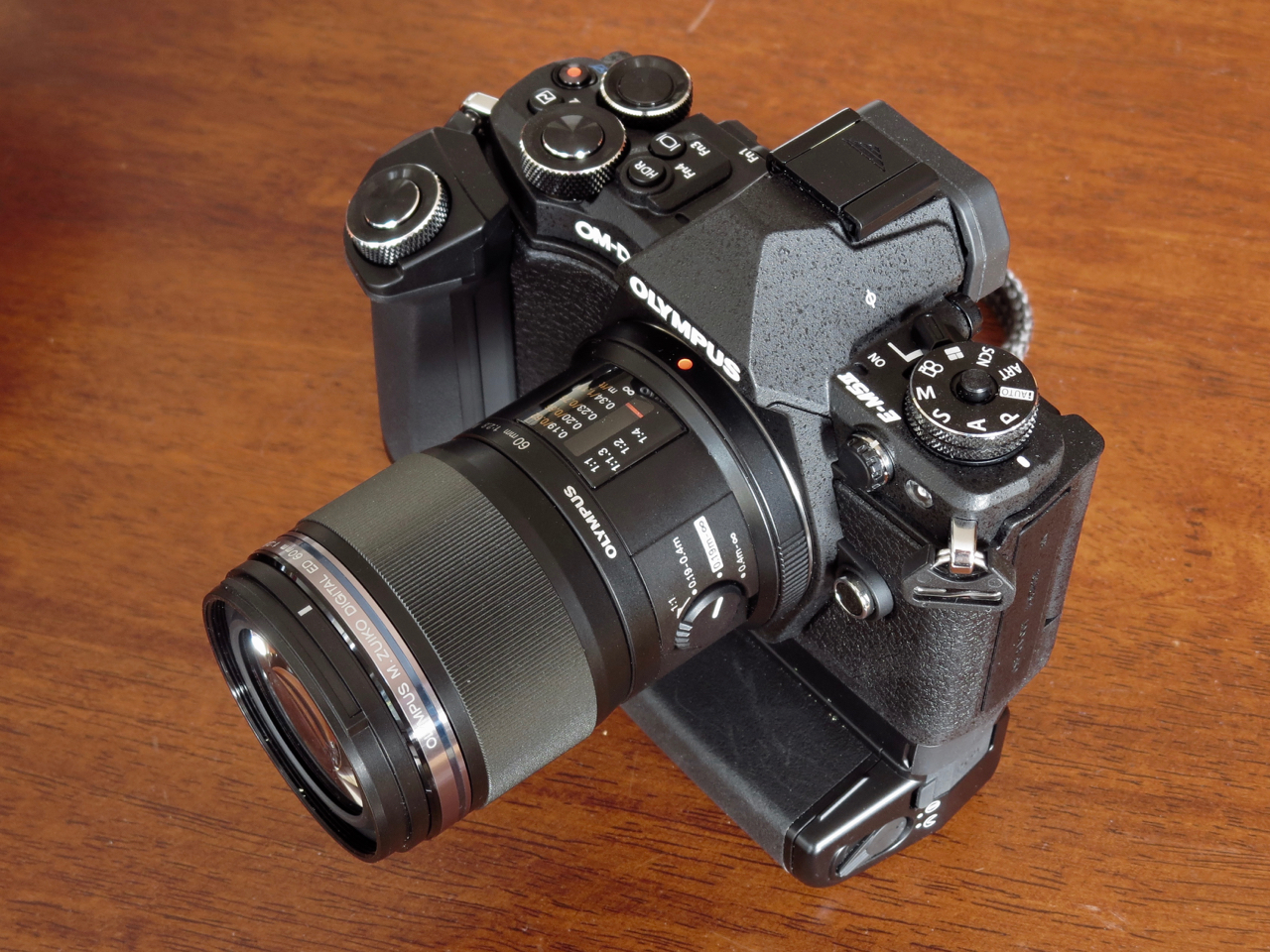
The Olympus M.Zuiko ED 60mm F2.8 Macro: Doing more than macro in M4/3 format.

It may be the most curious looking lens of the entire Olympus optical line up for M4/3 format camera. Strange may be also another epitheth to describe it. Its physical aspect with its non-obvious function dials are giving to the Olympus M.Zuiko ED 60mm F2.8 Macro lens a more confidential reputation based for a good part to its specialized first task intended i.e. macrophotography.

Close focusing photography has been always of a great interest for me as for many of us. Subjects in that field are infinite with various points of view. On a purely documentary side doing macro photography was at first on the scientific priority but very early on following the first spreading of the new medium we have seen beautiful artistic black and white and later on colourful macrophotographic pictures. We may qualify them as the prelude of abstract photography.


Although many fine lenses designed for more general purpose can produce very fine close focusing pictures camera and lens manufacturers had soon beging to offer specific macro lenses calculated mostly to cope the flat field exigence of reproduction purpose. That trend has been observed throughout the technical evolution of the photographic equipment. Today macro lenses are current part of many photo arsenal of photographers around the world.

Into the M4/3 format lenses you can rely on different models part of the Olympus and Panasonic line-up. All of them are exceptional contenders of their own. Normal focal ones such as the 30mm length are more suited to be versatile as macro and everyday lenses. Long focal counterparts such as 45mm and 60mm may represent a more powerful alternative for doing very small and near object or better tool for studio and reproduction works.

The Olympus M.Zuiko ED 60mm F2.8 Macro represent a very interesting lens with close focusing ability at first and unprecedented characteristics such as its longer focal length and its all-weather construction. With an angle of view of 20 degrees it surpass many short telephoto for portrait work. Even with a maximum aperture of F2.8 it can be use for action photography in normal daylight condition. Of course close focusing can be its primary advantage combined by the fact that its longer focal length prevent most of its potential obstruction of light on the close subject.

Maybe the most spectacular part of the Olympus 60mm Macro is its oddly aspect if you compare it with others lens designs. But in the past many macro lenses had and still have that kind of visual aspect. I have to concede that it is not the most discrete optic I have ever used.

As for most telephoto macro lenses the Olympus M.Zuiko ED 60mm F2.8 Macro is a very creative tool and versatile because of its close focusing ability. If you accept the fix focal length factor you will find many ways to produce very original pictures that emphasize your main subject. As usual telephoto lenses can be also very competent for doing landscape or urbanscape photography with their dramatizing compression of many subjects in one frame.

The Olympus M.Zuiko ED 60mm F2.8 Macro lens is a small optic which is part a the traditional M4/3 format line of prime lenses. With a focal length of 60mm it is magnification factor of 2.4X compare to a standard lens (25mm) with an angle of view of 20 degrees which is qualified the optic for portrait or for small telephoto work. At 185g it is also a very light package easy to bring with you as an extra lens but you have to pay more attention to your stability in use since it is not possible to count on its own weight inertia (like bigger telephoto counterparts), In that case the camera stabilisation option is a welcome feature.

Manual focusing can be performed nicely through its large and very smooth focusing ring. Using the 60mm with the OM-D E-M5 II and its EVF (Electronic ViewFinder) is easy and the image is clear and accurate in most photographic situations. Focusing speed is surprisely responsive for this type of (macro) optic and it qualify the 60mm Macro lens for all other subjects associated with the use of a medium telephoto.  And yes the use of the limiter dial can save you time (and picture opportunities!) if it is applied in the good working context. The reproduction ratio scale is an amusing gadget also.

Typical third-party screw-in (46mm) metal lens hood
for telephoto. (Always check for trace of vignetting)
There is always that annoying discussion about the utility of using a lens hood with the 60mm since Olympus does not provide one with the lens (which is also very annoying...) My answer is simple: if you can afford to buy and bring one dont prevent yourself to do so. I have found the Olympus official lens hood to be a clever design (like the one that came right from the box for the Olympus M.Zuiko ED 40-150mm F.2.8 Pro model !) but you may consider some third party options less pricy and less bulky available through the Web. Essentially lens hoods are preventing some lens internal reflections (flare) especially when you are pointing in direction of punctual light sources.

The Olympus M.Zuiko ED 60mm F2.8 Macro is a very fine lens as it is intended to be. We are reaching pro level image results. Picture are crisp and rightly detailed. Colours are accurate and follow the Olympus expected bias without any adaptation compare to the other lenses of the Olympus line up. Out of focus areas are pleasant even considering the moderate maximum aperture of the lens.
The macro ability of this 60mm is flawless and enhanced by the longer focal length that reduce the risk of interfering with the subject light.

In bref it is fair to consider the Olympus M.Zuiko ED 60mm F2.8 Macro lens as an all-around medium telephoto optic with very handy macro possibilities but also nice other abilities such as for spontaneous photography, portrait or even action subject.


18 août 2017

The mid-range deep of field is on your side!

To Be or Not To Be (as for to have or not to have...)


Olympus M.Zuiko 14-42mm @ 42mm, 1/125sec F5.6 ISO200 Monochrome
There is the ones who are searching for the minimal deep-of-field and there is the others that are looking for a maximum deep-of-field. Portraits, sports, fashion are part of the first category and landscape, architectural, illustration are dedicated in the second type of photography. And to get such results within the traditional optical limitations i.e. maximum aperture in one case and less light diffraction in the other way you have to rely on specific cameras or/and lenses that may be expansive and far less versatile.


Panasonic Lumix G Vario 12-32mm @ 32mm, 1/125sec F5.6 ISO200
Since I am not very fond of big and costly photo equipment my answer to that challenge is simply the following. Why not exploring more abordable photo material and discover how to get image results that will fulfil those special tasks regarding the amount of deep-of-field (DOF) that will satisfy yours needs. Is it possible by using very basic optics such as so-call "kit" lenses? In my modest examples I have tried to outreach the usual standard imposed to these products.And dont forget in this digital world of wonders that most of the time "what you see is what you get" usually apply!

How can we definite mid-range deep-of-field (Mid-DOF)? Anything between two extreme: almost no deep-of-field or about infinite deep-of-field like in landscape photography. So Mid-DOF can be assimilated as an intermediate area between the closest and the longest(or infinite) distances. Most lenses for compact camera format (M4/3, APS-C and 24 X 36mm called wrongly "full-frame") if not all have the ability to do mid-range deep-of-field by using their smaller aperture settings such as F4.0, 5.6, 8,0 or 11.

Panasonic Lumix G Vario 35-100mm @ 100mm, 1/800sec F7.1 ISO 200 Monochrome
The safety gap
If you are facing many various picture taking conditions it is good to rely on a certain deep-of-field margin. This "safety gap" ensure you that critical focusing is at least obtained for the principal subject  especially considering its volume aspect for example on a face, on objects with incrustations, etc. Sometimes you won't be able or you will simply forget to double check the full clarity of your subject. This is why a mid-range deep-of-field will play as an insurance for your final image results.

Optical quality pick of the lens
Rarely you will get the optimum quality of your image by using the maximum aperture available on the lens. Furthermore we know already that the diffraction phenomena for an optics will appear by using its minimum aperture. So the best output will be registered in selecting the medium aperture such as F4.0, F5.6 or F8.0 on many lens model or even at F2.8 with lenses doted of a larger maximum aperture (F1.7, F1.8, F2.0).

Compactness
Lens models that are designed with a more moderate or modest maximum aperture are reckoned to be more compact and lighter package a big advantage if you have to carry them extendely. Their smaller size mean also more discretion or less intimidating aspect. All these consideration of better mobility and less carrying fatigue will be fully appreciated for your street or traveling photo projects or any other situation that required an additional effort from your part.

Good pricing on your part
Many moderate maximum aperture lens models are far less expensive compare to their "Pro" counterparts. Often they are available on special selling package with the camera at a ridiculous add-on price tag. I can recommend you without any doubts the Olympus M.Zuiko 14-42mm F3.5-5.6 II R & 12-50mm F3.5-6.3 EZ or the Panasonic Lumix G Vario 12-32mm & 12-60mm both F3.5-5.6 OIS or the Fujifilm Fujinon XF 16-50mm F3.5-5.6 & 18-55mm F2.8-4.0 both OIS which are all excellent optical tools.

Panasonic Lumix G Vario 12-32mm @ 32mm, 1/320sec F5.6 ISO200
What you loose? Essentially a larger maximum aperture for a minimal DOF, a higher quality design and construction and often a better sealing protection for using the lenses in adverse conditions. But you will double or triple your price tag to get them. And you will have to bring them with you...

A picture should tell a story and that story can be very limited when you are selecting a very narrow deep of field or on the contrary the story can be very long (translate boring) if you choose an infinite deep of field. Something in between could be the best thing to do... The choice is yours but a mid-range deep of field choice is certainly on your side. And the beauty of this is already available on the most affordable (kit) zoom lenses.


18 février 2017

Black'nd Mine: An Adventure in Gray Tone.

Tone my expression in a gray world and I will be in the black of mine. Storyboard of my life is the témoignage of the despair of emotion. Click the instant desire of eternity and the full inspiration of the romantic soul.

Where are you my love, my muse, my perfect picture of the physical human art. Light is triking the edge of my insanity. And I hope some understand my deviance. That's only photoetry.

You must say something, you must show something so we want to see.


04 février 2017

Film "Odd"-ity

Going back to film is trendy but not particularly practical or futurist!
(Second Personal Splash of 2017!)


Antique Editing Table
Yes we have seen recently a new trendy attitude toward digital photographers proclaiming the return of the traditional film picture support as a growing alternative tool for the future of the medium. As an ex-emerging photo youngster from the film era I am fascinated by the "discovery" of those who want to experiment the ancient ways of creating picture expressions. And I fully respect them for creating their original photo projects on that technical base.

Exploring any expression medium can be a very exciting experience whatever if it is an ancient formulation or a contemporary technique. So we cannot discuss the real pertinence to use it or not. It is up to anybody to choose the medium and use it as he wish. No discussion there for sure especially considering the artistic point of view of it. Visual representation is an universal art with many avenues and meaning.


Good Old Artefacts of the Film Era
Photography is part of our modern surrounding by proposing the temporal extension and interpretation of the instant reality. The technical of doing photography have expanded for more than two hundred years.

Now you have to consider the digital revolution that have transformed the production and the diffusion the photographic medium. It is cheap, accessible, easily editable and  more easily shareable.
All these advantages contribute to push photography into new frontiers never imaginable even 25 years ago. Like it or not it transgress every attempt to control its flux to specific audiences. It like music. It is everywhere, every time for everybody with less and less limitations.

This is why the digital revolution of photography is so important. Yes I respect without discrimination every form of art expression and techniques used to do so. But you cannot really pretend that there is a return of evolution to the film era, an era that I have been issued both personal and professionally I must add.


Primitive Color Calibration by Eye Appreciation
Digital is becomed a superior technical way of doing photography at lesser price in term of ressources and processing time. The traditional film have strong limitations that can be properly use as selective options if you intend to do so. But it is still a difficult ways of doing photography and it will ask you a strong effort to apprehend the technique. The learning curve of traditional film photography is intense and often discouraging.

You have to be honest and admit that digital photography is now part of the future evolution of the medium.

Rolls of Pain and Pleasure!

28 décembre 2016

Montréal Like It Like It Not: A Black & White Desire


Montréal is my born city even if I became a suburb boomer like many of us. Montreal is the essence of our cultural french identity the other places are simply anecdotical for us. When I walk in the streets of Montreal I am always strike by infinite nature of changes over the places, the people and the time. Montreal is a survivor in this very competitive world of North America.


You can see the buildings, the beautiful girls and boys as the ancients, the surroundings, the noise and  the music, it is the the dis-harmony of life. It is Montréal!


Are you with me ?


10 juillet 2016

The Panasonic Lumix GX85/GX80 (Japan GX7 Mark II): TheTraveller Successor


The Panasonic Lumix GX85/GX80 or GX7 Mark II (Japan):
A very classical rangefinder style digital modern camera
My first introduction to M4/3 image captor format was with the Olympus Pen EP-3, The camera and lenses dimensions were just perfect in my sense for an everyday compact camera. The only irritating omission was the absence of a traditional viewfinder and using the add-on EVF accessory simply destroy the homogeneity of the basic idea. Later the coming days of the OM-D series solved partly the problem by integrating a workable EVF and by offering in-body stabilization.

Panasonic have developped over the years a complete series of rangefinder style cameras such as more recently the GX7, GM5 and GX8 models all cameras doted with a good EVF and in-body stabilization. It reunited other successful features such as standard 16MP image sensor or the moe recent 20MP sensor for the GX8, touchscreen and tilt-able or fully orientable (GX8) LCD screen. The GX7 was a near perfect size model and the GM5 was a real traveler camera.
Many still photographers prefer the tilt-able screen
option over the fully orientable side-screen alternative
designed more for videographers
.

Now Panasonic have decided to refresh the GX7 by presenting the new GX7 Mark II (in Japan market) relabelled GX85 or GX80 into the other world markets. The "Mark II" designation clearly indicate the filiation with the previous and original GX7 version.

Many factors are differenciating the original GX7 from its successor, the Lumix GX85 / GX80 / GX7 Mark II. I will review some of them that I have found more determinant.

Less grip compared to the original
GX7 but more than the GM5
The Grip Factor
The Panasonic Lumix GX85 / GX80 have not the same grip volume as the original GX7. It results in a smaller prehension confort. Since the camera is more on the moderate heavy side for its overall dimensions it will ask you a more careful attention in bringing, holding and manipulating the model.  But compare to the previous and diminutive Lumix GM5,  the Lumix GX85 / GX 80 offer a more secure way to work with its body. It  is always possible that in the near future an add-on accessory grip will be proposed for some of of us  who are asking for a better grip.

The Switch Factor
The On/Off switch is is located on the upper right side of the body of the camera but reaching it with your thumb may ask you a strong contorsion exercice. All the other operating dials and fonction buttons are classically presented. No more direct dial for the the automatic and manual focusing setting is present on the Lumix GX85 / GX80 model. That absence can be compensated by using the autofocus with manuel correction option.

Reactivity and Focus Factors
In general the Panasonic Lumix GX85 / GX80 is a very reactive camera fast enough to capture spontaneous pictures of acting subjects. If you have chosen to work with larger aperture prime lenses such as F1.7 or more the auto focus adjustment seems to be faster and on target most of the time. Screen touch focus selector can be another option easy to reach when you are more selective with less usual subject target (that option can be also desactivated on demand).

The Monochrome Factor
Some of my previous viewers know already my love affair with black and white photography and the Panasonic GX85 / GX80 will perfectly respond to that task by offering two monochrome photography options: MONO and MONO L. Ether versions give you a tonal palette from black to gray to white which is rich and detailed. Black and white photography rendering with digital still camera is now a mature feature. Professional results are obtained right from the start preventing that way more destructive post-treatment manipulations.

The Sensor Factor (16MP vs GX8's 20MP)
Panasonic have chosen to maintain the commun standard 16MP sensor for the GX7 Mark II. Quality  output of the picture using this sensor has been already demonstrated several times over the past. A marginal improvement can be observed by the fact of the absence of an anti-aliasing filter initially used to prevent  the moiré effect. These changes may offer you better image cropping factor ability without noticeable quality decrease.

Severe cropping is possible without altering the overall quality of the picture.
None retouched original picture


The Viewfinder Factor (Tilt GX-7 EVF vs Fixed GX85/GX80 EVF)
The Panasonic Lumix GX85/GX80 s doted with an in-board EVF without the previous option of upper tit-ability present in the original GX7. That option has been offered with the newest rangefinder style Panasonic flagship model the GX8 which is in fact a larger camera with all-weather sealing and maybe more capability to resist from intense using. Apart from the tilt-able option, the previous (GX7) and the newest (GX85/GX80) EVFs are behaving in the same matter giving a good but more contrasty representation of the actual image. The big advantage of using EVF is its direct relation with the final result registered by the image captor. It is an almost perfect tool to preview black & white results. Moreover the EVF allow you to do instant review of your last picture taken without losing contact with your subject.

The Design Factor (Angular vs rounded GX7)
The Panasonic Lumix GX85/GX80 is marginaly a more boxy camera compare to the first version of the GX7. It represent a certain drawback in term of ergonomic design of the model. Body style is more classical which is a popular present trend among many camera manufacturers. On a daily using basic sharp angular design camera are less confortable to work with to say the least but it is partially compensated by the more discrete presence of the device in face of the subject.

The Stabilization Factor (GX85/GX80 more in-board Axis)
Modern cameras need to be stabilized for many reasons. They are smaller and lighter packages and we are facing most of the time faster subjects or contexts that need to be adequately  stopped or freezes. The Panasonic Lumix GX85/GX80 offers the two stabilization options with in-board stabilization sensor and the possibility to combine lens stabilization (if offered by the lens model used) and sensor stab. Most of the time the stabilization factor will increase the definition of your picture output in a decisive way. Dont prevent yourself to use it extendely.

The Lens Factor (Panasonic G lens system + Zuiko M. options)
One of the decisive factor of selecting to work with M4/3 ILC format cameras resid in the the very interesting choice of lenses available on the market. These lenses can be versatile, fast or specialized and their overall dimension stay compact and lightweight. For sure my preference goes for the prime (focal fixed) lenses with moderate larger aperture such as the Panasonic Lumix G 20 F1.7 or G 42.5mm F1.7 OIS models. There are perfect matches to bring you good to outstanding results from the camera. For a one-lens traveler combination  you can consider the Lumix G Vario 12-32mm F3.5-5.6 OIS that is offered at a ridiculous selling price when you decide to buy the GX85/12-32mm package. There are many others lenses that can fit your specific need and the Olympus Zuiko M lenses can be also another option.

Other factors
The in-board flash of the Lumix GX85/GX80 can be a good help for using the fill-in flash technique and you have the possibility to put an external unit if you are a heavy flash user.

As usual for ILC mirrorless cameras an extra battery is clearly a must recommendation. For charging them an external charger seems to me a very practical add-on. I hope in some way that an add-on grip will be in someway available in the near future.


In short the Panasonic Lumix GX85/GX80 (GX7 Mark II) represents a very interesting successor of the previous GX7 and GM5 models.