Aucun message portant le libellé Fujifilm X-Pro2. Afficher tous les messages

30 septembre 2021

The mechanical feeling: further thoughts about the Fujifilm X-Pro2


 One of the most distinctive features regarding the use of the Fujifilm X-Pro2 camera model, it is certainly its mechanical style approach which is illustrated by many analog style controls or dials. Many basic functionalities are present such as ISO adjustment, shutter speed and exposure correction dials, aperture and focusing rings, viewfinder option front lever as for auto/manual focus control dial. Even the presence of a shutter release button with a screw-in cable release option is typically a reminiscence of the traditional analog film camera era. 

Analog control dials are usually by stepped one-stop exposure value graded, compared to the more precise stepless electronic adjustment. This can be observed with the shutter speed scale, the aperture ring setting, and the ISO selector. And the convenience to set manually those dials is by forcing the photographer to get a better comprehension of the parameter choices in relation with the subject and its context. Automation often induces a less attention to the effect of the configuration used to photograph. Moreover, it is easier to directly set a particular parameter without working through control dials or buttons that are only reflected by viewfinder/live view info’s.


There is a bit of controversy about the utility of using an optical viewfinder (OVF) knowing that an electronic viewfinder (EVF) will deliver you a good preview of your final picture result. But EVF had proven to be more tiring for the eye of the photographers. An optical viewfinder in these digital days is offering a bit of a relief from all those electronic screens that are a constant part of your life even if you consider the less reliable framing accuracy of some OVF. Using an OVF is also a good way to measure how your film simulation bias are altering the "raw" picture rendering in terms of color, contrast, dynamic, etc. It may force you to reconsider that special image sensor configuration aspect.

Analogue control dials and rings don't mean that there is a mechanical link between them and the material functionality of the camera. For sure we understand most of those adjustment is done electronically ("by wire") and we cannot compare an electronic Fujifilm X-Pro2 to an almost complete mechanical parametric system like the Leica M (if you except the image sensor part).


Many Fujifilm X-Ts, X-H and X-Pro’s products have this mechanical feeling that characterize their series for years now. Beginning in 2012 with the introduction of the original X-Pro1, Fuji is now offering an impressive and expanded line of camera models and various X-mount lenses. Most of them respect the analog style presentation but as time is passing by, some of the most recent Fuji X-mount models such as the X-S10 have now adopted the standard electronic multi-function dial/push-button trend, and there are sensitive economical and industrial good reasons to do so.

If you like to do photograph in a simple manner but you still want to participle directly to the selection of the fundamental picture parameters, the Fujifilm X-Pro2 is certainly a strong camera choice to do so. Even though all automation versatility is present on the X-Pro2 and are reliable if you need to use them, on the other hand, you can configure, one by one, an exposure bias or a focusing zone of your choice that will open a different pictorial interpretation of your subject and its context. There are your image sensor configuration (JPEG film simulation or RAW), your sensor sensibility (ISO quality), your shutter speed (movement control), your lens aperture (deep of field), your focus point and, eventually, your exposure correction. Most of them have a direct control dial access and you can go further with all the menu functionalities or the other function push buttons like the white balance (picture temperature Kelvin control), the autofocus behavior, etc.)

Since the emergence of the digital photography, we have seen the reintroduction of the two camera design historical trends, i.e. the off-lens axis viewfinder (à la rangefinder) and the centered ones (à la single lens reflex or D-SLR). Each school has his/her supporters. Off-lens-axis viewfinders allow generally to stay more discrete in front of the subject, in looking less serious or as a pro-type of photographer, more face-to-face generous contact which is an advantage when you are looking for more spontaneous photography. The camera body design is often more slick, less bumpy although it will signify a less secure hand holding. At the end the virtues of each viewfinder type depend what kind of use the photographer will do with the camera.

Last remark regarding the Fujifilm X-Pro2 is its ability to be able to pre-select faster basic parameter without looking to the camera viewfinder/live-view. Getting an intuitive technical photographic approach save more time to look to the subject in its context with your naked eye and increase your ability to search and find different angles of view or to anticipate the scene time and space development. In that sense, the Fujifilm X-Pro2 is a very creative photographic tool.

More about the Fujifilm X-Pro2

28 septembre 2021

The pleasure and ... the pain!: the Fujifilm X-Pro2


If you are looking into my modest photo bag, you will certainly notice the contrast between the presence of two opposite camera model design and interface: the Fujifilm X-S10 and the Fujifilm X-Pro2. The first one (X-S10) can be called an action subject captor and the second one (X-Pro2), a classical photo composer. Although the Fujifilm X-Pro2 is an excellent traveler camera (urban, casual, intimate, etc.), this older Fuji X-mount model have the other interesting quality of being simple to use with a less extended interface menu to deal with. Only the absence of any in-camera stabilization sensor system (IBIS) may be seen as a disadvantage by some photographers (which I agree to a certain extend).

Following my usual compact camera criteria, the Fujifilm X-Pro2* have a rather big camera body alongside with somewhat larger control dials and function buttons that are making most parameter manipulations easier to do and secure. And many of those functionalities are cleverly done such as the auto-focus look (AF-L) that can be used to pre-focus the attendee subject leaving at the same time the front focus lever to its continuous position (C). Some reviewers compare the Fuji X-Pro2 with the Leica M series models which is, in a sense, an incorrect analyst because the X-Pro 2 is an automated camera model at first rather than an exclusive manual one (especially in autofocusing optionality).


One of the very specific features regarding the Fujifilm X-Pro2 is the presence of its optical viewfinder (OVF) that mimic the old optical viewfinder of the great rangefinder camera era. Although the focusing system of the X-Pro2 is using a complete different technical and hardware principle, some advantages have been retain such as be able to see outside the frame of the lens focal selected for anticipating the subject final composition getting a non-distracting view of the subject without any image sensor interpretation (a "raw" view if you prefer). For other photographers that prefer to preview as much as possible their final picture before taking it, the electronic viewfinder (EVF) can fulfill the task like many other mirrorless camera models. The EVF option is also a better viewing option when you are coupling a zoom lens with the Fuji X-Pro2. At the end, the Fujifilm X-Pro2 viewfinder options are unique in this market (interchangeable lens camera, ILS).

The Fujifilm X-Pro2 offers less than many other Fujifilm X-mount series models. For examples, no moveable rear LCD screen; no internal electronic flash; no (complete) Auto switch or control dial Auto position; no filter or special effect interface. But as a "pro" camera model, the camera body construction is suited for an intense use in adverse conditions.


The freedom of creativity is often opposed to the diktat of technically and modern photography and is one of the best illustrations of this dilemma. Getting be too much involved by the multiple interface (and parameters) possibilities can simply kill the enthusiasm and the motivation generated by a creative impulsion. It can also have the tendency to force photographers to replicate the algorithms embarked into the camera CPUs. But, on the other hand, automation is a good thing à priori because it prevents to be overwhelmed by purely technical challenges that are eventually stop spontaneity and enthusiasm to take pictures.

If you are looking for an "intended" photo in regard of the basic parameters of a picture such as image rendering, shutter speed, aperture/deep of field, composition, shooting moment, all of these can play a fundamental role to your final picture. But some of those technical adjustments may be less important and will depend of the context and of the goal of doing this particular imagery. The reference algorithms are based on a widespread image analysis of sometime thousands of photographic situations and the final parameter adjustments applied to them, but there are common bias that can restraint many constructive pictorial creative attempts. Working with a simpler interface camera to technically pre-set like the Fujifilm X-Pro2 opens larger original imaging possibilities.


In view of the newest Fujifilm X-Pro3, many of us may ask if is it still pertinent to stay with or choose the Fujifilm X-Pro2? In fact, those two successive Fuji camera models have a different personality despite their optical viewfinder central characteristic. And it is mainly du of the different LCD back screen design interpretation. In one case (X-Pro2), the LCD is a fixed one with direct visual reference that is been aligned with the lens axis. Moreover, the X-Pro2 LCD screen can be activated exclusively to review your already done pictures. On the X-Pro3, the LCD screen is movable but in an off-camera position which seem to me more intended to use it as an after taking-picture reference and its natural closed intended position is obvious. Time will tell which system will be favored if Fujifilm persist or not in that trend for future X-Pro designed cameras.

If you are asking what the best camera would be to choose, you may simply confuse yourself with all the different reviews, diverse statistics or even with the good-intended advice that will create a final confusion without any help to select a definitive camera model. The Fujifilm X-Pro2 is definitively no more, five years after its 2016 introduction, the flavor of the month. Its availability (as new) is almost non-existent now, but it remains a solid valid choice for basic reasons like its optical-electronic viewfinder, its simplicity to use and its obvious durability.

More about the Fujifilm X-Pro2!
________________________________________

* Nobody is perfect for us and certainly not a specific camera model. The Fujifilm X-Pro2 is a large size camera comparable to a Leica M10 (35mm image sensor format) in dimensions although the Fuji is weighing notably less and because of its "rangefinder" design with its off-center viewfinder, it is an easy camera to hold with your right hand.

The Fuji X-Pro2 optical viewfinder (OVF) is still puzzle me a bit and I have found that it is better suited to use it in conjunction of a fix focal lens. Comparatively, the electronic viewfinder (EVF) is the perfect tool when using a zoom (variable-focal) optic. In both cases, the autorotation (horizontal-vertical) info display is a very pleasing feature.

28 mars 2020

Cayo Largo désertée (mars 2020)


L'année 2020 sera marquée d'une pierre noire pour l'ile de Cayo Largo, avec la fermeture momentanée de son aéroport en début d'année et finalement la désertion complète de l'ile en pleine haute saison touristique de mars 2020 par sa clientèle toujours fidèle mais vaincue par les évènements que l'on connait.


Nous avons fait partie des tous derniers contingents de visiteurs alors que d'ores et déjà la moitié des complexes hôteliers avaient mis fin à leurs opérations et que pour les autres, il ne reste qu'une poignée d'irréductibles.


Malgré toute cette désaffectation exceptionnelle, Cayo Largo a gardé son charme incomparable et sa douceur de vivre au son des vagues déferlantes sur ses plages blanches. Ce refuge parfois rustique demeurera toujours une destination pour celles et ceux qui veulent momentanément s'affranchir du rythme effréné et bruyant de notre société matérialiste.


28 février 2020

The graphite and spartan Fujifilm X-Pro2! Did we said traditional like boring or exciting?

Fujifilm X-Pro2 w/ XF 23mm F2 R WR (Graphite version)


Some love to own devices that are fully stuffed with functionalities and the latest novelties available. We just have to look at the "phone" market to acknowledge that it is not really recent consumerist phenomena. The same thing happens for the photo equipment market which is a "niche" market partly habited by eternal debaters who are looking for the "best" camera.

So, it is more a discussion about numerous potentialities and less about the practical use of a camera model for most of the time. It is to forget that for many decades during the analog-film era, the camera designs and interfaces were, by far, perfectible and not always fully reliable but it didn't prevent the vast majority of the photographers of that time period to make outstanding pictures.

I was hoping with this long introduction to awake our good logical reflexes and put our photo materialist preoccupation to a higher level, but I have so often failed for my own that I have no lesson to give to anybody in the first place.

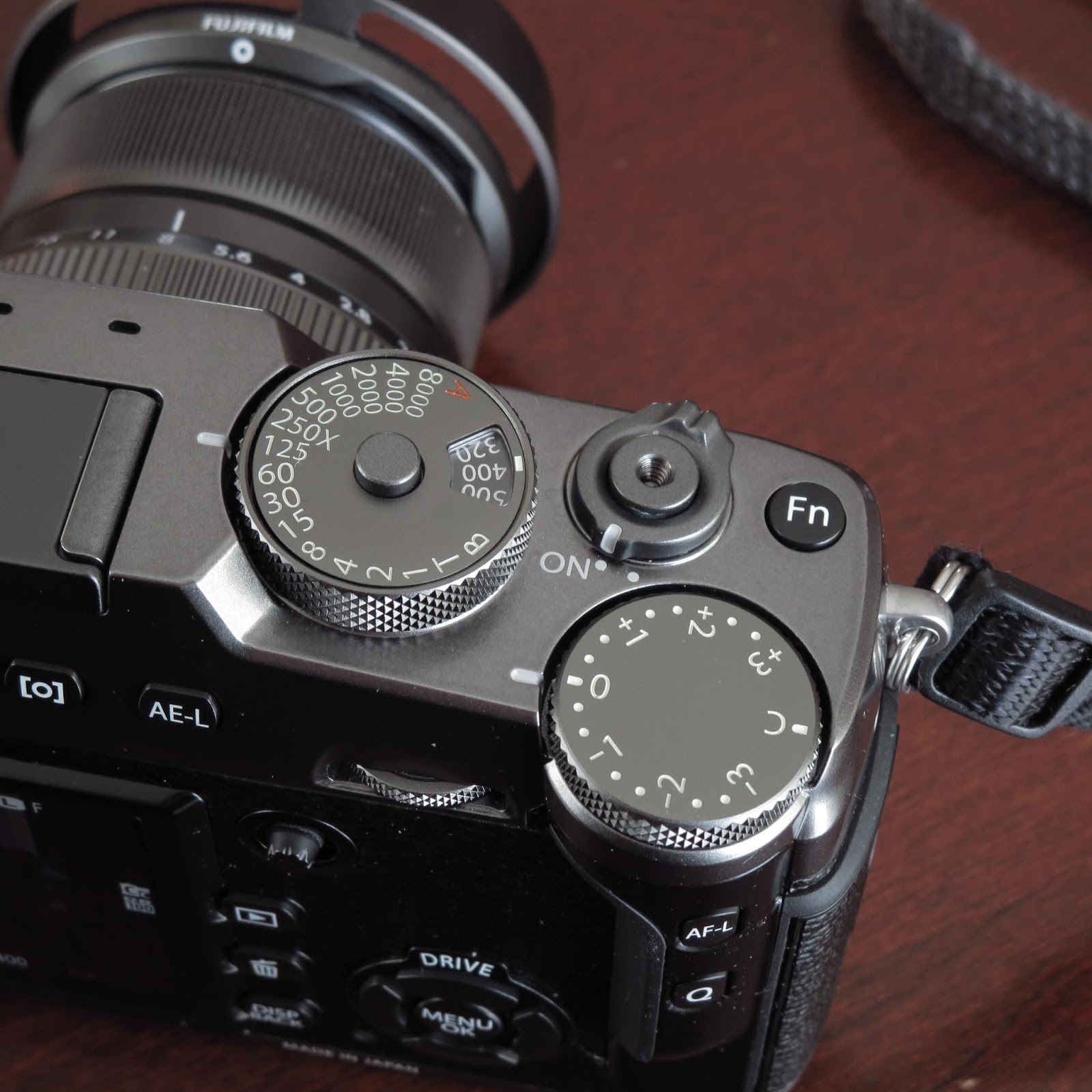
The love of dials (ISO, Shutter speed, Exposure correction)
Recently Fujifilm have presented a flurry of new models (X-A7, X-T200, X-Pro3, X-T4) and as usual it is very difficult to be totally insensible to the harmonious songs of novelties. After all, choosing to buy a new camera is a completely irrational behavior! In consequence as it happened so many times in my brief photo life, I was wondering what my next adult toy into the Fujifilm planet will be. As a X-E series user, the Fujifilm X-Pro3 should be the nicest gift that I suppose (to cherish in my sleep every night) but I say to myself, what not have a second look to the previous (already 4 years old!) X-Pro2 model.

For those few who are following my blog over the years, you know already my always motto to want and buy a camera model of the just preceding generation at a discount selling price right at the moment of its replacement by a newest model. Because I have a tendency to prefer a more mature product that have benefited with all the latest firmware and have been more smoothly manufactured. For example, you can be very confident to use a Fujifilm X-H1 pro model considering its inherent qualities and the obvious fact that its last promotional selling price tag was simply a hell of opportunity.

But even with the introduction of the new X-Pro3, the price level of the previous X-Pro2 is still on the higher side for modest budget like mine. Luckily one of our best retailers in Montreal have made a special offer over the Fujifilm X-Pro2 Graphite kit (w/ XF23mm F2 R WR) that I cannot have ignore and here I am with one of the best (and at least affordable for a time!) "rangefinder style" digital camera on the market!

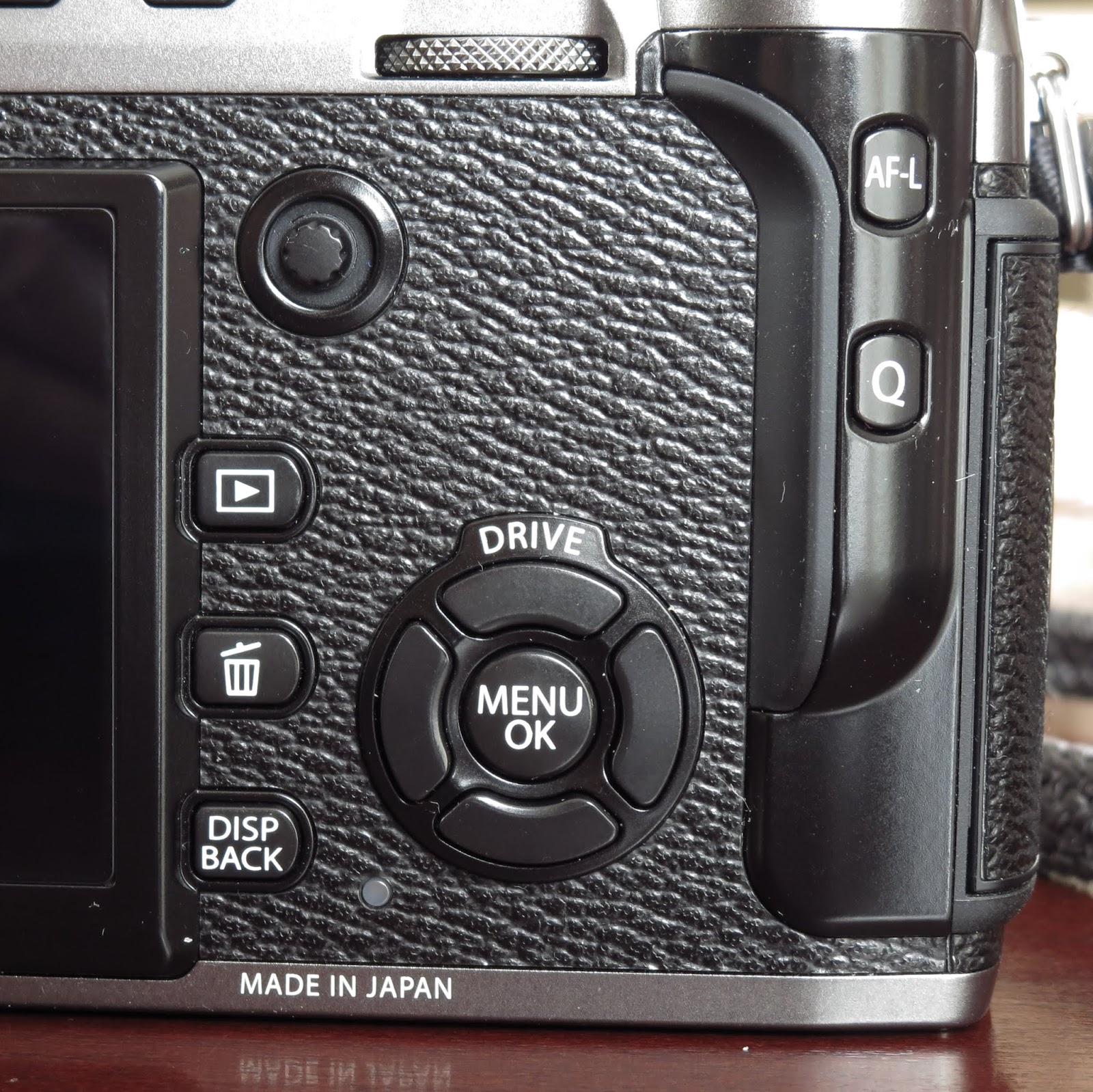
Compare to X-E series, the Fujifilm X-Pro2 is a bigger camera although its hand prehension may appear more secure depending your hand size. Many basic controls (dials and push buttons) are similar from what we can expect on a Fuji X-mount camera model. The combination of the "joystick" and the D-Pad command selector is welcome because it facilitates different direct configuration such as film simulations, white balance, focus areas and drive functionalities. Fine tuning of the shutter speed and expanding of the exposition correction factor can be performed through front and back commander dials. Auto-exposure and auto-focus lock are easy and well implanted. The Quick menu let go to the most used functionalities extracted from the complete menu. And there are other adjustments available from programmable function buttons.

But the Fujifilm X-Pro2 won't offer you all the usual requests that photo equipment web reviewers always ask for. No moving LCD back screen. no internal flash, a very limited video use and no provision for headphones, no optional vertical battery grip, etc. Sure, without the Leica label, you cannot avoid the critics about these choices of voluntary omission. No, the Fujifilm is not a do automatically everything camera for you and you will have to adapt yourself with imagination to cope with certain picture taking situations.

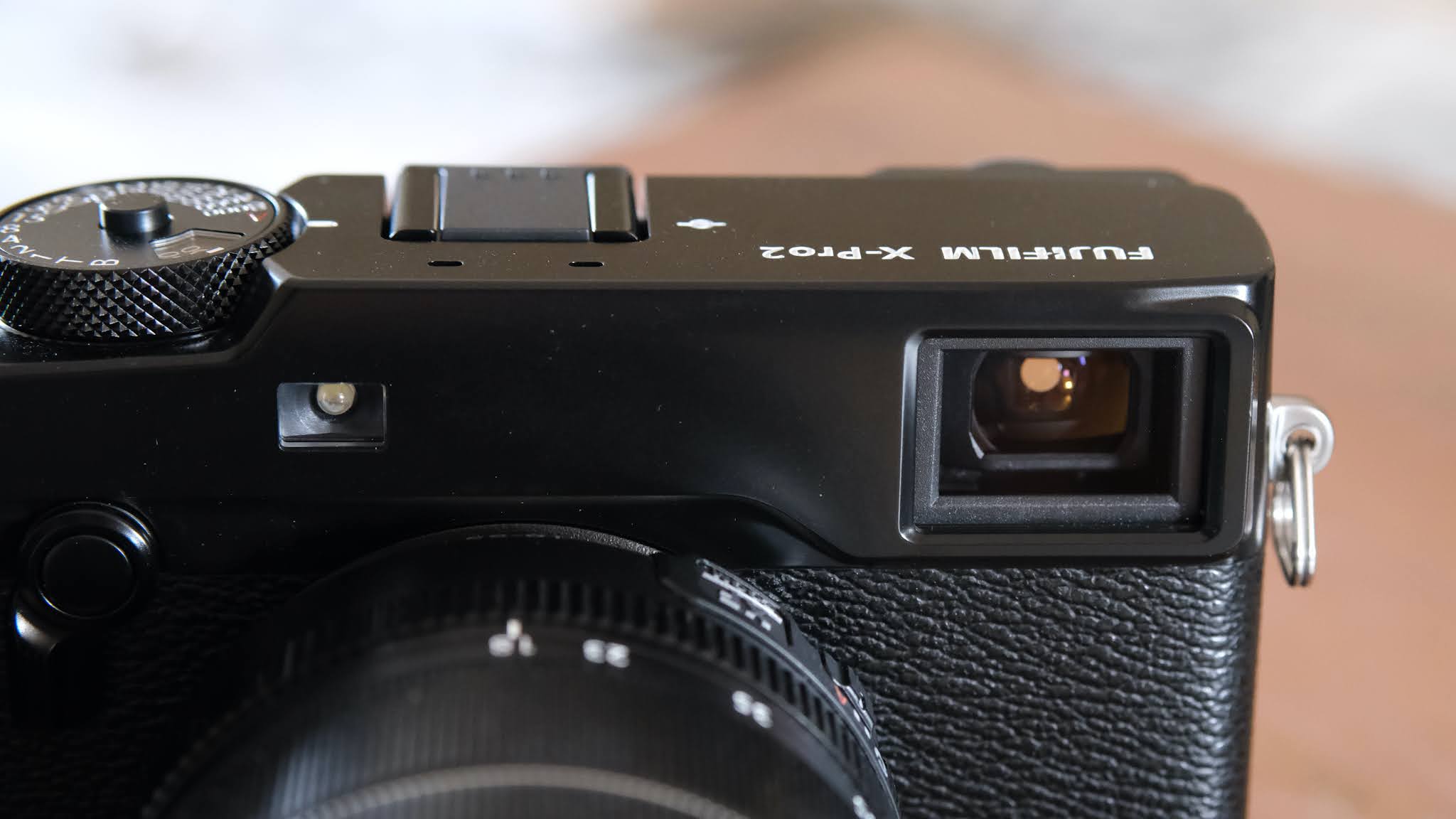
Front view of the optical viewfinder (OVF)
Very unique viewfinder
The Fujifilm X-Pro2 is equipped with a dual-option viewfinder, a unique feature among the "rangefinder style" digital ILC (Interchangeable Lens Camera) camera models. In simple words, we can select between a truly optical viewfinder (OVF) with picture frame parallax adjustment and a now classic EVF (Electronic Viewfinder). At first, I was skeptical about the utility of the optic option but after a certain time, I have found it very comfortable considering that the EVF (although more precise and more practical to preview the final picture taken) seems to develop some eye fatigue during an extended photo session. I must add that the larger view version of the OVF is not really interesting for glasses wearer like me.

The EVF is considered as the primary viewfinder by many X-Pro photographers. Its ability to project a preview picture in all the image and exposure configurations we may choose to make it as a very efficient photographic tool. With the eyepiece that Fujifilm have implanted, the eye relief of the viewfinder is (for the glasses wearer) limit for evaluating the entire frame especially for the extreme corners. All the proper information is well presented (into OVF or EVF) and have the autorotation ability. Lastly, you may prefer to select a different brightness of the EVF through the menu manual setting (in my case, minus 1 has been selected).

The Fujifilm X-Pro2 rear viewing screen can be operated to get a good Live View of your picture or as a reviewing screen for all the pictures already taken. The image definition is excellent, its reactivity is fast, and you can rely on it for many various photo opportunities. As already mentioned, the screen is fixed on the camera and no other orientation is possible. That can be annoying for people that are accustomed with more "video" oriented devices, but less external mechanisms might mean better long-term reliability and less provision for accidental (and fatal) manipulations. You can shut down the rear back screen if you don’t intend to refer to it during the photo taking session with the exception of reviewing the already pictures taking which is a very nice feature (you don't need to reactivate the rear screen to do so).

Contax G2 w/Planar 35mm F2 (35mm film ILC)
Source: Wikipedia
The pleasure of working with the X-Pro2
The Fujifilm X-pro2 is bearing resemblances with older rangefinder cameras of the film (analog) era such as the Contax G2 illustrated here. But to evoque such a comparison like that is sometimes misleading because of the strong differences in term of design and manufacturing between the two types of cameras (film (analog) versus digital). And performances associated with them were also very apart. Digital cameras of today have a much performant auto focus system and auto exposure calculator that are more versatile and more reliable than it was 25 years ago. Going back is more an esthetically nostalgia than anything else.

The Fujifilm X-Pro2, doted with a 24MP APS-C digital image sensor, can be a very simple camera model to operate. Its handling is facilitated by its more prominent size. The shutter sound is smooth and discrete. The X-Pro is reactive in auto-focus and for the auto exposure setting. It is easy to parameter the photo basic like the ISO, the shutter speed, the aperture and the exposure correction factor. You take the camera and with an eye glance, you are informed about all these data. The accuracy of the X-Pro2 metering system is reliable even in more critical situation but you can adjust the camera following your own bias.

The bottom of the Fujinon XF 23mm F2 R WR Graphite
Made in Japan! (not Philippine)
 
With the Fujifilm X-Pro2, many photographers will couple accordingly a fix focal lens which is more compact (and suitable in using the OVF) and that will guaranty high quality image files. The optical viewfinder will better be mated with short focal lenses such as the 18mm, 23mm, 35mm for example. The EVF on its part will suit any focal length challenge. With the graphite version, Fujifilm will combine a graphite (made in Japan!) XF 23mm F2 R lens which is a versatile optic for many purposes. You can gradually construct a complete lens park with the XF 16mm F2.8. the XF 23mm F2, the XF 35mm F2 and the XF 50mm F2, all these fix focal lenses are weather resistant (WR) same as the X-Pro2 (a good reassuring factor for photographers who are facing various contextual conditions).

The Fujifilm X-Pro2 have provision to accommodate a pair of secure digital (SD) memory cards allowing its owner to duplicate pictures in RAW and JPEG or simply get a longer autonomy. Power consumption is supported by the regular NP-W126(S) battery pack seen on most others Fujifilm models (except for the newest X-T4). Keeping spare (and loaded!) battery packs is a good habit to have with electronic camera models.

The best of both worlds: Joystick + D-Pad controls
Numerous (practical) controls
As already mentioned, the dual presence of the D-Pad and the jock stick is given you a rapid access to many other functionalities. The "Fn" push button is programmed initially to start the video recording but it can be configured for more still photography utilities. I won’t bother you in listing all the possibilities that the X-Pro2 give us access through its quick (Q) and extended menus. I leave you that part to explore and to discoverer how the Fujifilm X-Pro2 is an outstanding camera model for a lot of different photo situation. And yes, a traditional flash PC plug is located on the (LCD) side of the X-Pro2 for those who have the nostalgia of the annoying old (and hazardous) PC cord.

The autofocus system of the Fujifilm X-Pro2 perform nicely even under low light conditions. For the still photographic purpose, the system can be adjusted following more specific needs. Normal action photography can be correctly served although erratic subject movements are always been a particular challenge for any autofocus system and depend essentially on standardized algorithms that have been programmed by the manufacturer. Even if the Fujifilm X-Pro is not a "track and field" labelled camera model, it can manage its way to that task as long its owner understands its limitation and work on a creative alternative like the subject panning technique, the pre-set focus, or the voluntary blur, etc.

A shutter release cable mounted on the Fujifilm X-Pro2
Fujifilm picture quality output
One of the major strengths of Fujifilm digital camera models is certainly its science of colors and black and white that the manufacturer has imported from its past and renown experience from the film (analog) era. All the Fujifilm film simulations are interesting to try because they can offer new picture interpretations you never think of. For sure, black and white (especially ACROS) simulations are very popular. If picture quality is your primary criteria for electing a camera model, you won’t be disappointed par Fujifilm and the X-Pro2.

Since the Fujifilm X-Pro2 is designed as a professional camera, its lifespan is proclaimed to withstand more than 150,000 shutter actuations, meaning 600 working days of 250 camera shutter releases per day. For the more moderate users, it represents years of continuous use. At this date (and before the release of the X-T4 model) only the Fujifilm X-H1 can surpass that mechanical longevity interns for the number of pictures produced. Saying that a camera model is a pro one doesn't necessarily induce that it is a fully loaded photo device with all the functionalities that you may think of. It simply implies that the X-Pro2 is primarily designed and manufactured for an intensive pace of utilization.

The Fujifilm X-Pro2 like its predecessor the X-Pro1 and its successor the X-Pro3 are all greater dimension camera models not really playing into the more compact field of the X-E series for example. That bigger size allows the manufacturer to combine effective an OVF and an EVF, a specific feature you cannot find to other competitor rangefinder style models. The durability of the X-Pro2 should classified as a working everywhere and under most adverse conditions camera model and that will withstand intense uses. But it can be also seen as a long-term camera device for someone who to spend more time, more destinations, more subjects to his/her photo projects. Are still some X-Pro2 available out there? For one, I was privilege to have found one of the last in Montreal!

All illustrations were realized by Daniel Marchand except for the one presenting the Contax G2.