Aucun message portant le libellé Flowers. Afficher tous les messages

26 mai 2020

Flash-Post: Black and White Flowers!

One Picture, One photographer, One experience Series


It seems odd to talk about flowers ... in black and white (!) but you can be sure that this particular photographic subject is not a new one because, almost two centuries ago, flowers and other vegetal were ones of the first documented by photographers.

Even it appears more challenging to take black and white pictures of flowers, it happens that in several occasion, the subject rendering seems to be more appealing and informative then its usual color representation, a phenomenon that many black and white predominant photographers have experimented over time.

The different gray tonal areas of flowers are rich and often very distinctive each from another. The blend of colors that often have the tendency to melt the flower rendering disappears in favor of various gray picture zones creating an interesting tridimensional effect.

Every flower may ask a specific approach in terms of angle, of composition, of light, of contrast, of surrounding back and foreground, etc. The word "study" is rightly defining the photo experience with the flower subjects. And black and white picture bias is simply adding a lot to the emotive impact of it.

Other samples:


01 décembre 2018

The Olympus M. Zuiko ED 40-150mm F2.8 Pro

The Olympus M. Zuiko ED 40-150mm F2.8 PRO is now part of a very successful Olympus MFT story  especialy considering its extended versatility and its reduce size compare to the DSLR 24X36mm sensor format equivalents. Furthermore the same statement can be proclaimed for many M4/3 format photo equipment products.

For sure there is still a strong resistance to the introduction of the M4/3 format from the so-call professional intelligentsia. The picture quality argument has been served ad nauseam to reject any more compact option. But time is passing by and moreover people are adopting MFT and APS-C formats. The new state regarding photography and its popularity is intimacy related to its fast, versatile and portable ability. Big DSLR dont seem to follow that path so extinction seems not far away for them.

The Olympus ED 40-150mm F2.8 PRO stays a massive lens by MFT compact standards. But it replace at least two DSLR Pro lenses, i.e. the traditional 70-200mm zoom and the powerful 300mm telephoto, both with maximum aperture of F2.8. So the trade-off is still at the advantage of the Olympus M.Zuiko 40-150mm F2.8 Pro. It prevent also the necessity of changing lenses or to operate with two different camera bodies.

Using big telephoto zoom lenses increase the unbalance tendency between the optic and the camera. That fact can be critical if you need a correct handling especially if you are panning the action not only for the effect but simply to follow the subject. Fatigue can be a highly distractive factor that will affect your ability and motivation to produce pictures. You can enhance your handling by adding an additional grip or vertical power grip on the camera. If you adopt a more static position, a fix support like a monopod or a tripod will be a great help for stabilisation and a more careful picture cropping. In fact the nature and the context of your subject will characterize your working methodology.

With such a Pro lens model with a larger maximum aperture of F2.8 the photograph will select most of the time a fairly large lens opening often between F2.8 and 5.6. Those aperture opening will narrowed the deep-of-field phenomena and privilege the main subject. Focus can be critical at that point and autofocus or prefocus have to be set carefully. Your picture waste may also increase accordingly. That is part of the experiment. Many photojournalists  may prefer to work with DSLR 24X36mm sensor format classic equipment. I am always impressed to see those boxes full of photojournalists with identical equipment in major sports events. They often reproduce the same picture without any search of originality. This is another specie of photographs in danger of obsolescence.

As a Pro lens the Olympus ED 40-150mm F2.8 is getting a superior quality of construction. The zoom and focusing rings are larger and will turn nicely with a simulated friction similar to old-fashioned lenses. The click-on manual option (Clutch Manual Focus) available on the focus ring is a very secure and fast way of selecting between auto or manual possibilities. By selecting the manual focusing only position you over rule the autofocus fonction and get a better focusing ring resistance similar to the previous manual focusing lenses. It replicate what is already present to the Olympus 12-40mm F2.8 Pro lens which is often the companion optic chosen by many. As for all the Olympus other M4/3lenses, no aperture ring are offer on that model assuming that it will done by one of the dials of the camera.

The monumental push-pull lens hood is included with the Olympus ED 40-150mm F2.8 Pro. Operating the mechanism may require some study and practices from your part. I have worked freely with or without the lens hood (if it was possible to do so without compromising my picture quality). The Olympus 40-150mm F2.8 Pro is also doted of an already tripod/monopod accessory mount that can be rotate for horizontal or vertical shooting. The making of this piece appears to be very well designed and constructed. My suggestion is to kept it permanently on the lens and simply rotate it aside when you are handholding the lens. The Olympus 40-150mm F2.8 Pro lens got the weather protection which qualify the optic for an extended use in most adverse conditions. It allows you also to fully clean the lens.

Contrary of the usual mystic regarding the use of those big Pro lenses could require from the photograph an effort in preparation and during their specific manipulation. Shooting at will may expose you to some disappointment in view of the final results. With try and experience you will master the care and the limit of these pro telephoto lenses such as the Olympus ED 40-150mm F2.8 Pro. In-board camera stabilization may partially help you but the fundamentals stay the same such as selecting a higher shutter speed and follow (panning) your subject. If possible an external support such as a monopod or a tripod can help you a lot (and prevent fatigue!).

The Olympus ED 40-150mm F2.8 Pro can be a very fine portrait lens and many beautiful examples presented over the Web illustrate that fact. It can be also an interesting "abstraction" lens that allows many defocusing experimentations. Working with relatives short distances (for this type of lenses) will narrow the deep-of-field for bokey effect. Sport and nature photography appear to be the most spontaneous themes of preference for what the Olympus ED 40-150mm F2.8 Pro has been first designed et manufactured. And many users have already demonstrate the rightful of this perception. As I have already said at the beginning of this post, this telephoto zoom pro lens is in fact more versatile into a smaller package. In many ways it respond to the standards imposed in almost any photojournalistic situations.

Finally here is a short note regarding the high selling prices of many of those "pro" lenses. Usually these professional intended optics are produced in smaller quantity with higher cost material and for a limited distribution. Therefore their price tags are positioned at a selling point more difficult to reach for many of us (including obviously myself!). But if you consider the added durability of these models and their constant value over time, you will often discover that they simply follow the inflation rate over the years and the decades. It is up to you to invest yourself in that kind of higher expense.


The Olympus M. Zuiko ED 40-150mm F2.8 Pro lens is a very fine, constant, versatile, workhorse optic that is reliable into various conditions of uses. It is part of the traditional duo along with the Olympus M. Zuiko ED 12-40mm F2.8 Pro and also with the T(h)ree family if combined with the Olympus ED 7-14mm Pro. All these pro lenses will form a very competent equipment when teamed with OM-D bodies like the E-M1 and E-M5 or even the E-M10 series.

A complete Pro system
Olympus is very serious about its Pro line of lenses involvement and offer a complete line-up of fine, fast and sturdy optics with the M. Zuiko 7-14mm F2.8, 12-40mm F2.8, 12-100mm F4.0 IS, 40-150mm f2.8, Fisheye 8mm F1.8, 25mm F1.2, 45mm F1.2 and 300mm F4.0 IS. Combined with the OM-D E-M1 series, an independent professional photographer will find a very competent and compact eco-system that will sustain most of its need.

(First Published in September 2017, Revised in May 2019)


18 août 2017

The mid-range deep of field is on your side!

To Be or Not To Be (as for to have or not to have...)


Olympus M.Zuiko 14-42mm @ 42mm, 1/125sec F5.6 ISO200 Monochrome
There is the ones who are searching for the minimal deep-of-field and there is the others that are looking for a maximum deep-of-field. Portraits, sports, fashion are part of the first category and landscape, architectural, illustration are dedicated in the second type of photography. And to get such results within the traditional optical limitations i.e. maximum aperture in one case and less light diffraction in the other way you have to rely on specific cameras or/and lenses that may be expansive and far less versatile.


Panasonic Lumix G Vario 12-32mm @ 32mm, 1/125sec F5.6 ISO200
Since I am not very fond of big and costly photo equipment my answer to that challenge is simply the following. Why not exploring more abordable photo material and discover how to get image results that will fulfil those special tasks regarding the amount of deep-of-field (DOF) that will satisfy yours needs. Is it possible by using very basic optics such as so-call "kit" lenses? In my modest examples I have tried to outreach the usual standard imposed to these products.And dont forget in this digital world of wonders that most of the time "what you see is what you get" usually apply!

How can we definite mid-range deep-of-field (Mid-DOF)? Anything between two extreme: almost no deep-of-field or about infinite deep-of-field like in landscape photography. So Mid-DOF can be assimilated as an intermediate area between the closest and the longest(or infinite) distances. Most lenses for compact camera format (M4/3, APS-C and 24 X 36mm called wrongly "full-frame") if not all have the ability to do mid-range deep-of-field by using their smaller aperture settings such as F4.0, 5.6, 8,0 or 11.

Panasonic Lumix G Vario 35-100mm @ 100mm, 1/800sec F7.1 ISO 200 Monochrome
The safety gap
If you are facing many various picture taking conditions it is good to rely on a certain deep-of-field margin. This "safety gap" ensure you that critical focusing is at least obtained for the principal subject  especially considering its volume aspect for example on a face, on objects with incrustations, etc. Sometimes you won't be able or you will simply forget to double check the full clarity of your subject. This is why a mid-range deep-of-field will play as an insurance for your final image results.

Optical quality pick of the lens
Rarely you will get the optimum quality of your image by using the maximum aperture available on the lens. Furthermore we know already that the diffraction phenomena for an optics will appear by using its minimum aperture. So the best output will be registered in selecting the medium aperture such as F4.0, F5.6 or F8.0 on many lens model or even at F2.8 with lenses doted of a larger maximum aperture (F1.7, F1.8, F2.0).

Compactness
Lens models that are designed with a more moderate or modest maximum aperture are reckoned to be more compact and lighter package a big advantage if you have to carry them extendely. Their smaller size mean also more discretion or less intimidating aspect. All these consideration of better mobility and less carrying fatigue will be fully appreciated for your street or traveling photo projects or any other situation that required an additional effort from your part.

Good pricing on your part
Many moderate maximum aperture lens models are far less expensive compare to their "Pro" counterparts. Often they are available on special selling package with the camera at a ridiculous add-on price tag. I can recommend you without any doubts the Olympus M.Zuiko 14-42mm F3.5-5.6 II R & 12-50mm F3.5-6.3 EZ or the Panasonic Lumix G Vario 12-32mm & 12-60mm both F3.5-5.6 OIS or the Fujifilm Fujinon XF 16-50mm F3.5-5.6 & 18-55mm F2.8-4.0 both OIS which are all excellent optical tools.

Panasonic Lumix G Vario 12-32mm @ 32mm, 1/320sec F5.6 ISO200
What you loose? Essentially a larger maximum aperture for a minimal DOF, a higher quality design and construction and often a better sealing protection for using the lenses in adverse conditions. But you will double or triple your price tag to get them. And you will have to bring them with you...

A picture should tell a story and that story can be very limited when you are selecting a very narrow deep of field or on the contrary the story can be very long (translate boring) if you choose an infinite deep of field. Something in between could be the best thing to do... The choice is yours but a mid-range deep of field choice is certainly on your side. And the beauty of this is already available on the most affordable (kit) zoom lenses.


02 avril 2017

Fix our attention on focal fixed lenses. Mix with the Fix(es)!


Panasonic Lumix G 42.5mm F1.7
It is a matter of fact that I have a basic tendency to privilege the focal fixed lenses over the zoom (or vari-focal) ones when it comes to qualify them as creative photographic tools. In every formats prime lenses are usually faster, often smaller, seem better built, less intrusive, nicely balanced and easier to handhold and control. The good zoom lenses and more the "Pro" ones are often bigger units with natively smaller maximum aperture but yes their respective variation of focal length represent by itself a big advantage in term of versatility and handling speed. But even considering this specific factor the focal fix lenses are still strongly alive and popular among photographers from professionals to simply amateurs.

Fujinon XF 60mm F2.4 Macro

One of a beauty of the compact format is that the most serious manufacturer players, Fujifilm, Olympus and Panasonic, have really invested on focal fixed lenses as major part of their line-up right from the start. One of the best early example was the Olympus M.Zuiko 12mm F2.0 an equivalent of the 24mm in 35mm film format. We are still waiting for a similar lens offer in APS-C format from Canon and Nikon D-SLR which represent in my sens a mesure of the non-committement from those two camera majors manufacturers for a compact format. And wide angle zoom lenses cannot be fully comparable to a good focal fix doted with a better maximum aperture.

Olympus M.Zuiko 45mm F1.8
Compaticity is another factor in favour of fixed focal lenses. Lighter and more discrete they are a serious tool for non-intimidating "on-the-spot" photography. Their larger maximum aperture give a greater latitude when you are facing low light condition. Moreover this advantage translate also by the availability of a shallow deep-of-feild that is helping you to better discriminate your principal subject from the foreground/background. With less optical distortion (or stronger in-body camera post-treatment) and less visible chromatic aberration the prime lenses will ask less post-editing treatment to get a finer picture.

And focal fixed lenses can be more spontaneous photographic tools in same case being less intrusive for the main subject as already mentioned.

Compare to the zoom optics, the focal fixed lenses will ask you more effort to apprehend your subject, prepare yourself and your equipment and take finally the picture. But the result will be very often more precise, more creative on your part and at the end more rewarding.

Olympus M.Zuiko 17mm F1.8
Panasonic Lumix G 42,5mm F1.7
Panasonic Lumix G 42.5mmF1.7
Panasonic Lumix G 20mm F1.7
Olympus M.Zuiko 75mm F1.8


28 mars 2017

Guadeloupe: a visit to the French Antilles Island with the Panasonic Lumix GX85

iPhone picture by Manon Paquette
Guadeloupe is the designation of a two parts island localized into the French Antilles. A dream island for many French vacationers and retired people with an ideal warm climate. For its own population it can be a different story considering in particular the lack of economical opportunities for the local and especially the youngsters.

You can travel for weeks and months to be able to discover the very diversified facettes of the Grande-Terre and Basse-Terre territories which compose the Guadeloupe. Here is some photo extracts that I have done recently with the help of the Panasonic Lumix GX85 and the Lumix G Vario 12-32mm & Lumix G Vario 35-100mm f4-5.6 Mega O.I.S. lenses.

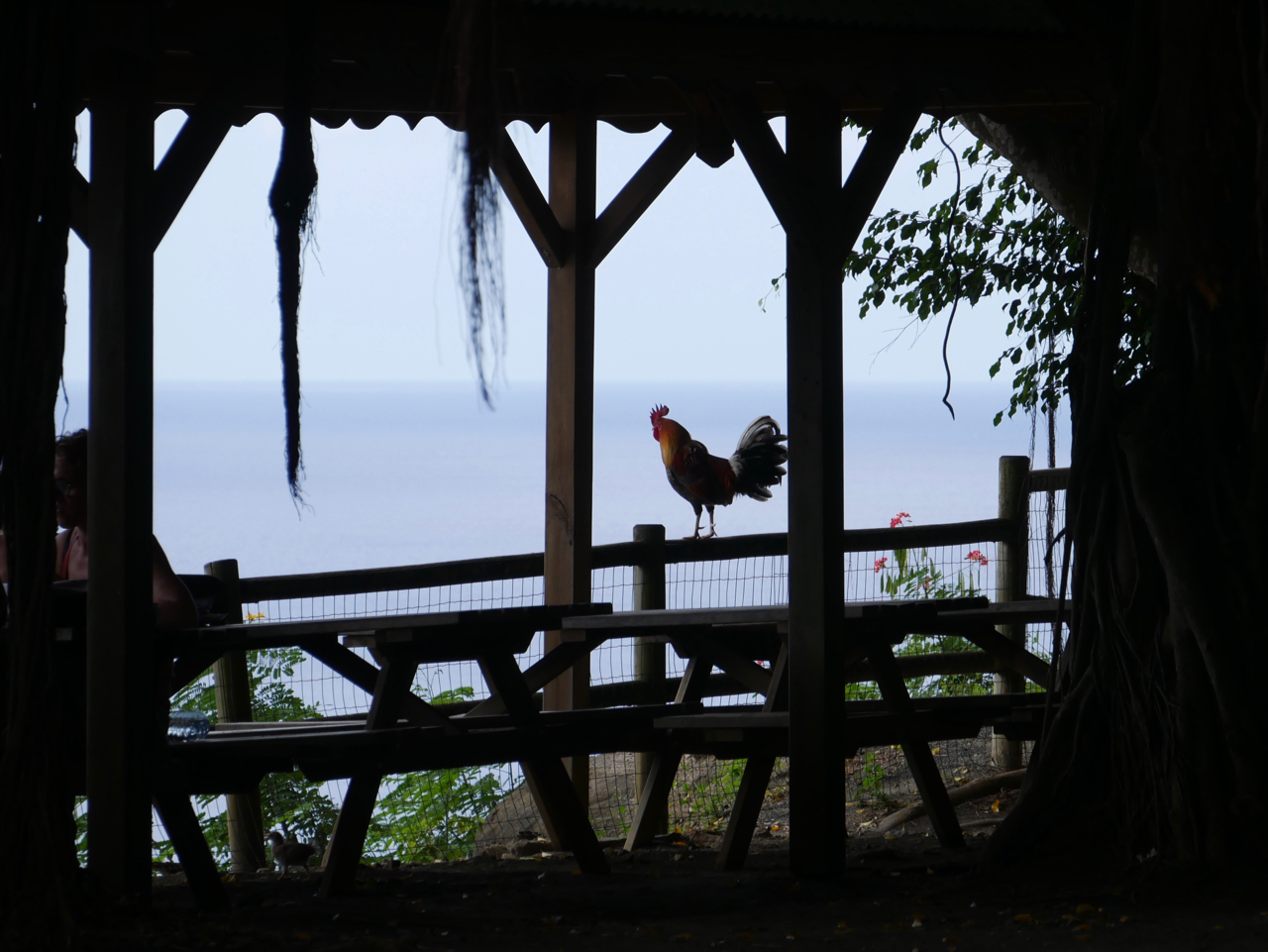
The colours of the French Antilles are very attractive but you can also produce beautiful black & white compositions. Architectures subjects, people, flowers, animals, etc are all subjects of discovery and artistic experimentations.

A Church at Saint-François, Grande-Terre

Marché nocturne (Night Market) at Saint-François, Grande-Terre

Marché nocturne (Night Market) at Saint-François, Grande-Terre

Jardin botanique (Botanic garden) at Deshaies, Basse-Terre

Jardin botanique (Botanic garden) at Deshaies, Basse-Terre

Jardin botanique (Botanic garden) at Deshaies, Basse-Terre

Jardin botanique (Botanic garden) at Deshaies, Basse-Terre

Deshaies, Basse-Tesse

Pointe-des-châteaux, Grande-Terre

Pointe-des-châteaux, Grande-Terre


06 novembre 2016

The Superior Lens: The Olympus M.Zuiko ED 75mm F/1.8 Premium

It sometime arrive that a new product is becoming a fetish item right from the start and it was effectively the case for the beloved Olympus M.Zuiko ED 75mm F1.8 Premium, the "made in Japan" state of art optic for M4/3 format cameras.
It is a purely indecent and expensive piece of glass that everybody want to touch, try and ... adopt if they can afford to pay for this majestic device.
Carefully crafted the Olympus 75mm is also a beautiful collector jewel especially in its silver version. The short and fat design of the lens can be still assimilated as a compact design considering the fact it is a real telephoto with a fairly large maximum aperture. The focus is sumptuous and using it in conjunction of the Auto-focus/Manual option of the camera is a charm. When you turn manually the focus ring you will easily feel and ear the by-wire mecanisism of the lens coupled with a lighter turning resistance compare to some prime lens models. For my personal point of view I have seen it more as an avantage than an inconvenient.

Plumage (OM-D E-M5 II / M.Zuiko 75mm f1.8)
A short word about the lens hood
The dedicated and factory lens hood of the Olympus ED 75mm F1.8 Premium is not part of the included accessories that come with the lens. In fact the Olympus policy regarding lens hood availability is not really clear. It seems that most of the "polymer-made" hood are included with the lens and the "metal-made" ones are optional accessories. For the Olympus 75mm lens, the gigantic metal lens hood (and expensive) has to be bought separately. Considering the hood large dimension it is really an occasional  add-on accessory that will bother more than be practical. It's up to you to "invest" or not.

With 16 degrees of (narrow!) angle of view the Olympus ED 75mm F1.8 is the first real telephoto that will give you an equivalent three time magnification compare to your normal eye sight. Combined with its maximum aperture of F1.8 it can be a very discriminating lens considering its reduced deep of field.
Because of its great selectivity the Olympus 75mm F1.8 is more an off-contextual lens than the others lenses doted with a wider angle of view. Perfect in doing portrait or such related subjects this small and fast telephoto can be also used in cultural (such in theatre or musical scene) and sport events.
You may consider the Olympus ED 75mm F1.8 as a true "project" lens that will ask a greater sense of study of your subject. In fact working with the optic will allow you to really discover different aspects of your subject.


What to add more about that optical marvel from the Olympus M4/3 line-up except its outstanding performance. Yes this a superior optic even if it is a specialize piece of glass. But using the Olympus 75mm may transform you in an addict of this focal length with a narrow angle of view.

Urbascape with the Olympus M.Zuiko ED75mm F1.8 Premium

13 août 2016

The Panasonic Lumix DMC-GX8: the "Pro" Still Photographer ...


The Panasonic Lumix GX8 in its nice silver delivery.
A more discrete black version is also available

My first impression was that GX8 fit like a glove to me. The handling, the control and the interface are easy to comprehend and you have the feeling to hold and to use a very pro oriented M4/3 format still camera.

The very confortable
 and secure front grip
 of the Lumix GX8
The grip factor is really one of the strongest points of the Lumix GX8 that is giving a very secure and confortable way of working with the model. Many times I have used the GX8 without bothering to put my wrist strap since I was feeling fully confident about the handling. The electronic viewfinder (EVF) is large and very informative of the picture output result you can expect. Direct dial options are easy to learn and reach if needed. As usual push bottoms are handy and fast to react but can be accidently activated during shooting if you are not aware of your palm hand position. The LCD screen is also a very fine viewing tool and can be fully oriented in many ways.

The very beautiful and classical design of the Panasonic Lumix GX8 upper deck. An interesting mixture of classical presentation and modern direct dial functionality attributions
The Panasonic Lumix GX8 is a bigger camera than the previous GX7 (original). It appears as a design choice by Panasonic study board rather than a technical constraint especially with the venue of the new Lumix GX85 / GX80 (Japan GX7 Mark II) that has a significaly smaller size despite its similar features. For a full time photographer (dixit so-called pro) the dimensions of the GX8 are still smaller compare to traditional DSLR even more if you add the equivalent lenses. So it confirms in a way the “Pro” orientation of the model.

The tilt able electronic viewfinder (EVF) of the Panasonic 
Lumix GX8: a Chest level alternative that can preserve parallel 
vertical lines or help you for low level point of view
Is the Lumix GX8 an action camera? For spontaneous photography you can say without a doubt yes. For sport or very moving subject it cannot in any way compete with the modern DSLR that are the most advanced autofocusing system available on the market. Using the faster prime lenses will give you a more reactive GX8 in the view o my modest experiences. So doing action photography with the Lumix GX8 can be more challenging for the user. You have to rely on a more pro-active approach (Anticipation) than a reactive watching.


No in-board flash is available on the Lumix GX8. Again it seems to be a voluntary designer choice. Panasonic has often been joggling with that feature like in the case of the diminutive Lumix GM5. Without in-board a flash option you need to bring an external flash unit of some kind to perform at least fill-in flash operation. So it represents an additional device to think of but the advantage came by the fact that most of the external flash units are self-powered saving the camera own battery life. Again no in-board flash unit is reflecting a traditional “Pro” design approach.


The Panasonic Lumix GX8 is delivering beautiful image outputs. The exposure system is very accurate and you can rely on it on every operating modes offered by the GX8. Color rendering especially in the “Natural” mode is respecting the reality of the scene. The exposure direct control dial is handy.
You can produce rich black and white pictures that as always a big advantage of using a camera equipped with an EVF that is showing you on the spot the final image output prior to the picture taking.  In a strictly personal point of view using the new 20MP image captor didn’t represent a strong departure from the usual 16MP sensor used on many others M4/3 models. I am sure that the new 20MP will give some edge advantages on specific picture taking situations or in performing particular image post treatments. But for a Web diffuser like myself the difference will appear marginal at the most.
In combination with the Lumix Vario G 12-60mm lens the 
Panasonic GX8 can deliver very pleasant colours and fine details.

Using the monochrome option on the GX8 is producing 
excellent black and white results

After a few days of companionship the Panasonic Lumix GX8 had proved to be a very solid still camera. Its larger size will give you confidence to bring it everywhere on every circonstances even in bad weather. But you must remember this is not a very compact model such as the smaller Lumix GX85/80 model. Lens combination with the GX8 are better served by selecting the "Pro" lens version like the 12-35mm f2.8 and the 35-100mm f2.8 or the versatile 12-60mm. 

As a professionally oriented model, some aspects of the Lumix GX8 such as its generous grip, the add-on external flash option, its 20MP image captor and its titl-able EVF for example will be well received for everyday and intensive photographers.


On the road with the Lumix GX8

Although the Panasonic Lumix GX8 is a very well crafted camera it cannot be assimilated as an impressive model such as to be the previous Lumix GX7 (first version) which had many interesting features in a more smaller package. Even considering the improvement of the image sensor this redesign won't necessarely seduce everybody. Paradoxically Panasonic has already done better with the new GX85/80 (Japan GX7 Mark II) but with the sacrifice of the weather sealed body feature.

Now (August 2016) the current selling price of the camera combined with the Lumix Vario G 12-60mm lens is representing a better quality-price ratio for this quality level of product.


Special thanks: With the complicity of Panasonic Canada and my kindly representing contact person I was able to work with the GX8 model equipped with the newest Lumix Vario 12-60mm Power OIS lens.