Why am I no more very attracted by the newest camera model? Is it fatigue of being bullied by novelties that cannot ever satisfied the photo gear Web reviewers of this planet? I cannot say but as a photographer, I can only state that the search of technical specification performance has seem to overshadow the pleasure to adopt a tool for producing an interesting imagery to share.
This is a big introduction to justify my new camera model adoption, the Olympus OM-D E-M5 Mark III. What can I say more that I am late in the show of these fantastic and famous photo gear reviewers of this photo sphere? Perfect for me, I don’t want to compete with their marvelous knowledge on equipment performances. As a secret between us, many of them don’t understand that, at the end, they are only a perfect marketing tool to be manipulate (Shut up! Don’t tell them!).
Olympus has really enhanced the Micro Four Third format (MFT) with the introduction of the original OM-D E-M5 for the (still) photographer as Panasonic have done with their GH series for the MFT videographers. It was not so far ago (9 years) but it is easy to forget the impact of the first Olympus OM-D E-M5.

Most MFT still photographers will certainly agree with one of the biggest advantages of this format system is its compactness and the Olympus OM-D E-M5 different versions are in complete accordance with this fundamental characteristic. The OM-D E-M5 Mark III is small, but not too, and is light at a point that some photographic gear reviewers were a bit deceive by the "plastic" feeling they proclaim to had when holding the camera model, the first time but honestly, I didn't have this impression. Holding the OM-D E-M5 Mark III a day long prove to be a lot more friendly experience for the less physical strength it is asking compare to the bigger image sensor format camera models. Couple with a standard zoom lens, the combination camera body and optic is becoming a pleasure to work with in many contexts and for various subjects.
At last, a real and practical viewfinder for the (eye glassed) photographers!
It always has been a rarity to find a camera model that will suit the need for photographers who are wearing eyeglasses, to be able to see the entire image frame through its viewfinder. Many camera models have an eye relief (the distance between the looking eye and the viewfinder ocular front glass) which is already limit for the naked eye for a complete "corner to corner" appreciation of the picture. The Olympus OM-D E-M5 Mark III have solved the problem by extending its viewfinder eye relief up to 27mm (compare, for two examples, to 20mm for the Olympus Pen-F and to 21mm for the OM-D E-M1 Mark III). In doing so, the OM-D E-M5 Mark III offer an almost exclusive advantage to photographers who are privileging the extended use of the viewfinder during their photo taking session.
An "all-around" photo device
The Olympus OM-D E-M5 Mark III is often presented as a travel camera model in regard of its weather resistant qualities (especially if you combine it with an appropriate weather resistant lens). That can be a bit reducing about the ability of the OM-D E-M5 III to withstand in various adverse conditions that can be encounter even in your own backyard! Because of this useful characteristic, there is almost no limitation to bring with you the OM-D E-M5 III into different photographic contexts. Cold, rain, humid atmosphere or sandy wind won't prevent yourself to take original pictures providing you take a special care of the after-session camera cleaning.
Handling is a too personal sensation...
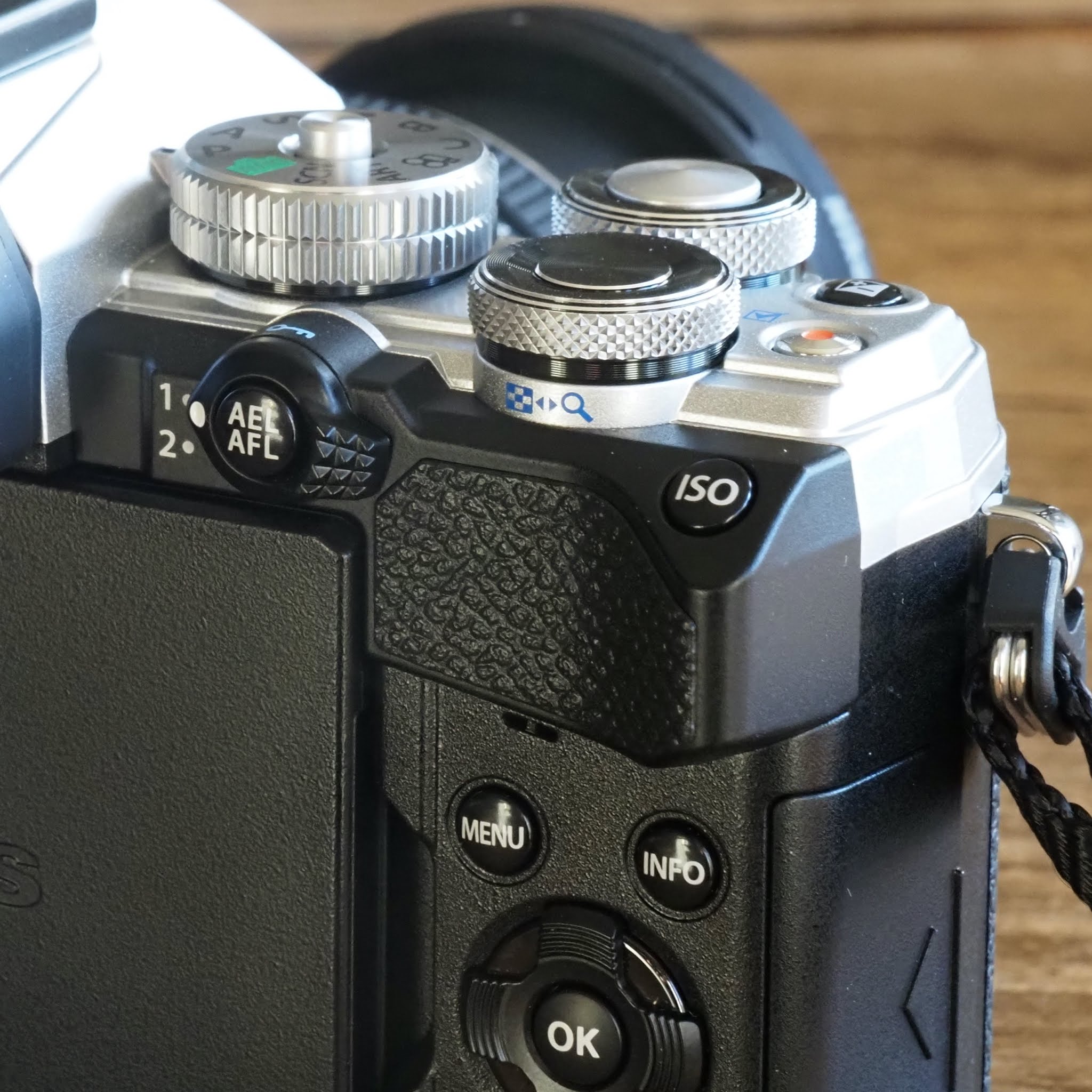
Speaking about the handling comfort of a camera model is a very tricky business. It depends on a lot of our specific morphologic attributes and our own perception to how we like to interact with a photo device. In one word, if you feel comfortable to handhold the Olympus OM-D E-M5 Mark III and if the control dials and function buttons are stimulating their use, you can say that is a good design that fit your personal approach of this photographic tool. It depends also which lens combination you attend to couple with the camera body. In any event, Olympus/OM Digital Solutions have proposed an optional hand grip (with shutter release button and front control dial), the ECG-5, that could satisfy action photographers that are intending to use bigger size and heavier lenses with the OM-D E-M5 III.
Interface for all
This modest personal short review won't try to substitute the operating manual of the Olympus OM-D E-M5 Mark III. What we can state as a general rule for most of the modern digital camera models with interchangeable lens (ILS) is that the possibilities of different functional configurations are surpassing almost every aspects of the photographer specific demands. And the big challenge is in fact to learn how to use the multiple camera settings. My only suggestion is to invest your spear time to experiment and get use of the OM-D E-M5 III because that is always paying off at the critical moment of a photo shooting session or event. And be sure to stay with the optimal image quality available in regard of the circumstances (which will definitively pay in return if you intend to post-edit more extendedly your pictures after).
Some have said that the Olympus OM-D E-M5 Mark III have a more simplified interface than other OM-D or Pen models and it is true (like having only one custom mode (OM-D E-M5 III) compare to four (!) custom modes for the Pen-F for example). My question, do we really need four custom modes that we will have difficulties to remember the content? But others may argue that they prefer to get a more direct control from dials and function buttons instead of a quick menu option. Yes, interfaces have to be easy to apprehend and operate and some are better than others therefore we can rate the OM-D E-M5 III on an average level compare to other camera models more intuitive.
An adequate 20MP image sensor
The Olympus OM-D E-M5 Mark III is equipped with the same 20MP image sensor that you will find into the flagship OM-D models such as the E-M1 Mark II and III as for the E-M1X and Pen-F. So, the picture performance is reaching the same level of quality if you are using similar exposure parameters and same optics. At the basic ISO sensibility setting (ISO 200), the results are stellar and will remain as very good or outmost acceptable up to the higher scale with, I would say, a personal limit of 3200. There is no real fear to recommend the OM-D E-M5 III for critical artistic works or for pro assignments.
Today bad image outputs are resulting from a misuse of the photo device by itself and except for very specific high-resolution works that are requiring true medium image sensor format (anything larger than the 35mm sensor size), the Micro Four Third format can fill the task nicely. Don’t be misled by the various and furious Web image sensor format promotors.
The different image modes that can be configure and enhanced through the various OM-D E-M5 III functionalities allow you a universe of picture variations despite that most Olympus users usually concentrate only to a few of them that suit their iconographic choices.
Technical performances are there
If you are asking you how the Olympus OM-D E-M5 Mark III can respond in term of technical performances, you can be reassured that autofocus abilities both in still and continuous modes, the exposure metering system, the different camera in-body mechanism such as the shutter or, equally important, the stabilization system (In-Body-Image-Stabilization/IBIS), etc. are all very accurate and reliable.
The OM-D E-M5 III is performing at a pro level if you are asking for, although the camera model is not primarily designed for a very intense use into very adverse conditions, tasks reserved for their flagship models OM-D E-M1 series.
Personal and practical thoughts about the OM-D E-M5 III
We are different persons with different perceptions, different ways of doing things and different tasks to fulfill. So, it is inevitable that opinions differ, and sometimes in a broader view, regarding the same photo gear. In fact, the more generic a product is, the less it has a certain persona, the more it tends to be simply ignored. And that happens often particularly regarding photo equipment.
The Olympus OM-D E-M5 series is one of the major factors that has contributed to my adhesion of the MFT system alongside with the compactness of their camera models and lenses. I loved to work with the OM-D E-M5 Mark II for a long period and even more recently. At the introduction of the OM-D E-M5 Mark III in 2019-2020, I had reserves concerning some design choices seen on this newest model. No more traditional flash PC sync port, no add-on vertical battery power pack grip (attached to the optional front handgrip), more apprehended plastic feeling although polycarbonate pieces have a better resistance to deformation, less function buttons, etc. The introducing selling price level was another deterrent especially compare with the OM-D E-M1 mark II reduced selling prices lately.
But the OM-D E-M5 III still have its own advantage with a more compact and lighter camera body with the weather resistant feature. Adverse climatic issues are part of my everyday life environment with cold temperature, sometimes high humidity, wind, rain and snow. Knowing that your camera-lens combo can withstand all these is a welcome relief. The long eye relief (27mm) of the electronic viewfinder (EVF) is another nonnegligible asset to the OM-D E-M5 III. Since I use primarily the EVF (almost all the time), a comfortable and easer complete view of the picture frame is always much appreciated. The price to pay is a reduced viewing magnification which can be partially compensated by the use of the loupe option in case of a manual focusing task.
I have selected both silver and black versions of the OM-D E-M5 III. Black got usually my preference over the silver presentation but I cannot resist to add the silver version into my old LowePro Passport photo bag. I was questioning myself about the optional Olympus EGC-5 hand grip, but after a good trial of it that the EGC-5 is a good designed grip, more confortable than the previous HLD-8 combined with the E-M5 II (the EGC-5 is less angular and more secure). We can only regret the abandon of the ancient vertical power grip companion which was very useful for its added battery power pack option and its vertical shutter release button. The optional hand grip should be very useful when a heaver and longer in size lens is combined with the camera body (I can't help myself to be a bit disappointed by the abandon of the vertical grip with shutter release because there are many photo taking contexts (Portrait, action, birding, etc.) where it is so practical in offering a good comfort for long period of time of vertical framing).

My long-time struggle with any auto-focus system have started right with the introduction of the Nikon F4 and has continued since the introduction at large of this demoniac feature. Even in action photography, I use to be a pre-focus photographic person who doesn't have a strong confidence about any autofocus system pretention. Again, the OM-D E-M5 III make no exception in my (highly) subjective book. Is a camera can being so intelligent to be able to anticipate my creative mood? I hope not because it will deny the utility of my implication in this world. Suffice to say that the Olympus OM-D E-M5 Mark III have plenty of autofocusing options to confuse yourself for more than a decade! The bravest of our photo community will certainly experiment them ad nauseam!
In single mode (S-AF) the auto-focus system is efficient and fairly fast for doing pre-focusing on the subject. In continuous auto-focus mode with tracking (C-AF TR), The interface is easy to set on the main subject to follow and surpriselly reliable. These two auto-focusing settings are the ones that I am using the more often in static (S-AF M) and action (C-AF TR) contexts.
The advancement of the exposure metering systems and the great exposure latitude of the digital image sensors have been extraordinary during the last decades. For a more spontaneous photographer like myself who is also an adept of pre-set camera configurations, it is a very welcome technical revolution. It allows you to concenter to basic important parameters such as sensibility (ISO), lens aperture (Deep of Field), shutter speed and overall exposure compensation. There is no doubt that the OM-D E-M5 III is a very serious and competent tool in that essential photographic matter.

The Olympus OM-D E-M5 Mark III is a fairly recent product, one of the last designed and produced under the previous Olympus administration before the taking over by OM Digital Solutions who seems to take their full time to analyze and determine what kind of future the Olympus/OM line of products will be. So, we don’t really know if changes will occur and to what extent. But we suspect with all the already mature Olympus products of the present time that no big departure from the recent past of the MFT system should be introduced. The rest is pure speculation that many reviewers often confound with their own opinions.
How many pictures we use to do in, let say, one year? Suppose a daily rhythm of 50 pics that is translated in a year total of 20K on the camera shutter release counter. Now supposing also that a camera model is designed for a minimum lifespan of 100K, you may anticipate a total use of 5 years minimum and considering this is a minimum, you can probably extend those figures for, at least, a few years. And the technological advancements will probably overpass the simple durability of the camera model.
Is the Olympus OM-D E-M5 Mark III a creative photographic tool*? Surely, considering its practical design, its good performance and durability and its compactness. Some design choices have been nice enhancements (re: 20MP sensor, autofocus performances, EVF) from the previous model (E-M5 II), others can be more disputable (re: no vertical grip) but as a "go every day" camera, the OM-D E-M5 III is an excellent compact companion**.
___________________________________________________________________________________
*
As usual, I hadn't evaluate the video capabilities of the OM-D E-M5 III.
** I am rating this OM-D E-M5 Mark III higher than its predecessor version (Mark II) considering its obvious heritage from the OM-D E-M1 II flagship model with two reserve observations: the abandon of the vertical power grip HLD-6P (seen on the previous E-M5 and E-M5 II) and the impossibility to preserve (upload and download) the owner interface configurations though the Olympus Workspace software as it was in the past for the previous E-M5 II and Pen-F.