16 février 2021

Less better than more: a pandemic lesson!


I have never been particularly interested by crowded places or of big gatherings. It can be paradoxical for an urban fellow like me, but it may be because my mother had taught me in a very young age to be a self-sustained person more than a socialite one. For sure I am not the only one that secretly appreciate the more peaceful way to live that the pandemic crisis has provoked for almost a year now. But I won't argue the very human necessity to interact with our other relatives, friends and fellows.

Many have complained how much the new restrictions regarding mobility and social opportunities have depressed them deeply. I can understand partly them because it is never easy to adapt radically our behavior in a very short notice. For some like me, sincerely it was not that difficult. Simply put, it allows us to better concentrate our life on already more solitaire ways of doing things such as doing photography (my case).

Contextual photography doesn't necessarily need to be stereotyped by an obvious human presence. It can be as subtle as you can choose to visually interpret it. One small detail might do the difference between a powerful message or a complete soup of ignorance when too melted with other distracting details. We can call the process of "purgation". It is like presenting too many pictures instead of really pointing the only one that will impact the looker.


Our daily material surrounding is very rich and even, let's say, an empty wall can be revealed by the changing light and its own texture. The experience of observation is the one that will be questioning yourself first and before photographically register it. Every visual situation is a fest of diverse sensations that can be personally painted in our mind. This iconic interpretation is transposed on the bias of our photographic representation, i.e., on the taken picture and share.

We cannot emphasize more the importance of observing our always changing world, small and big universe of diversity in term of subjects and contexts. And the message we generate by doing photography is essentially an individual one opposes to an insipid majority and repetitive one because there is not only one universal comprehend of our world but multiple thinking variations.

What the actual pandemic situation, which is not new in the modest human history, should have learned to us at least is the vanity of abondance compare to the necessity of a certain spirituality of the things. The photographic wonders of this world are may be already beside you!

11 février 2021

An Olympus(pic) Saga: Why, When and What to think of a beautiful but rocky story.


This is the story of my life, trying and trying again, be curious, be intense and be passionate for something, for someone, forever. It never finishes or if so, it will be the end of my own road. Many times as I think I have reached the bottom of it, there is always a rebirth of interest, of enthusiasm.

And so, we can resume the odd and tumultuous path that Olympus cameras evolution have followed during these past several decades and even today it seems that the pattern is staged again ... and again! Pen, OM, Camedia, E, OM-D, Pen-F, all those denominations are part of a long list of innovative but often forgotten product design through the analog film and digital photographic eras.

My love for Olympus cameras has started during my college years with the introduction of the OM-1 and OM-2 revolutionary models that a friend showed me. Those little 35mm film camera gems were fantastic reincarnations of the Leica G-M spirit into the SLR (Single Lens Reflex) world of that time (1974-1975). I was amazed not only of their inherent photographic capacity but also by their beautiful aesthetic. The stage was set for a loving affair that will last for a few decades only to be phase down by the autofocus cameras introduction.

Later on, Olympus reinvent themselves into the digital age with the Camedia and E series at a fast speed moment of technical challenges in term of photographic abilities to be conquered over the analog advanced camera models. Yes, that path was also very hazardous, and, except for the traditional two camera manufacturer majors (Canon and Nikon), it was very difficult to impose new digital standard over the photo equipment market.

When I first saw the Olympus OM-D E-M5, I cannot help myself to remember vividly of the cult Olympus OM-1 model presence of my student years. In my mind it was like a sentimental tsunami of the past-present times. And I could not help myself to buy one (E-M5) right from that moment of impulsion. What is particular about Olympus cameras is that they are inspiring photographic devices. You like to bring them with you, to play with them, to experiment the medium and to register without fear and intimidation your photographic subject. They (Olympus cameras) are part of a creative process of visual expression. It sounds lyrical but, in fact, it is!

Today, I am still using a OM-D E-M1 (Mark II) alongside with beautiful optics such as the M.Zuiko 12-40mm F2.8 Pro and the M.Zuiko 40-150mm F2.8 Pro lenses that are all competent and durable photo gear that deliver beautiful imagery. No camera is perfect, and no manufacturer is the best, but I have always found that Olympus is a kind of rebel into an industry more and more oriented by marketers of all kinds. And rebels are not really appreciated by conformists...

Long life Olympus, we are still there!

08 février 2021

The imperfect camera user!


What will characterized the imperfect camera user?


A deficient eyesight (ex.: glasses wearers like me!)

A (Wrong) left eye dominant (The cameras are designed for right eye dominant people and  for small noses)

An incorrect hand and fingers size (The long or big fingers are not welcome)

A misuses of the camera functionalities (Why all those control dials and function buttons that confuse us?)

A lack of photographic general knowledge (Everybody can be a professional photographer)

A none "optimal" photographer height (Too short, too high, too late to succeed)

A (mis) use of the lens cap during the photo session (Decorative, easy to loose, obstructive)

No spare battery pack (What's the hell? The camera will shut off by itself!)

A wrong camera program setting selection for the subject intended (Am I a computer genius?)

And finally, a (complete) ignorance of the camera operating manuel content! (Why bother?)

01 février 2021

" Ask yourself ...if you can fight WOR! " ***


*** WOR: Way-Over-Realism

Back to MFT (Micro Four Third sensor format) ... again and again! And back again with the Olympus OM-D E-M1 mark II ... again and again and again!!! After all, the OM-D E-M1 II has proven over the years how reliable as a competent photo device it can be despite the technical enhancements now present into the newest other camera models.

What is still attract me to the MFT sensor format system? Ergonomic with or without its vertical grip for sure. The silent of use with no big "clap" when you release the mechanical shutter . Its back screen that you can reverse completely without programming the EVF (Electronic Viewfinder) automatic shut off. Its spartan designed look which functionality virtues transcend over multi-gadgetry presentations. Its superb sensor monochrome rendering. Its weather resistant characteristics that fulfill its total "go-along" availability without being concerned by the possible adverse conditions. Etc., etc...

Is the Olympus OM-D E-M1 mark II THE perfect camera? Surely not and in particular for those who hate the model, or the manufacturer, or the sensor format, or the MFT system. For those ones I recommend simply to go elsewhere and be happy (or unhappy if they prefer to be). But what I have seen through the Web since a few years are these declarations of love for the OM-D E-M1 II even if we are in 2019, 2020 or 2021. That is certainly something special, something talking about the performance, the durability and the ergo-design of this model.


And what about the special secret about using Micro Four Third sensor format? Its greater deep of field!!! Yes, the supposed big disadvantage of the MFT sensor can be seen on the contrary a smarter one especially with voluminous subject (in 3D) located nearer of your taking camera. I mean what is the use to get (eye) pupil sharpness without focused eyelashes? Something I am still not understand after, let’s say, e few years into the photographic business... The MFT sensor format is great to work with if you like to be close to your subject AND get a minimal deep of field that preserve its volume details. But you can still maintain your (shallow) point of view regarding this absolutism of the absence of photographic deep of field. And you can call it "Way-Over-Realism"!

You can say that compact cameras are my way to love photography and using MFT models are my secret love to do pictures with lighter and easiest to bring the (discret) photo gear with me. And the bonus is that I am still finding their picture results pleasing and rewarding... Back to MFT (Micro Four Third sensor format) ... again and again! And back again with the Olympus OM-D E-M1 mark II model ... again and again and again!!! After all, the OM-D E-M1 II has proven over the years how reliable as a competent photo device it can be despite the technical enhancements now present into the newest other camera models.


What is still attract me to the MFT sensor format system? Ergonomic with or without its vertical grip for sure. The silent of use with no big "clap" when you release the mechanical shutter. Its back screen that you can reverse completely without programming the EVF (Electronic Viewfinder) automatic shut off. Its spartan designed look which functionality virtues transcend over multi-gadgetry presentations. Its superb sensor monochrome rendering. Its weather resistant characteristics that fulfills its total "go-along" availability without being concerned by the possible adverse conditions. Etc, etc...

And what about the special secret about using Micro Four Third sensor format? Its greater deep of field!!! Yes the supposed big disadvantage of the MFT sensor can be seen on the contrary a smarter one especially with voluminous subject (in 3D) located nearer of your taking camera. I mean what is the use to get (eye) pupil sharpness without focused eyelashes? Some thing I am still not understand after, lets say, e few years into the photographic business... The MFT sensor format is great to work with if you like to be close to your subject AND get a minimal deep of field that preserve its volume details. But you can still maintain your (shallow) point of view regarding this absolutism of the absence of photographic deep of field.

You can say that compact cameras are my way to love photography and using MFT models are my secret love to do pictures with lighter and easiest to bring the (discret) photo gear with me. And the bonus is that I am still finding their picture results pleasing and rewarding...

28 janvier 2021

Missed photo shots!


Life is highly a dynamic thing full of photographic opportunities that will often be for most of it missed by those who are trying to register them. It is something that can be very frustrating to the photographers that spend his/her energy to get the best and most accurate picture following their own interpretation of this world.

Having a good sense of timing can be annoying for people who like to study first their subject before choosing the moment to immortalize it. The common key largely evoked in photo taking tutorials of any kind is "anticipation», the faculty to forecast and prevent the evolution of the event or the right expression-position-context of the main subject. Being prepare is not only a technical challenge but also an observing habit which basic curiosity play a big part.

A person mind is like a gigantic computer that register, select and classify discriminately the images and sounding (as for the others human senses) moments of our life at a fast pace. It can be done voluntarily or, for most of the time, unconsciously. That bank of picked images, empty at our birth, is constantly fulfilled during our entire life but may be subject to limitations especially with aging phenomena or by accident or sickness. With time passing by, we eventually all experimented these sorts of "broken hard disk" phenomena that are occulting specific moments previously memorized as our infancy and younger ages.


This is where photography is becoming a precious aid that make possible a greater, more accurate and longer life preservation of events and subjects, the famous "trace of light that survive a little further than the actual moment of flash". And all we want is to select our best moments to catch and reproduce on photographs. Translate our mind photographic selection into a "material" picture is not a natural task at first and it got its technical challenges. It has been already said that using a camera should an extension of our senses and abilities. So, holding and playing with your camera should a frequent habit if not constant!

Many of us are intimidated by holding a camera in many situations especially the social ones. And there are good reasons for that and one of those is the obvious fact that the person feels very insecure by the image registered in photo. And that insecurity is easily translated on these pictures. So, if you add insecurity on both sides of the camera, it results most of the time to a disappointing picture result. Confidence is a key factor to succeed in the iconographic quest. And confidence must be reciprocated and patiently experimented. Many professional models are in their private life very intimate people but in front of a camera, they literally transcend themself into an extrovert nature that fashion photographers succeed to translate onto their pictures.

There are many lessons to learn before taking a picture. It can be knowing your subject, creating a good and respectful contact, experiment different facets of it and extend the project to other photo opportunities. In my book the very technical photographic parameters cannot in any substitute the study of your subject. That is may be the paramount element that can prevent to miss a photo shot!


26 janvier 2021

The vertical touch!


Foreword: It is true to say that I have a special commitment with "vertical" framing since my early 35mm analog photography times. I always found the "portrait" way of taking picture more dramatic, more incisive of the subject. Even with a traditional panoramic perspective in view, the question if the "vertical" should be a better picture rendering is always part in my mind.


It may be a cinematographic bias to have the habit to see our surrounding world into a panoramic view, i.e., horizontally framed. And we have a tendency to privilege "vertical" framing mainly for a portrait type composition. But selecting an "upper side" view as context photography is rarer to do and to share. Even doing systematically for a photo project with vertical frames can be difficult to present in terms of continuity or acceptability.

Explore the height is not a usual eye reflex except for some specific subjects like humans or urban buildings. But most of the time our view will be directed to a horizontal search or a panoramic scan. It can be a kind of ancestral behavior that has been implanted for survival purposes. Looking at the sky has been associated to the dreamers, the mystics or the oddly curious ones. Activities like writing for westerners is a highly horizontal exercise although some people are very good in diagonal paper reading!


What didn't really help those who are tempted to do vertical framing is the fact that many camera models are much more designed for a panoramic view. In the past we have seen specific cameras that privilege a vertical view but today those curiosities are sparse to find. So, doing vertical framing will ask you to perform some adaptations in the way you are taking pictures with your camera, especially holding it and interact with its interface. Some camera models will be more adaptable with the addition of an optional "vertical" grip although the combination camera/grip will be bulkier and heavier (and more noticeable from the subject!). In a common rule, we can observe that the compact cameras are easier for doing vertical framing (in flipping them on the spot) than the bigger cameras.

Subjects that can be vertical. I cannot no special limitation to select a vertical framing of a subject even-though that many teaching photographers would tell you the contrary especially for projects like landscapes and panoramic view attempts.

Subjects to explore vertically. All subjects can be vertically interpreted although some are more usually done like portrait, fashion, action close-up, etc. Some like urban architectures are now well represented and some others like landscapes have a less propension to be treated in the "upper" way. The question for the photographer is to ask herself/himself if it will be not interesting to try it.


Vertical contexts. Are there pictures taking situations more suited to a vertical view? Probably not because at the end it is only a photographer personal iconographic interpretation. It can be done in many ways during the photo taking session as for the post-treatment of the picture selected.

Vertical fragmentations. We already know and appreciate the work and the result of assembled pictures to get a panoramic view of the subject. The subject by itself may be decomposed in different part illustrated by a picture assembly. The same can be done vertically although it seems odd from the start, but the experimentation should conduct us to better understand the intrinsic nomenclature of a subject and its context and surrounding.

Reframing in post-edition. A vertical lecture of a horizontal picture is another option that a photographer may choose after a photo session. This was very popular during the analog photography era especially in using a square frame medium format camera. With a larger negative the drop-off image quality was staying on the minimal side. In fact, cropping a recorded image afterward will force you facing with some kind of picture resolution and definition lost that may result in a none-suitable final presentation for your taste. With high resolution digital sensors that phenomena will be less perceptible if not almost negligible.

Preferring a vertical (rectangular) framing for your image is, at the end, a personal creative choice. It can be more likely a photo taking bias insuring that way a stronger vertical interpretation of your subject on the spot and it assure you an optimum quality image recording. By pivoting our natural way of eye scanning the context and the detail of a subject, it destabilizes the looker and force him/her to pay a different attention to the picture with less filtering bias. It may be the reason that we are now seeing more and more vertical photos alongside with the smartphone popularity. It may the future standard, who knows?


19 janvier 2021

Full psycho of the syndrome of the mania for the newest photo gear available!


What about 1973 or 1987 or 2004 or 2021? Are they special years in my entire life of spending (a lot of) money on photographic gear from the cheapest to the expensive ones? And when that race of flavors will be ended by my own incapacity to take pictures?

What has been a story of ambiguity and unbalanced passion in getting and trying something else to do photography? Because did I really know or not what I was doing with all these iconographic devices named under fantastic names from every foreign language even from some nonexistent ones! Should I really try to enumerate them or should better be to forget all these material ephemera pieces of past uncommon human genius.

The big question is for what higher purpose do we need to substitute our successful equipment for the newest one. Surely the taste of the day may play an important role. Curiosity is another factor and our love to look over the fence and see a brighter landscape. The there is also all these influential people that promote all these novelties with the implicit complicity of the manufacturers or simply because they want to be ahead of everyone.

Lately I was struck by the futility of always changing for something, let say honestly, that will allow us the same level of artistic or documentary satisfaction or may be worse ask us to do again an apprentice for devices not really more technically appealing. At the end we are facing very consuming habit just for the desire to own something that will be replace in a short future by another one. What is the use to do so again and again? Do we have learned something regarding this futile material behavior.

Hopefully, may be because of the pandemic, although it has started a bit before, there a recent trend to go back to basic photographic good, reliable and still performing photographic gear that are fulfilling nicely our photographic task with a much lesser price in term of money and in term of spending time for their learning curve of use. You can consult over the Web some interesting articles or posts about less recent camera models or lenses that their respectable authors are sharing and are still proving their pertinence.

What lessons we can retain from the race for the photographic latest gear acquisition mania. May be that, for some, they cannot prevent the appeal to switch for the newest of the newest. For many others, that material rush doesn't seem to be a logical way of doing photography because of the more importance to master the medium by themself and doing their own technical artistic choice over the inside camera computer internal algorithmic.

At the end it is a matter of needs, tastes and ... money!

07 janvier 2021

Light poles (... in Canadian winter!)


Going outside during the winter season is not popular among every people that don't really appreciate the cold and frosty feeling on their face. If you are living in a more urban area, it seems that the cold level perception is much higher may be because you are a little bit more habit to a warm inside way of life.

So, going outside will require you to be better accordingly clothed for preventing the obvious discomfort and the frost bite dangers. But winter is also a wonderful season of light mainly because of the lower angle of the sun during the shorter day period of time. Just be beware about your in-camera battery shorter life and bring with you some extras.

This series has been taken in Montreal near the Rockland Road overpass


06 janvier 2021

A race that never stop!


On the contrary
of we may have thought last year (2020), the manufacturers of photo equipment have been very active not only to consolidate their infrastructures and operations but also by offering a surprising high level of new products. The fact that the traditional photo market has been more limited and definite than the passing years before can have helped a lot.

Photography have generated a nice niche consumer market during the past decades (and centuries!). Oppose to the habitual mass market concept, a narrowed specialized consumer base deeply simplifies the technical and marketing challenges with specific needs and constraints and the traditional photo equipment market have learned its lessons about the numerous attempts (and failures) to overpass this simple fact.


The rich, the poor and the maniac are may be the real segmentations that characterize the photo gear market base. The rich composed from professional and wealthy people, the poor that are ranging from the newcomers and the modest wallet persons, and the maniacs made of enthusiasms and aficionados of the domain. The task for the manufacturers is to fulfill a part or the complete spectrum of this market which represent millions of potential sales because it is a "large" niche market after all!

There is no certitude for anybody, big or small, into any consumer market. Photo equipment market cannot escape that constatation. From a very strong position, you as a manufacturer may move to a much more fragile state in a short period of time and past examples are numerous and dolorous. The best ideas, the better concepts, the finest products are not a full guaranty to success or longevity. Even a trademark name may not be sufficient to survive.


Reviews from last year (2020) activities about photo gear announcements and product introductions have presented you their own choices of the more significant novelties. These preferential listing are often incomplete and a personal interpretation of a real overview of the photo gear market in term of importance in view of a more global analysis. What we have seen during these twelve past months is a surprising resilience from manufacturers to survive, regroup and progress in spite of a very disturbing media climate. Already forecasted programs have been rearranged to face the new challenge of the pandemic input shortages difficulties. Moreover, manufacturers have accelerated the rationalization of their production plants. And some players finally decided to exit may be faster the market.

In the whole, Canon, Nikon, Sony, Fujifilm, Panasonic, Leica and the non-mentioned others, are still in activity and are not certainly going to throw the towel in a short term. Although they will play their cards differently, their maintaining market presence is the best reassurance that the consumers can ask for the moment. For a specific product or line of products from each of them, we cannot predict a specific continuity, but for the trend, we can be reassured of an active future. Yes, that race is still on the go and promising!

All pictures from CIPA - Camera & Imaging Products Association.

22 décembre 2020

Winter grip needed!


At the start of every winter in Montreal
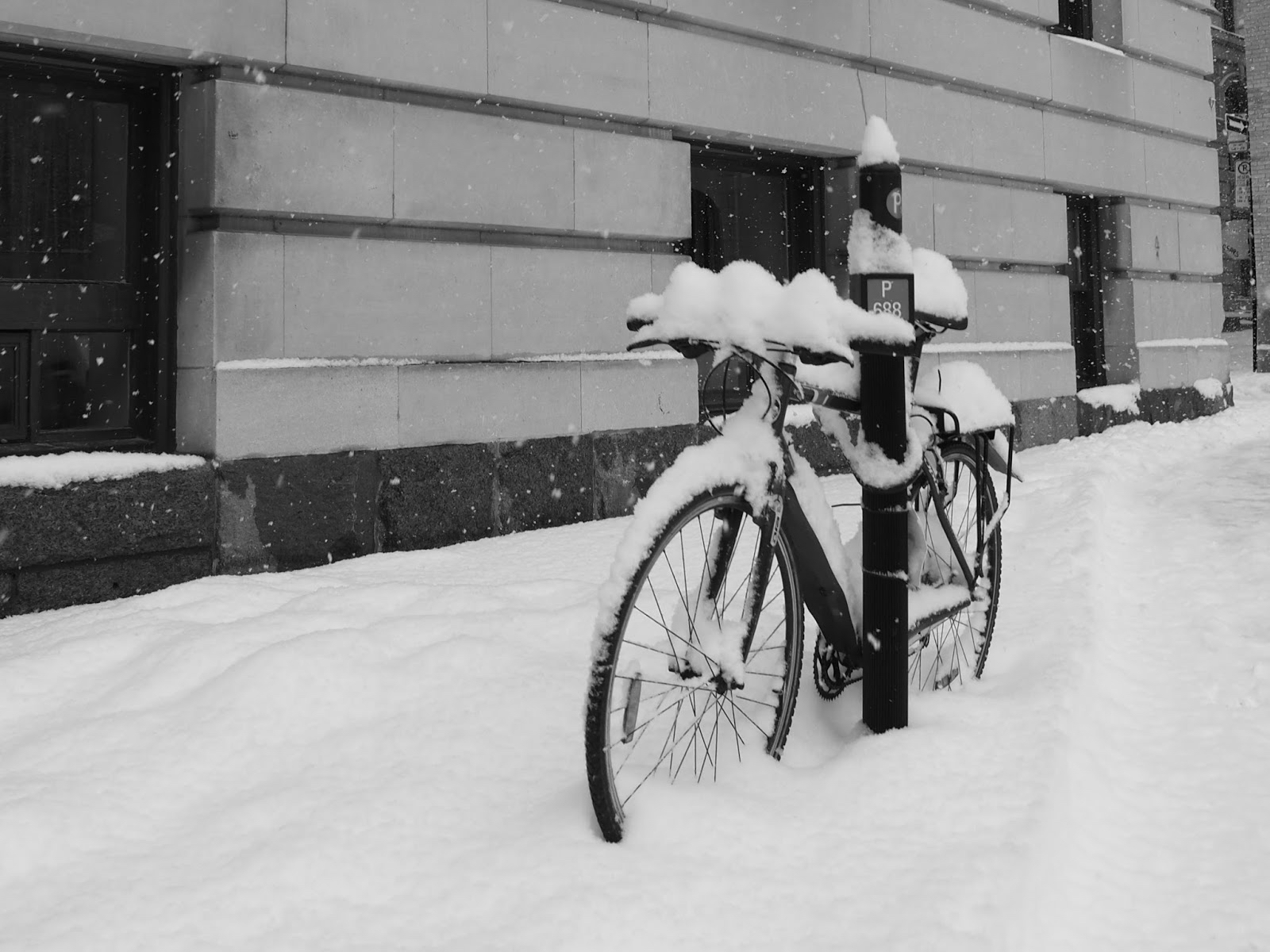
 (Canada) the same story is repeating itself and, here and there some (mild season's) bicycles have been surprised by the first snow fall. If lucky, their owner are able to recover them but there are always some others that are becoming orphans that ultimately be freed the next spring, usually in a very bad shape, by the municipal services. The most strange about this is that the unlucky ones  are staying "safely padlocked" all the winter season!


20 décembre 2020

Santa Claus doesn't exist!!


This year 2020 has been a very peculiar one in every senses. Not only for the pandemic world crisis, which was a strong event by itself, but also because of this many long-forecasted changes that have been occurred in short space of time. In the photo equipment planet, the consolidation of the mirrorless market was already obvious, and the D-SLR and the compact counterparts have finally been reduced significantly although these last two are still maintaining a niche presence.

I kept a particular affection for the MFT (Micro Four Third) system. Another factor that has guided my choices is the decrease of my revenue resources as many others have experimented this year. Many of my past photo equipment had to be sold but I have no regret since we always have too much material that at the end will confuse us and affect our creativity search.


Secondly and more important is the emergence of new photo opportunities in term of people, places, events, etc. So, how about the next year 2021? It seems that will be a very gradual social process that can highly differ between the nations and the administrations. What will be of the outmost interest is how the world has been altered by the sanitary crisis. The availability of things, of activities, of people gatherings, all these giving past possibilities will be surely revealing a new aspect. Let's hope that photography will record all these changes of the human paradigm.

Photo (real) reporting could be a difficult task in this world of increase of institutional and corporate controls. Furthermore, photographing people is becoming more and more restrictive on the base of respecting personal privacy policies or rules. Facing that trend, spontaneous photography like street, casual even travel is presenting a new challenge for everybody.

Next year 2021 can also be a big transition period to something that is very touchy to predict but, the passion of photography is still convoyed by all the ones who love and care about this powerful artistic medium. Excellent, Happy, Healthy 2021 new Year for all!

🎉