25 mai 2021

More bird snapshots with the Olympus M.Zuiko ED 75-300mm F4.8-6.7 II super zoom lens.


When it comes time to do birds photography, all eyes are turn on the telephoto lens model you are choosing to realize your pictures. And it is also obvious that such an optic has to give you at least a increase magnification of 10 times compare to your normal eyesight. That means for the Micro Four Third format something like a 250mm (10 X 25mm). But you can manage to install a more bird friendly and nearer (!) environment, with some bird tables (feeders) or baths that will allow you to be nearer of them as it is my case with the advantage to get a more predictable arrangement and a better rate of success.

Following my introduction of the use of the Olympus M.Zuiko ED 75-300mm F4.8-6.7 II telephoto zoom lens, it is my pleasure to offer you other interesting results in bird photography.


Bird No.1: White-breasted nuthatch; Bird No.2: American Goldfinch (Male); Bird No.3 Blue Jay; Bird No.4: Evening grosbeak(Female)

Photos Daniel M

19 mai 2021

The Olympus M.Zuiko ED 75-300mm F4.8-6.7 II: The Tele-genik Photo Lens!


It is a kind of bizarre to be a faithful user of the Micro Four Third image sensor format (MFT) with the strong will to have the most compact camera body-lens combination and finally choose a super telephoto zoom that the final physical length extension remind the days of the 35mm film-analog era and their big bazooka telephoto optics.

The Olympus M.Zuiko ED 75-300mm F4.8-6.7 II zoom lens is a beast compare to the usual standard zoom lenses associated with the MFT format system (let’s put the Pro optic line-up aside in that case) which are presented into a small-sized dimensions. But, in fact, the Olympus ED 75-300mm II is real compact tele-zoom lens considering its high magnification, from 3X to 12X compare to the standard focal length in MFT format (25mm). To get there, the "made in Japan" optic is doted of a small maximum variable aperture of F4.8 to F6.7 which is the slowest maximum aperture for a telephoto lens that I have ever own! The front filter accessory diameter is 58mm and the lens weight is only 423g.


A large focal length control ring with a good resistance when turning it allows the zoom framing adjustment. The focusing ring for its part is small and offers no real resistance with a "free" rolling characteristic and its reactivity is, in my sense, too much slow for changing the focusing point. Coupled with a compact Micro Four Third camera body, your left hand will support mainly the weight of the lens-body combination as it was the case during the past age of the 35mm analog-film era. There may be a bit an adaptation to do here if you are accustomed to use smaller lenses.

With a modest variable maximum aperture such as the Olympus ED 75-300mm II have, we can say that you have a good safety in term of deep of field for focusing your subject which a good thing when you are targeting fast moving subjects such as animals or birds for example. Foreground and background have a pleasant defocusing degradation (Bokeh). The Olympus ED 75-300mm II can be also an interesting optic to do portrait assuming that your distance between you and your subject will be further than the usual way to do this kind of photographic project.

A long minimal focusing distance of almost 3 feet (0,9 m) is characterizing the Olympus ED 75-300mm II but this is not preventing you to do picture of smaller objects. In any case, this kind of distance allow you to not disturb the subject, its spatial arrangement and its light distribution.


Stabilization is a must!
At first, telephoto lenses can be hard to get satisfactory picture results. Partly because of the necessity to be stable when holding the camera boy-lens combination especially considering the greater magnification proposed by any tele-lens. Internal camera sensor stabilization (IBIS) is a direct answer to this problem although some other lens model offers an optical stabilization (which proclaim to be more efficient for super telephoto lenses).

There is also the haze (air) effect that is more evident with the compression perspective generated by telephoto lenses. By configuring certain picture taking factors such as the exposure and the contrast, or by a post-editing fine tuning, you can counteract this inevitable fact of life.

Check your shutter speed and follow the subject travel (Panning). 
Because of its seducing high magnification, the Olympus D 75-300mm II is an easy pick to isolate your subject from its surrounding but there is a catch with such long telephoto lenses. Even with a good camera sensor stabilization system, you may have to select a faster shutter speedway be at least equal to the focal length as we do during the film analog era. In doing so, you will probably open your telephoto optic to its maximum aperture and observe a very shallow deep of field. Trying to photograph moving subjects can be another kind of challenge because of the limited maximum aperture of the Olympus ED 75-300mm II. Panning your main subject, the same direction of its movement travel can be an answer but it requires a good knowledge of the subject movement behavior, practice of the technique, persistence and ... some luck of your side!


Tripod and monopod limitations.
The Olympus ED 75-300mm II is not really a tripod (or monopod) intended lens. Although it is possible to secure your camera body with such accessories, the follow-up of your main subject can be awkward and the none-equilibrated camera-lens combination might stress your camera tripod base too much in certain case. So, you may adapt the way you are holding the camera-lens combo by using the palm your left hand as a plateau and your elbow can lean on a more stable base. In the past, the bean bags were very popular among photographers at a time that the "pro" telephoto lenses have not any provision to be screw alone on a tripod (such as the Olympus ED 40-150mm F2.8 Pro has).


The Olympus ED 75-300mm II is surely a real birder optic considering its superlative magnification. That goes also for the animal photographers. If you are using a good picture taking technique, the results can be outstanding (in regard of the price level of this lens model). If you like to use super zoom compact camera models with fix lens, the quality gain difference will be very significant.

And yes, you can do portrait with the Olympus ED 75-300mm II providing you got the space you do it properly and that your subject doesn't need constant coaching.

If you are a Micro Four Third format photographer and you are using an Olympus camera model*, the Olympus ED 75-300mm II can be a valuable long telephoto optic solution. If you like to be on the move without transporting large and heavy photo gear which is, in a way, the basic essence of the MFT format, the Olympus ED 75-300mm II merits a good consideration. Its design limitations (small maximum aperture, no tripod collar provision, loose focusing ring) are compensated by its optical performances and to get marginally better you will have to spend a lot of additional money on your budget.

The more you will experiment the Olympus ED 75-300mm II, the better you will appreciate it for its long telephoto perspective. By using a good picture taking technique, this tele-genik photo lens will seduce you further than you can think of.


* The same logic can be applied for the Panasonic Lumix G Vario 100-300mm F4-5.6 II lens for the MFT Panasonic Lumix camera models. See this previous post.

11 mai 2021

The Olympus M. Zuiko ED 9-18mm F4-5.6: the pocket super wide zoom!


The Olympus M.Zuiko ED 9-18mm F4-5.6 zoom lens is a small optical elf into the M.Zuiko lens line-up. Considering its focal length latitude, it is so compact that many won't regard it seriously as a true super wide angle zoom lens. But it is a such optic despite its very modest maximum variable aperture of F4-5.6. Its angle of view ranges from 62 to 100 degrees which certainly classify the 9-18mm as a real practical wide-angle lens. Weighing only 155g and with a front lens filter diameter of 52mm, its compactness is obvious. Its polymer construction can be deceptive and the M.Zuiko ED 9-18mm is part of the very first Olympus Micro Four Third (MFT) lens series introduced more than twelve years ago!

The M.Zuiko ED 9-18mm lens is also a strange fellow optic by today's standards. It is a retractable lens (a very old feature on past lenses of the last century) with a locking focal length stop. After its "opening", the lens will physically extend by more than one third compare to its retracted rest position. Thankfully, the lens is doted of a metal rear mount. There is a provision for a dedicated bayonet mounted lens hood, but no lens hood is included with the lens (and so, you have to buy it separately).


After all these material considerations, we can concentrate how the Olympus M.Zuiko ED 9-18mm F4-5.6 will perform optically and how it handles on the field. It is not a "swiss knife" optic that will suit every photographic subjects or contexts and that it could be enough versatile to be a one lens option except if it corresponds to your specific creative vision of this world. Moreover, it is a more difficult lens to apprehend because of its exaggerated perspective it generates compare to our usual eyesight. At the 18mm focal length, it can be used as a moderate semi-wide angle lens which is very interesting if you are working into tight urban or interior areas and want to get more latitude into your subject cropping.

At 9mm focal length setting (which is one of the main reasons you may have bought the Olympus ED 9-18mm zoom lens), the Olympus super wide zoom lens is really a "proximity" optic offering a very large angle of view (100 degrees) that allows you to create beautiful contextual spatial picture. You can explore many architectural designs or environmental graphic arrangements. You can also be near if not in contact with people (when the situation doesn't have any pandemic preoccupation that are preventing proximity) providing that some facial deformations will be tolerated or simply avoided.

The very modest maximum variable aperture of the Olympus ED 9-18mm which is ranging from F4 at 9mm focal setting up to F5.6 at 18mm and will give you a safety marge of deep of field for focusing your main subject but the price to pay is a less lens ability to subtract this very subject from the foreground and the background. Considering that most of my privileged subjects are architectural, design or spatial arrangements, a larger deep of field is becoming an advantage but that can be different for other photographers.


As I have already mentioned, the Olympus ED 9-18mm lens can be difficult to apprehend first and some will be rapidly discouraged to use it in that special perspective. A special attention to the foreground as a participating part of your main subject or your complete picture context can be a key of success when a wide-angle lens view such as the Olympus ED 9-18mm is selected. The position of the photographer can be also a strong factor to get pleasant results. Although every "zoom" lens are reframing optics, the discriminating effect is harder to conciliate with the inclusion or exclusion of the foreground.


When you are setting a longer focal length and especially starting from the 12mm setting, the Olympus ED 9-18mm is acting more as a moderate wide-angle lens up to its 18mm position which is almost a normal angle of view (62 degrees). At this point, the optic proves to be enough versatile to be keep on the camera for a complete journey venture providing you don’t want to be more discriminate or prefer to use a real telephoto optic. If you have the chance to work simultaneity with two camera bodies, the Olympus ED 9-18mm can be easily your first or second first chosen lens of the day. It can be also a very good "interior" lens if you accept to parameter your camera with a higher ISO or leave it on its automated ISO selection. (If you choose to light your subject with an electronic flash, be sure that its coverage angle will meet the one of the focal lengths selected on the zoom lens in order to get an even light distribution).


Depending on your picture taking position, it is easy to register converging and undesirable graphic lines. That can be totally or partly corrected by activating the Keystone functionality (which is acting as an optical electronic Tilt-Shit) present in many different Olympus camera models. This handy program permits you to re-establish parallelism to the vertical and horizontal lines. By using the Keystone correction, you must be aware that your angle of view will be reduced, and the definition of your picture may be altered in a certain degree but it worth the try and the experimentation.

What I am missing the most after more than one pandemic year (2020-2021) is the possibility to travel even locally to explore and experiment new photographic subjects in different contexts. A lens like the Olympus ED 9-18mm is the perfect tool to do so if you are interested to create images with story of people, of things, of mood and atmosphere. Micro Four Third format cameras and lenses can be awesome daily companions to do so because of their compact presentation and their nonintrusive factor to the subject. I hope we can be able soon to use again the Olympus ED 9-18mm at its full potential.

The Olympus M.Zuiko ED 9-18mm F4-5.6 super wide zoom lens is not an optic that everybody will appreciate, of course, because of its difficulty to apprehend easily and many will avoid its exaggerated perspective that include too many aspects of the subject with a spatial obvious extension. But if you like to do wide angle photography, the Olympus ED 9-18mm could a competent and valuable compact tool available at a more accessible price level.


10 mai 2021

The glass edge


Life is a very fragile thing
Fragile as the edge of a glass
And glass reflect this perfect fragility

28 avril 2021

The Olympus OM-D E-M5 Mark III: The everyday space traveller!!!


Why am I no more very attracted by the newest camera model? Is it fatigue of being bullied by novelties that cannot ever satisfied the photo gear Web reviewers of this planet? I cannot say but as a photographer, I can only state that the search of technical specification performance has seem to overshadow the pleasure to adopt a tool for producing an interesting imagery to share.


This is a big introduction to justify my new camera model adoption, the Olympus OM-D E-M5 Mark III. What can I say more that I am late in the show of these fantastic and famous photo gear reviewers of this photo sphere? Perfect for me, I don’t want to compete with their marvelous knowledge on equipment performances. As a secret between us, many of them don’t understand that, at the end, they are only a perfect marketing tool to be manipulate (Shut up! Don’t tell them!).

Olympus has really enhanced the Micro Four Third format (MFT) with the introduction of the original OM-D E-M5 for the (still) photographer as Panasonic have done with their GH series for the MFT videographers. It was not so far ago (9 years) but it is easy to forget the impact of the first Olympus OM-D E-M5.


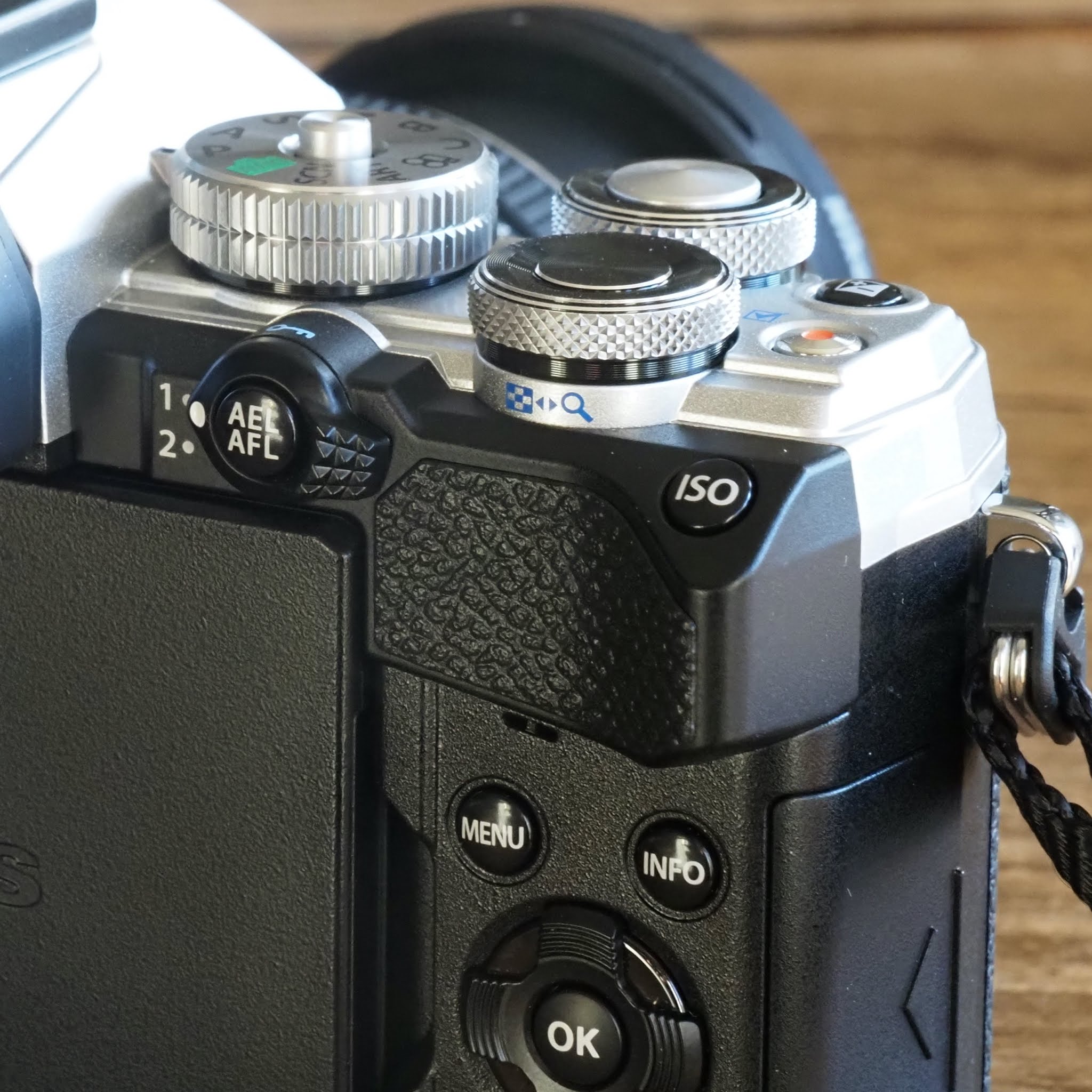
Most MFT still photographers will certainly agree with one of the biggest advantages of this format system is its compactness and the Olympus OM-D E-M5 different versions are in complete accordance with this fundamental characteristic. The OM-D E-M5 Mark III is small, but not too, and is light at a point that some photographic gear reviewers were a bit deceive by the "plastic" feeling they proclaim to had when holding the camera model, the first time but honestly, I didn't have this impression. Holding the OM-D E-M5 Mark III a day long prove to be a lot more friendly experience for the less physical strength it is asking compare to the bigger image sensor format camera models. Couple with a standard zoom lens, the combination camera body and optic is becoming a pleasure to work with in many contexts and for various subjects.

At last, a real and practical viewfinder for the (eye glassed) photographers!

It always has been a rarity to find a camera model that will suit the need for photographers who are wearing eyeglasses, to be able to see the entire image frame through its viewfinder. Many camera models have an eye relief (the distance between the looking eye and the viewfinder ocular front glass) which is already limit for the naked eye for a complete "corner to corner" appreciation of the picture. The Olympus OM-D E-M5 Mark III have solved the problem by extending its viewfinder eye relief up to 27mm (compare, for two examples, to 20mm for the Olympus Pen-F and to 21mm for the OM-D E-M1 Mark III). In doing so, the OM-D E-M5 Mark III offer an almost exclusive advantage to photographers who are privileging the extended use of the viewfinder during their photo taking session.

An "all-around" photo device

The Olympus OM-D E-M5 Mark III is often presented as a travel camera model in regard of its weather resistant qualities (especially if you combine it with an appropriate weather resistant lens). That can be a bit reducing about the ability of the OM-D E-M5 III to withstand in various adverse conditions that can be encounter even in your own backyard! Because of this useful characteristic, there is almost no limitation to bring with you the OM-D E-M5 III into different photographic contexts. Cold, rain, humid atmosphere or sandy wind won't prevent yourself to take original pictures providing you take a special care of the after-session camera cleaning.


Handling is a too personal sensation...

Speaking about the handling comfort of a camera model is a very tricky business. It depends on a lot of our specific morphologic attributes and our own perception to how we like to interact with a photo device. In one word, if you feel comfortable to handhold the Olympus OM-D E-M5 Mark III and if the control dials and function buttons are stimulating their use, you can say that is a good design that fit your personal approach of this photographic tool. It depends also which lens combination you attend to couple with the camera body. In any event, Olympus/OM Digital Solutions have proposed an optional hand grip (with shutter release button and front control dial), the ECG-5, that could satisfy action photographers that are intending to use bigger size and heavier lenses with the OM-D E-M5 III.

Interface for all

This modest personal short review won't try to substitute the operating manual of the Olympus OM-D E-M5 Mark III. What we can state as a general rule for most of the modern digital camera models with interchangeable lens (ILS) is that the possibilities of different functional configurations are surpassing almost every aspects of the photographer specific demands. And the big challenge is in fact to learn how to use the multiple camera settings. My only suggestion is to invest your spear time to experiment and get use of the OM-D E-M5 III because that is always paying off at the critical moment of a photo shooting session or event. And be sure to stay with the optimal image quality available in regard of the circumstances (which will definitively pay in return if you intend to post-edit more extendedly your pictures after).

Some have said that the Olympus OM-D E-M5 Mark III have a more simplified interface than other OM-D or Pen models and it is true (like having only one custom mode (OM-D E-M5 III) compare to four (!) custom modes for the Pen-F for example). My question, do we really need four custom modes that we will have difficulties to remember the content? But others may argue that they prefer to get a more direct control from dials and function buttons instead of a quick menu option. Yes, interfaces have to be easy to apprehend and operate and some are better than others therefore we can rate the OM-D E-M5 III on an average level compare to other camera models more intuitive.


An adequate 20MP image sensor

The Olympus OM-D E-M5 Mark III is equipped with the same 20MP image sensor that you will find into the flagship OM-D models such as the E-M1 Mark II and III as for the E-M1X and Pen-F. So, the picture performance is reaching the same level of quality if you are using similar exposure parameters and same optics. At the basic ISO sensibility setting (ISO 200), the results are stellar and will remain as very good or outmost acceptable up to the higher scale with, I would say, a personal limit of 3200. There is no real fear to recommend the OM-D E-M5 III for critical artistic works or for pro assignments.

Today bad image outputs are resulting from a misuse of the photo device by itself and except for very specific high-resolution works that are requiring true medium image sensor format (anything larger than the 35mm sensor size), the Micro Four Third format can fill the task nicely. Don’t be misled by the various and furious Web image sensor format promotors.

The different image modes that can be configure and enhanced through the various OM-D E-M5 III functionalities allow you a universe of picture variations despite that most Olympus users usually concentrate only to a few of them that suit their iconographic choices.

Technical performances are there

If you are asking you how the Olympus OM-D E-M5 Mark III can respond in term of technical performances, you can be reassured that autofocus abilities both in still and continuous modes, the exposure metering system, the different camera in-body mechanism such as the shutter or, equally important, the stabilization system (In-Body-Image-Stabilization/IBIS), etc. are all very accurate and reliable.

The OM-D E-M5 III is performing at a pro level if you are asking for, although the camera model is not primarily designed for a very intense use into very adverse conditions, tasks reserved for their flagship models OM-D E-M1 series.


Personal and practical thoughts about the OM-D E-M5 III

We are different persons with different perceptions, different ways of doing things and different tasks to fulfill. So, it is inevitable that opinions differ, and sometimes in a broader view, regarding the same photo gear. In fact, the more generic a product is, the less it has a certain persona, the more it tends to be simply ignored. And that happens often particularly regarding photo equipment.

The Olympus OM-D E-M5 series is one of the major factors that has contributed to my adhesion of the MFT system alongside with the compactness of their camera models and lenses. I loved to work with the OM-D E-M5 Mark II for a long period and even more recently. At the introduction of the OM-D E-M5 Mark III in 2019-2020, I had reserves concerning some design choices seen on this newest model. No more traditional flash PC sync port, no add-on vertical battery power pack grip (attached to the optional front handgrip), more apprehended plastic feeling although polycarbonate pieces have a better resistance to deformation, less function buttons, etc. The introducing selling price level was another deterrent especially compare with the OM-D E-M1 mark II reduced selling prices lately.

But the OM-D E-M5 III still have its own advantage with a more compact and lighter camera body with the weather resistant feature. Adverse climatic issues are part of my everyday life environment with cold temperature, sometimes high humidity, wind, rain and snow. Knowing that your camera-lens combo can withstand all these is a welcome relief. The long eye relief (27mm) of the electronic viewfinder (EVF) is another nonnegligible asset to the OM-D E-M5 III. Since I use primarily the EVF (almost all the time), a comfortable and easer complete view of the picture frame is always much appreciated. The price to pay is a reduced viewing magnification which can be partially compensated by the use of the loupe option in case of a manual focusing task.

I have selected both silver and black versions of the OM-D E-M5 III. Black got usually my preference over the silver presentation but I cannot resist to add the silver version into my old LowePro Passport photo bag. I was questioning myself about the optional Olympus EGC-5 hand grip, but after a good trial of it that the EGC-5 is a good designed grip, more confortable than the previous HLD-8 combined with the E-M5 II (the EGC-5 is less angular and more secure). We can only regret the abandon of the ancient vertical power grip companion which was very useful for its added battery power pack option and its vertical shutter release button. The optional hand grip should be very useful when a heaver and longer in size lens is combined with the camera body (I can't help myself to be a bit disappointed by the abandon of the vertical grip with shutter release because there are many photo taking contexts (Portrait, action, birding, etc.) where it is so practical in offering a good comfort for long period of time of vertical framing).


My long-time struggle with any auto-focus system have started right with the introduction of the Nikon F4 and has continued since the introduction at large of this demoniac feature. Even in action photography, I use to be a pre-focus photographic person who doesn't have a strong confidence about any autofocus system pretention. Again, the OM-D E-M5 III make no exception in my (highly) subjective book. Is a camera can being so intelligent to be able to anticipate my creative mood? I hope not because it will deny the utility of my implication in this world. Suffice to say that the Olympus OM-D E-M5 Mark III have plenty of autofocusing options to confuse yourself for more than a decade! The bravest of our photo community will certainly experiment them ad nauseam!

In single mode (S-AF) the auto-focus system is efficient and fairly fast for doing pre-focusing on the subject. In continuous auto-focus mode with tracking (C-AF TR), The interface is easy to set on the main subject to follow and surpriselly reliable. These two auto-focusing settings are the ones that I am using the more often in static (S-AF M) and action (C-AF TR) contexts.

The advancement of the exposure metering systems and the great exposure latitude of the digital image sensors have been extraordinary during the last decades. For a more spontaneous photographer like myself who is also an adept of pre-set camera configurations, it is a very welcome technical revolution. It allows you to concenter to basic important parameters such as sensibility (ISO), lens aperture (Deep of Field), shutter speed and overall exposure compensation. There is no doubt that the OM-D E-M5 III is a very serious and competent tool in that essential photographic matter.


The Olympus OM-D E-M5 Mark III is a fairly recent product, one of the last designed and produced under the previous Olympus administration before the taking over by OM Digital Solutions who seems to take their full time to analyze and determine what kind of future the Olympus/OM line of products will be. So, we don’t really know if changes will occur and to what extent. But we suspect with all the already mature Olympus products of the present time that no big departure from the recent past of the MFT system should be introduced. The rest is pure speculation that many reviewers often confound with their own opinions.

How many pictures we use to do in, let say, one year? Suppose a daily rhythm of 50 pics that is translated in a year total of 20K on the camera shutter release counter. Now supposing also that a camera model is designed for a minimum lifespan of 100K, you may anticipate a total use of 5 years minimum and considering this is a minimum, you can probably extend those figures for, at least, a few years. And the technological advancements will probably overpass the simple durability of the camera model.

Is the Olympus OM-D E-M5 Mark III a creative photographic tool*? Surely, considering its practical design, its good performance and durability and its compactness. Some design choices have been nice enhancements (re: 20MP sensor, autofocus performances, EVF) from the previous model (E-M5 II), others can be more disputable (re: no vertical grip) but as a "go every day" camera, the OM-D E-M5 III is an excellent compact companion**.
___________________________________________________________________________________

* As usual, I hadn't evaluate the video capabilities of the OM-D E-M5 III.

** I am rating this OM-D E-M5 Mark III higher than its predecessor version (Mark II) considering its obvious heritage from the OM-D E-M1 II flagship model with two reserve observations: the abandon of the vertical power grip HLD-6P (seen on the previous E-M5 and E-M5 II) and the impossibility to preserve (upload and download) the owner interface configurations though the Olympus Workspace software as it was in the past for the previous E-M5 II and Pen-F.


15 avril 2021

Beige-O-Thon


Beige is the color that some will call insipid, tasteless, washy, savorless, etc. But seing as a monochrome rendering, I have found beige interesting especially without the distraction of other colors. 


09 avril 2021

Le bourbier sanitaire qui perdure et qui change tout en photographie!


Avril 2021 et, vous savez quoi, bien des choses ont changé malgré tout. Certes l'activité économique mondiale, elle, a repris ses droits et privilèges parfois au détriment de toute logique sociétaire mais elle était devenue le point de mire d'une société de consommation impénitente qui ne peut se sevrer de son appétit matériel sans cesse en croissance.

Par contre ou le bât blesse plus particulièrement chez notre "civilisation moderne" reste toute la question de la mobilité physique de l'humanité. La grande vague de démocratisation du pouvoir de déplacement pour tous et chacun semble bien terminée pour être remplacée par un régime de restrictions qui condamne le citoyen a pratiquement demeurer chez soi et dans son environnement immédiat et encore avec de sérieuses limitations. La socialisation a pris une tournure essentiellement virtuelle pour ceux et celles qui peuvent se le permettre.

Tout cela n'est pas vraiment de bons augures pour les adeptes de la photographie qui tentent d'ouvrir leurs horizons vers de nouveaux sujets et de nouveaux contextes de prises de vues. Bien que je ne sois pas peu s'en faut, ce qu'on pourrait appeler un « socialite » photographe, un "social street photographer", il me pèse de constater l'absence presque totale de la présence humaine et de son interaction dans l'environnement. Et aussi le déclin de toute réactivité proprement humaine puisque, souvent, la méfiance a remplacé la curiosité et l'ouverture.


En fait cette pandémie qui s'éternise et s'installe à demeure dans nos vies, a accentué une tendance déjà existante d'une société dont la dépersonnalisation menace toutes nos communautés de vie. Elle restreint l'humanité à la recherche exclusive des besoins réels ou inventés de la consommation. Au-delà de ce spectre étroit, plus rien ne semble aussi prioritaire dans notre univers relationnel. Comme si toutes les grandes fêtes humaines avaient été annulées sous l'impératif de la survie individuelle et la recherche du risque zéro ce qui est en soi une sorte d'absurdité pour les mortels que nous sommes.

Le grand problème de tout cela c'est que la créativité et l'expression artistique ne se nourrissent pas seulement d'introspection et de méditation individuelle. Elles trouvent leur inspiration également de la découverte et de l'échange d'idées d'autres provenances externes à notre cercle habituel de vie. La pandémie actuelle a mis au ban l'esprit voyageur de l'humanité, parlez-en aux photographes du monde entier!

Se sortir de ce bourbier sera certainement un grand défi humanitaire et pour les photographes, le défi sera d'autant plus grand qu'il faudrait rebâtir les ponts de la communication et de l'échange entre tous. Mais ce challenge en soi pourra être une grande source de motivation pour refaire et réinventer tous ces témoignages futurs iconographiques. Il s'agit seulement de continuer à aiguiser nos réflexes d'observateur curieux et de technicien aguerri!

06 avril 2021

Tears-Drops!


Tears of joy, tears of pain, tears of love, tears of frustration, tears are everywhere in every circumstances because they are part of a universal process of life even in the material world.


03 avril 2021

Un-paralleled Mornings


Every morning can be a different new life story that are full of paralleled none-paralleled subjects to be recorded for our small prosperity and it suffice to click them with an always renewed eye!