Bien sûr tous et chacun connaissent le consensus habituel qui définie la longueur focale "normale de tout format d'image par sa diagonale de son plan-surface d'enregistrement. Le plus connu est célèbre et se retrouve dans l'ancien format-film 35mm (24 X 36mm) avec les objectifs de 50mm bien que le résultat de son véritable calcul se situerait plutôt autour de 43mm. Cette même règle s'appliquant aux autres formats cette dite longueur focale "normale" peut varier beaucoup.
De fait avec un angle de champs d'environ 45 degrés ou un peu plus, les objectifs "normaux" sont souvent perçus comme un peu trop discriminants et c'est pourquoi se sont développé une autre catégorie d'objectifs souvent qualifiés de semi-grand-angle avec un arc visuel de plus ou moins 65 degrés. Leur effet d'éloignement des sujets par rapport à notre vision personnelle n'est pas très prononcé et règle générale les distorsions engendrées par leur compression d'image restent modestes sinon imperceptible.
Au cours de la petite histoire de la photographie moderne plusieurs auteurs, reporters ou voyagistes ont privilégié cette autre distance focale normale comme avec les objectifs de 35mm dans le format 24 X 36mm parfois même s'aventurant avec des longueurs focales de 40mm surtout présent chez les appareils compacts mono-objectifs non-interchangeables. Plus près de nous plusieurs adeptes du 35mm film se rappellerons entre autres des Leica Summicron 35mm F2.0 ou des Nikon Nikkor AI(S) 35mm F2.8 comme des optiques de base très versatiles.
Aujourd'hui avec le développement prononcé et universel des objectifs-zoom les autres objectifs de longueur focale unique ou fixe ont pris un peu d'ombrage mais on assiste depuis une décennie à leur retour en force chez certains manufacturiers et plus particulièrement chez les systèmes compacts d'appellation "sans-miroir". C'est ainsi que chez Olympus, format de capteur MFT,on a développé toute une série d'objectifs nommés Premium et maintenant de la série "Pro" qui correspondent bien aux longueurs focales prisés par les amateurs de focales fixes. Parmi ceux-ci il y a ce 17mm F1.8 accompagné maintenant par son grand frère plus récent dit professionnel le 17mm F1.2.
L'Olympus M.Zuiko Premium 17mm F1.8 peut être le compagnon idéal d'un appareil compact comme les modèles OM-D E-M5 Mark II ou encore le Pen-F. Son champs visuel de 65 degrés correspond à un rendu visuel comparable à la zone de netteté de l'oeil humain même si notre champs visuel total est bien entendu beaucoup plus étendue. Ce 17mm F1.8 est compact et relativement léger. Sa mise au point peut être automatique ou manuelle à la volée puisque que la bague d'ajustement du point focal possède deux positions commodes et directement accessibles. Sa construction très métallisée est sérieuse mais l'objectif n'est pas qualifié officiellement par le fabricant de résistant aux intempéries.
L'Olympus M.Zuiko Premium 17mm F1.8 fait partie de cette catégorie d'optiques que j'aime nommer contextuel, i.e. en prise direct et à proximité du sujet. On retrouve dans cette famille d'autres longueurs focales comme les 12mm, 15mm, 20mm, 25mm ou encore les 42,5mm et 45mm, tous adaptés au format MFT, M4/3. Mais le 17mm a cet atout supplémentaire d'être véritablement un objectif "vadrouille" qui peut ramasser ou traiter à peu près n'importe lequel sujet spontanément. Et ce n'est pas un objectif intimidant, donc il est à l'aise en toute situation. C'est aussi l'objectif du reporter et du voyageur mais également du documentaliste puisqu'il respecte bien les proportions du sujet avec comme seule exception les gros-plans ou sujets rapprochés.
Parce que L'Olympus M.Zuiko Premium 17mm F1.8 n'est pas un objectif-zoom il exigera de la part du chorégraphe-photographe-auteur une plus grande disponibilité de mouvement en vue d'obtenir l'assurance d'un cadrage ou d'une composition adéquate pour son utilisateur et d'optimiser la qualité du résultat anticipé. Il en est ainsi de la plupart des objectifs à focales fixes bien entendu. Cependant ces objectifs de longueurs focales invariables sont des outils qui procurent une qualité d'image supérieure à bien des points de vue que les objectifs-zoom. Ils sont moins exigeants et plus linéaires pour les logiciels correctifs embarqués dans les appareils photos actuels. La correction moins grande induit ici une plus grande finesse de définition de l'image ce qui contribue à un post-traitement beaucoup moins destructeur même dans la situation d'un recadrage prononcé.
Peut-être découvrirez-vous que cet Olympus M.Zuiko Premium 17mm F1.8 est la seule optique que vous avez vraiment besoin ou encore la plus utilisée ou utilisable. Dans tous les cas ce 17mm saura bien remplir son mandat et deviendra un compagnon ou une compagne bien apprécié(e) n'en doutez pas!
02 février 2018
19 janvier 2018
Je suis en Pen...-F! : Impressions françaises sur l'Olympus PEN-F
Depuis l'an dernier, 2017, pendant laquelle j'ai publié l'un de mes blog-regards sur l'Olympus Pen-F j'ai toujours eu l'impression de ne pas avoir vraiment tout dit sur ma relation totalement subjective et affective avec ce modèle compact de format M4/3. Doté du même capteur de 20 méga-pixels que la version PRO de l'OM-D E-M1 Mark II, le PEN-F représente l'aboutissement logique de toute la série Pen d'Olympus depuis ses débuts avec le modèle EP-1. Moi-même ex-propriétaire d'une version EP-3 dotée de son viseur électronique externe, j'ai toujours considéré cette configuration à la "rangefinder" comme l'interprétation la plus juste représentant le format Micro 4\3, MFT.
L'Olympus PEN-F nous renvoie aux concepts d'appareils photos utilisés par des marques de légende comme le Leica. La similitude est frappante et les clins d'oeil faits par les designers d'Olympus sont nombreux sur le boitier. Qu'on songe à l'interrupteur d'alimentation, le ON/OFF, ressemblant à s'y méprendre à au bouton de rembobinage de film 135. Ou encore du sélecteur d'options situé à l'avant du boitier rappelant l'ancien sélecteur de vitesses d'obturation lente des Leica série F ou G. Et que dire de la possibilité d'utiliser l'antique cable déclencheur mécanique sur le déclencheur du PEN-F. Bref c'est un véritable festival de nostalgie et de technologie à la fois.
Mais le PEN-F c'est aussi un appareil diablement sérieux et qui peut avoir ses exigences. Utilisable en tout-auto vous me dites? Peut-être mais certains pourront facilement s'y mêler les pinceaux s'ils n'y prennent pas garde. Oui c'est bien un Olympus avec toute sa complexité habituelle à commencer par son interface aux options multiples. Et de plus il est totalement ou presque reconfigurable et il s'agit de bien se rappeler tous ces changements de fonctionalités des différents sélecteurs et boutons-poussoirs. Donc le PEN-F n'est surtout pas pour le distrait et l'explorateur inconséquent. Non Madame et Monsieur c'est un outil photographique qui demande à être respecté et profondément apprivoisé.
Il s'en est dit beaucoup sur ces formes délicieusement "vintage" suscitant une vague d'amour et d'endossement aveugle par beaucoup de bloggeurs reconnus, respectables et toujours si connaisseurs. Oui le PEN-F ressemble à un Leica M mais de vous à moi qui suis un ancien possesseur devenu pauvre (!) de Leica M4-P et M6, l'Olympus est d'une autre planète sinon galaxie par rapport à ces archaïques télémètres couplés d'un âge révolu. Le PEN-F est issu de l'ère numérique en étant performant, versatile et éminemment fonctionnel. Son capteur surpasse en résultat tout ce que les anciennes pellicules argentiques pouvaient offrir point à la ligne. Son posemètre analyse plus finement que n'importe lequel Sekonic ou Gossen de la génération des appareils à films. Sa mise au point automatique répond à des situations où l'oeil combiné au télémètre ne pouvait être aussi efficient. Bref on laisse tomber les tomates pour se consacrer aux oranges.
Ce que j'apprécie le plus de l'Olympus PEN-F est bien sa "fausse" discrétion classique car personne n'est dupe de votre présence avec cet appareil mignon comme tout mais dont tout le monde est séduit! C'est pourquoi il devient votre meilleur ambassadeur en toutes circonstances surtout en photo urbaine ou en voyage. Et aussi le complice de nombreux sourires. Mais attention le PEN-F peut être également un vrai pro toutes catégories... enfin presque.
En prise de vue son viseur électronique est dans la bonne norme avec un zeste de surplus de contraste surtout pour les scènes ensoleillés. Son temps de réponse est faible lui permettant une bonne réactivité aux situations spontanées. Sa visée-écran est excellente pour la composition précise ou encore les travaux de reproduction. Vrai aussi qu'une visée électronique décentrée ne correspond pas vraiment aux critères demandés pour un viseur d'action et centré prévu pour l'usage des objectifs téléphoto puissants, donc journalistes sportifs s'abstenir. La position des différents sélecteurs et boutons-poussoirs répond à la logique courante pour ce type d'appareil. L'écran-viseur est tactile ou non au choix de l'utilisateur, option déjà existante chez les autres modèles de la série Pen il faut le souligner.
L'Olympus PEN-F est compact mais pas au point de glisser dans la poche de votre pantalon à moins qu'il soit cargo... Si on le combine avec un objectif de focale fixe tel les 12mm, 17mm, 25mm ou 45mm l'ensemble reste discret et relativement léger. La remarque prévaut également pour les objectifs zoom comme les 14-42mm mais au détriment d'une réduction possible de la qualité d'image obtenue et d'une ouverture maximale passablement plus petite.
Avec le PEN-F vous perdez toute inhibition à montrer votre appareil photo et vous redevenez beaucoup plus productif. Vous le tenez prêt à toute éventualité photographique et comme disent mes cousins français, vous shootez! C'est pourquoi le PEN-F est un outil créatif de première ligne toujours paré à tout pour vous.
La tenue en main du PEN-F n'est cependant pas optimale comme à l'image des anciens télémètres couplés. c'est plutôt un appareil de poitrine ("chest device") comme on n'en voyait plein sur ces bons vieux touristes allemands des années 1950. Heureusement il est plutôt léger surtout avec une focale fixe comme précédemment mentionné dans ce texte. On le tient pour prendre des photos et non comme certains designs de type DSLR pour exercer ses poignets et renforcer ses biceps. La protubérance frontale du sélecteur de mode d'images peut être gênante pour certains utilisateurs, c'est dit.
Concernant la qualité et le rendu des images obtenues, l'Olympus PEN-F remplit son mandat en vous offrant des résultats détaillés et des couleurs réalistes sans trop d'accentuations agaçantes et purement commerciales. La neutralité des images en noir et blanc est exemplaire et correspond parfaitement à l'archétype attendu d'un vieux routard comme moi qui a fait son apprentissage et en partie sa carrière avec ce format (N & B) traditionnel dont la renaissance est un autre bienfait de l'ère numérique. À noter également cette possibilité de simuler directement les effets d'un filtre couleur pour le rendu monochrome.
La mise au point automatique est performante dans la plupart des situations. Il faut simplement s'assurer de l'initier dans la zone de netteté privilégiée du sujet. L'option de suivi du sujet, focus tracking, est intéressante si le mouvement reste fluide et selon un axe plutôt linéaire. La fonction "loupe" peut servir à affiner une mise au point effectuée manuellement à l'aide du viseur électronique ou de l'écran-viseur.
Pour des analyses pixel par pixel vous n'avez qu'à vous référer aux multiples ressources Internet spécialisées dans l'analyse de photos "à plat" répétées à l'infini. D'ailleurs tout au long de ma glorieuse épopée de photographe professionnel mes éditeurs se foutaient littéralement du matériel que j'utilisais et ne jugeant mon travail que sur les tirages ou transparents (diapo) présentés. Il en est ainsi dans ce monde cruel... Donc si le PEN-F vous permet de générer des images originales de qualité ayant un impact pour votre auditoire, il remplira vos exigences les plus pointues.
Quelques suggestions peut-être... Un accu BLN-1 et une carte mémoire SD supplémentaires assurément. Pour la photo au flash électronique d'appoint, le diminutif fourni avec l'appareil est par trop faible pour l'emploi à moins qu'il soit utilisé comme unité de déclenchement d'un montage multi-flashes. Privilégiez plutôt une unité autonome en énergie et puissance comme l'Olympus FL600R. La poignée amovible optionnelle ECG-4 ou ses clones a l'avantage de recentrer vers l'arrière l'orifice prévu pour le boulon du trépied et d'offrir un plateau intégré de type Arca-Swiss. Étant donné l'instabilité avérée de la version 2.0 du firmware, une mise à jour vers la nouvelle version 2.1 est fortement suggérée si vous voulez éviter la mise hors service impromptue de l'appareil.
L'Olympus PEN-F vous offre aussi les options de connectivité standard pour la tablette ou le mobile. L'interface est complète et comprend entre autres les options de prises de vues et de transferts des images en mode WiFi mais la connectivité Bluetooth est absence.
En résumé l'Olympus PEN-F est un appareil compact mignon mais sérieux qui incite à la photographie et c'est bien ce qu'on lui demande!
Blog-note on the Olympus Pen-F english version previously published in 2017.
L'Olympus PEN-F nous renvoie aux concepts d'appareils photos utilisés par des marques de légende comme le Leica. La similitude est frappante et les clins d'oeil faits par les designers d'Olympus sont nombreux sur le boitier. Qu'on songe à l'interrupteur d'alimentation, le ON/OFF, ressemblant à s'y méprendre à au bouton de rembobinage de film 135. Ou encore du sélecteur d'options situé à l'avant du boitier rappelant l'ancien sélecteur de vitesses d'obturation lente des Leica série F ou G. Et que dire de la possibilité d'utiliser l'antique cable déclencheur mécanique sur le déclencheur du PEN-F. Bref c'est un véritable festival de nostalgie et de technologie à la fois.
Mais le PEN-F c'est aussi un appareil diablement sérieux et qui peut avoir ses exigences. Utilisable en tout-auto vous me dites? Peut-être mais certains pourront facilement s'y mêler les pinceaux s'ils n'y prennent pas garde. Oui c'est bien un Olympus avec toute sa complexité habituelle à commencer par son interface aux options multiples. Et de plus il est totalement ou presque reconfigurable et il s'agit de bien se rappeler tous ces changements de fonctionalités des différents sélecteurs et boutons-poussoirs. Donc le PEN-F n'est surtout pas pour le distrait et l'explorateur inconséquent. Non Madame et Monsieur c'est un outil photographique qui demande à être respecté et profondément apprivoisé.
Il s'en est dit beaucoup sur ces formes délicieusement "vintage" suscitant une vague d'amour et d'endossement aveugle par beaucoup de bloggeurs reconnus, respectables et toujours si connaisseurs. Oui le PEN-F ressemble à un Leica M mais de vous à moi qui suis un ancien possesseur devenu pauvre (!) de Leica M4-P et M6, l'Olympus est d'une autre planète sinon galaxie par rapport à ces archaïques télémètres couplés d'un âge révolu. Le PEN-F est issu de l'ère numérique en étant performant, versatile et éminemment fonctionnel. Son capteur surpasse en résultat tout ce que les anciennes pellicules argentiques pouvaient offrir point à la ligne. Son posemètre analyse plus finement que n'importe lequel Sekonic ou Gossen de la génération des appareils à films. Sa mise au point automatique répond à des situations où l'oeil combiné au télémètre ne pouvait être aussi efficient. Bref on laisse tomber les tomates pour se consacrer aux oranges.
Ce que j'apprécie le plus de l'Olympus PEN-F est bien sa "fausse" discrétion classique car personne n'est dupe de votre présence avec cet appareil mignon comme tout mais dont tout le monde est séduit! C'est pourquoi il devient votre meilleur ambassadeur en toutes circonstances surtout en photo urbaine ou en voyage. Et aussi le complice de nombreux sourires. Mais attention le PEN-F peut être également un vrai pro toutes catégories... enfin presque.
En prise de vue son viseur électronique est dans la bonne norme avec un zeste de surplus de contraste surtout pour les scènes ensoleillés. Son temps de réponse est faible lui permettant une bonne réactivité aux situations spontanées. Sa visée-écran est excellente pour la composition précise ou encore les travaux de reproduction. Vrai aussi qu'une visée électronique décentrée ne correspond pas vraiment aux critères demandés pour un viseur d'action et centré prévu pour l'usage des objectifs téléphoto puissants, donc journalistes sportifs s'abstenir. La position des différents sélecteurs et boutons-poussoirs répond à la logique courante pour ce type d'appareil. L'écran-viseur est tactile ou non au choix de l'utilisateur, option déjà existante chez les autres modèles de la série Pen il faut le souligner.
L'Olympus PEN-F est compact mais pas au point de glisser dans la poche de votre pantalon à moins qu'il soit cargo... Si on le combine avec un objectif de focale fixe tel les 12mm, 17mm, 25mm ou 45mm l'ensemble reste discret et relativement léger. La remarque prévaut également pour les objectifs zoom comme les 14-42mm mais au détriment d'une réduction possible de la qualité d'image obtenue et d'une ouverture maximale passablement plus petite.
Avec le PEN-F vous perdez toute inhibition à montrer votre appareil photo et vous redevenez beaucoup plus productif. Vous le tenez prêt à toute éventualité photographique et comme disent mes cousins français, vous shootez! C'est pourquoi le PEN-F est un outil créatif de première ligne toujours paré à tout pour vous.
La tenue en main du PEN-F n'est cependant pas optimale comme à l'image des anciens télémètres couplés. c'est plutôt un appareil de poitrine ("chest device") comme on n'en voyait plein sur ces bons vieux touristes allemands des années 1950. Heureusement il est plutôt léger surtout avec une focale fixe comme précédemment mentionné dans ce texte. On le tient pour prendre des photos et non comme certains designs de type DSLR pour exercer ses poignets et renforcer ses biceps. La protubérance frontale du sélecteur de mode d'images peut être gênante pour certains utilisateurs, c'est dit.
Concernant la qualité et le rendu des images obtenues, l'Olympus PEN-F remplit son mandat en vous offrant des résultats détaillés et des couleurs réalistes sans trop d'accentuations agaçantes et purement commerciales. La neutralité des images en noir et blanc est exemplaire et correspond parfaitement à l'archétype attendu d'un vieux routard comme moi qui a fait son apprentissage et en partie sa carrière avec ce format (N & B) traditionnel dont la renaissance est un autre bienfait de l'ère numérique. À noter également cette possibilité de simuler directement les effets d'un filtre couleur pour le rendu monochrome.
La mise au point automatique est performante dans la plupart des situations. Il faut simplement s'assurer de l'initier dans la zone de netteté privilégiée du sujet. L'option de suivi du sujet, focus tracking, est intéressante si le mouvement reste fluide et selon un axe plutôt linéaire. La fonction "loupe" peut servir à affiner une mise au point effectuée manuellement à l'aide du viseur électronique ou de l'écran-viseur.
Pour des analyses pixel par pixel vous n'avez qu'à vous référer aux multiples ressources Internet spécialisées dans l'analyse de photos "à plat" répétées à l'infini. D'ailleurs tout au long de ma glorieuse épopée de photographe professionnel mes éditeurs se foutaient littéralement du matériel que j'utilisais et ne jugeant mon travail que sur les tirages ou transparents (diapo) présentés. Il en est ainsi dans ce monde cruel... Donc si le PEN-F vous permet de générer des images originales de qualité ayant un impact pour votre auditoire, il remplira vos exigences les plus pointues.
Quelques suggestions peut-être... Un accu BLN-1 et une carte mémoire SD supplémentaires assurément. Pour la photo au flash électronique d'appoint, le diminutif fourni avec l'appareil est par trop faible pour l'emploi à moins qu'il soit utilisé comme unité de déclenchement d'un montage multi-flashes. Privilégiez plutôt une unité autonome en énergie et puissance comme l'Olympus FL600R. La poignée amovible optionnelle ECG-4 ou ses clones a l'avantage de recentrer vers l'arrière l'orifice prévu pour le boulon du trépied et d'offrir un plateau intégré de type Arca-Swiss. Étant donné l'instabilité avérée de la version 2.0 du firmware, une mise à jour vers la nouvelle version 2.1 est fortement suggérée si vous voulez éviter la mise hors service impromptue de l'appareil.
L'Olympus PEN-F vous offre aussi les options de connectivité standard pour la tablette ou le mobile. L'interface est complète et comprend entre autres les options de prises de vues et de transferts des images en mode WiFi mais la connectivité Bluetooth est absence.
En résumé l'Olympus PEN-F est un appareil compact mignon mais sérieux qui incite à la photographie et c'est bien ce qu'on lui demande!
Blog-note on the Olympus Pen-F english version previously published in 2017.
21 décembre 2017
Play Professional? Play for yourself!
![]() |
| Splash on the impact of your picture that's the only rule! |
Ok lets start by avoiding an annoying debate with the DSLR fundamentalists around the Web. If you want really to get an approved by these old timer thinkers fully sold to DSLR (incorrectely called full frame but in fact already named small format during the 35mm film era) your only choice for a "real" professional camera are the Canon EOS 1DX or the Nikon D5 series. All the others choices are intended for amateurs, part-time paid photographers, passioned experts or collectors. In reality these two models have been designed in the first place for an intense use in adverse conditions and for the action and newspaper photography requirements. End of the line.
![]() |
| Late Associated Press photographer Henry Huet (Photo source: Wikipedia) |
The late Henri Huet {1927-1971)was a very fine Associated Press photo correspondent during the Vietnam war who lost his life in Laos in1971 along with others colleagues like Larry Burrought (Life magazine). The Associated Press replacement memo of Huet photo equipment has stated the lost of 2 Nikon F cameras, 3 Nikon lenses (35mm, 105mm, 200mm), a Leica M series body and a Leica 35m lens. All these equipment were at that time a compact kit using small film format (35mm/135). None of these products were all-wheather proof equipment although they were notorious for short term resistance. But Henri Huet manage to produce outstanding pictures that you can consult over the web and on various Vietnam war related publications and on Associated Press archives.
For fast acting shooting two camera bodies with lens is often better that one sophisticated camera with three lenses because of the readiness of the material. Using same camera model is another advantage for fast and reliable access to your personal settings. Compatibility of accessories such as power pack batteries, external flashes, remotes, memory cards is another plus of using identical equipment. A different camera model or even another complete system can be interesting if you can afford a third option used in a more secure context. If you are working under specific mandates with short term contraints or for unique events you have to keep in mind to plan an "on the spot" back up possibility. Even in this digital age this basic rule is still standing.
Today you are seeing more and more "phone" crash pictures (and movie clips) over the news web sites or even in printed newspapers or on TV/Web diffusion channels. So what to conclude on the many experiences of the past photojournalism is mainly that every options are reliable for photographers. Be ready and be available to take and to transmit a picture are the success keys of photojournalism. At this point you need only to produce a picture that will fulfil their publishing standards (that can vary a lot depending of the situation and the availability of the image ressources).
If you want to act as a "professional" photo reporter the first rule is to get a picture whatsoever you are using to produce it. And this why many photo professionals are equipped with backup material (identical or not compare to their priorate photo device).
During my time as a paid photographer I have (as for my colleagues) experimented photo equipment failures even from the very best material like Leica M, Nikon F and Canon F-1 series. It was part of the game knowing that the camera manufacturers were not able to design a complete foolproof camera for every imaginable situations. And dont be mistaken because all those cameras were really very expensive at the time.
Today I am amazed by the durability of the present photo material. Although it won't survive to a three story crash for sure or a complete immersion into 200 feet water deep, I have learn stories of various camera models that have been lost on the outside for months and been recuperated and still working! And there were not professional stamped models from their manufacturers. Having said that it is true that specific models are better suited for intense work in adverse conditions.
The DSLR fundamentalists of today-yesterday are became the strongest promoters of their photo material choice (True they are not alone because we see this in every consumer spheres of today). They are arguing that their equipment are the best (and the only one) that can fulfil the task of professional photography. Sorry for them but it never has been true because photography and its diffusion is so diversified that you cannot think a a general rule of choosing photo taking equipment that will suit every situations, every purposes and every publics. It is simply like that.
Many photographers were looking and still look for a more compact camera alternative. This is why in the past small 35mm film format material have got so success in every way. At the time they were strong quality limitations attached to that choice but it never prevent great photographers to produce outstanding pictures that have been published and printed up to the very fine image standards. Now with the fantastic digital photography technical advancement you can use compact cameras that will offer you superb image output if you care to take carefully your pictures. And videographers are experimenting the same story. As I have already stated in an earlier post the equipment size factor is paramount to the photographer confort of doing his/her task. And as usual the technical aptitudes of compact cameras are still improving and need to do so in area like the continuous autofocusing functionality. But we have reach a first level of maturity that allows photography to rely on compact cameras for still (and video) photography. For sure you have to know the limits of the actual technology and stay creative with your photo taking techniques.
So what is available for photojournalism in compact cameras field? Every manufacturers will propose us an interesting solution. With Fujifilm you will be directed to X-T (1 digit) and X-Pro models. Panasonic will offer you GH and G series more specifically. Olympus will present you its own OM-D E-M (1 digit) series. All those models are very capable digital cameras that can be combined with high class lenses especially designed. At the end what is the more important think is to play professional for yourself! (and to select your own combination).
And what about your mobile phone? It is maybe the best multifunctional communication device ever designed for photojournalism. It can act as a notebook, as an emergency and spontaneous camera, as a rapid connector between my pro camera and the web, as a storyline editor and sender, as a front line news front desk. Moreover it is an emergency camera that can deliver basic useful pictures (depending of the light conditions).
Photography is an evolutionary world and the choice of the past are different from the contents of today and it will be the same in the future. Nothing will be good for ever because world changes and we change. Be open to new tendencies and to new challenges is the beauty of the human search for a better world.
![]() |
| The Pro "Binôme" illustrated by two similar camera bodies of the same model couple with basic all-around purpose lenses. |
![]() |
| The "apple" may fall from the tree! |
If you want to act as a "professional" photo reporter the first rule is to get a picture whatsoever you are using to produce it. And this why many photo professionals are equipped with backup material (identical or not compare to their priorate photo device).
During my time as a paid photographer I have (as for my colleagues) experimented photo equipment failures even from the very best material like Leica M, Nikon F and Canon F-1 series. It was part of the game knowing that the camera manufacturers were not able to design a complete foolproof camera for every imaginable situations. And dont be mistaken because all those cameras were really very expensive at the time.
![]() |
| A "Pro" on assignation break! These models are designed for more "abusive" work in adverse condition. |
The DSLR fundamentalists of today-yesterday are became the strongest promoters of their photo material choice (True they are not alone because we see this in every consumer spheres of today). They are arguing that their equipment are the best (and the only one) that can fulfil the task of professional photography. Sorry for them but it never has been true because photography and its diffusion is so diversified that you cannot think a a general rule of choosing photo taking equipment that will suit every situations, every purposes and every publics. It is simply like that.
So what is available for photojournalism in compact cameras field? Every manufacturers will propose us an interesting solution. With Fujifilm you will be directed to X-T (1 digit) and X-Pro models. Panasonic will offer you GH and G series more specifically. Olympus will present you its own OM-D E-M (1 digit) series. All those models are very capable digital cameras that can be combined with high class lenses especially designed. At the end what is the more important think is to play professional for yourself! (and to select your own combination).
And what about your mobile phone? It is maybe the best multifunctional communication device ever designed for photojournalism. It can act as a notebook, as an emergency and spontaneous camera, as a rapid connector between my pro camera and the web, as a storyline editor and sender, as a front line news front desk. Moreover it is an emergency camera that can deliver basic useful pictures (depending of the light conditions).
Photography is an evolutionary world and the choice of the past are different from the contents of today and it will be the same in the future. Nothing will be good for ever because world changes and we change. Be open to new tendencies and to new challenges is the beauty of the human search for a better world.
17 décembre 2017
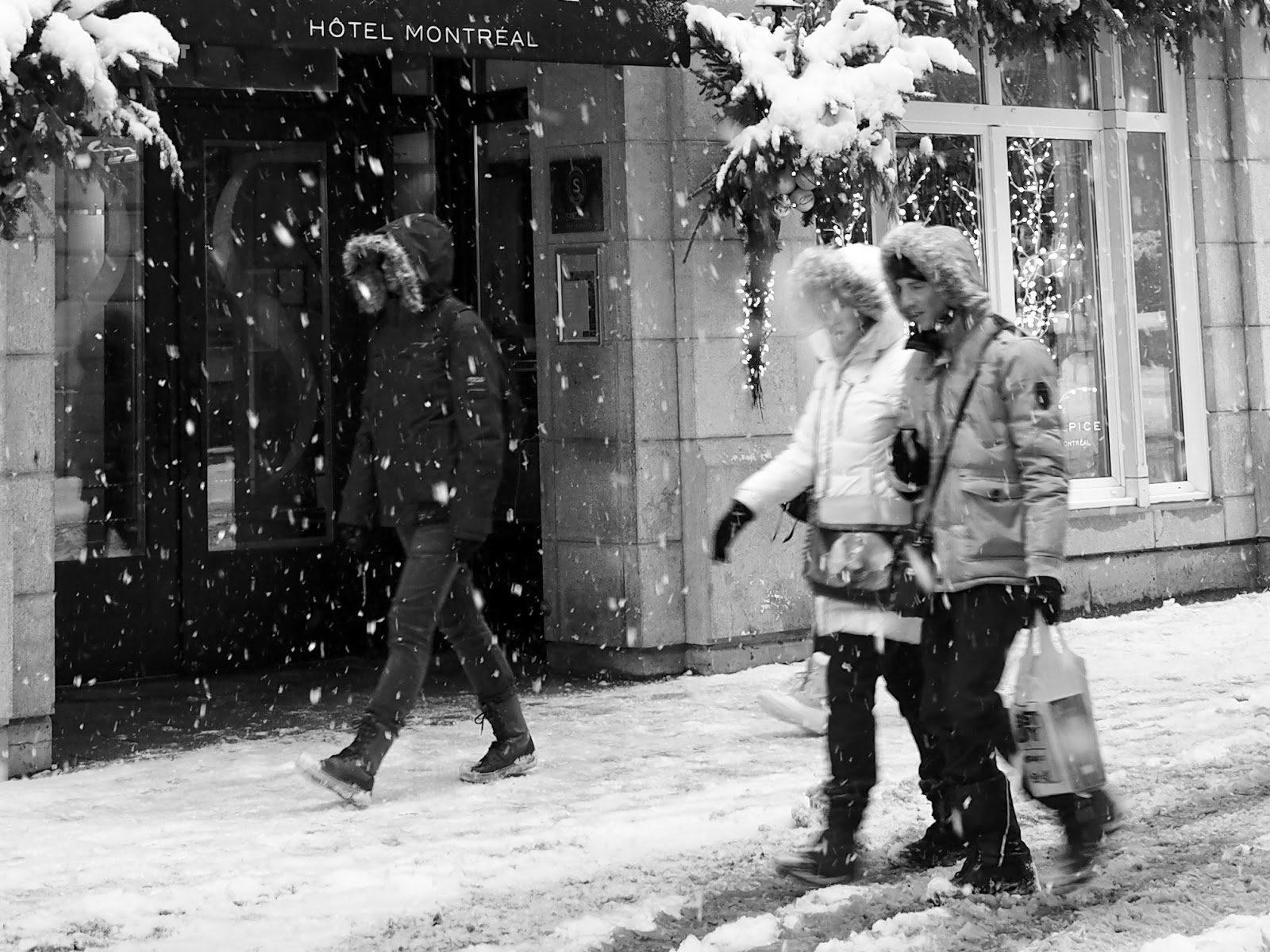
Montreal By Snow
Every year Montreal is turning in white to celebrate the winter season and the holidays period. A time to break down (a bit!) our frenetic way of life.
Happy Holidays and a nice new year to all!
10 novembre 2017
Doing your classical? (Is there a future for the traditional way of photographing?)
(Part of "the contemporary meaning of photography" series)
Nota: This final episode of our photography meaning search saga is dedicated to all my old friends and colleges that have a profound passion of the traditional ways of doing photography. A great great generation of picture takers that are thinking that they have been spoiled by the introduction of the digital age, an age that have no respect for traditions or ancien manners of all kind.
It is amazing to try to count how many times the death of traditional photography has been announced since the last 3 or 4 decades. In fact it is a testimony of the continuous resilience of the medium over two centuries. But is there still a future in doing photography the classical way? Otherwise described by that taking picture with a specialized camera device, then treating the image registered and then after diffusing it or printing it.
Specialized camera devices have known a lot of transformations during those 200 years. Many socall modern photo equipment have become totally obsolete in a relatively short period of time. It happens all the time and will happen again. SLR then DSLR designs are now on the verge of anhilation by more recent un-mirror design. Since we are constantly on the move we want performing cameras in a smaller and lighter package with easy connecting virtues. That is the price to pay for innovation and many traditional camera manufacturers are facing the challenge to simply survive in that new dimension.
So is traditional way of doing photography will disappear in profit of an "instamatic" world? Not really because the demand for more sophisticated photography both technical and artistically will remain and expand following our demographic grow. But as usual during all the course of the photo history learning the more demanding aspect of producing original and impacted pictures will stay the work of a more specialized users.
When I have started to take pictures we were at the pinacle of film photography and many older photographers were stating that the days of traditional photography were over, that everybody (meaning not especially skilled) can take good pictures. Since that time I can certify you that many very talented new artists and photographers just prove the contrary by exploring new ways of exploiting the medium.
It occurs to me that today photography can ask you a greater personal investment than just clicking but offer also a much more rewarding consideration. It is up to you to go ahead!
Nota: This final episode of our photography meaning search saga is dedicated to all my old friends and colleges that have a profound passion of the traditional ways of doing photography. A great great generation of picture takers that are thinking that they have been spoiled by the introduction of the digital age, an age that have no respect for traditions or ancien manners of all kind.
It is amazing to try to count how many times the death of traditional photography has been announced since the last 3 or 4 decades. In fact it is a testimony of the continuous resilience of the medium over two centuries. But is there still a future in doing photography the classical way? Otherwise described by that taking picture with a specialized camera device, then treating the image registered and then after diffusing it or printing it.
Specialized camera devices have known a lot of transformations during those 200 years. Many socall modern photo equipment have become totally obsolete in a relatively short period of time. It happens all the time and will happen again. SLR then DSLR designs are now on the verge of anhilation by more recent un-mirror design. Since we are constantly on the move we want performing cameras in a smaller and lighter package with easy connecting virtues. That is the price to pay for innovation and many traditional camera manufacturers are facing the challenge to simply survive in that new dimension.
So is traditional way of doing photography will disappear in profit of an "instamatic" world? Not really because the demand for more sophisticated photography both technical and artistically will remain and expand following our demographic grow. But as usual during all the course of the photo history learning the more demanding aspect of producing original and impacted pictures will stay the work of a more specialized users.
When I have started to take pictures we were at the pinacle of film photography and many older photographers were stating that the days of traditional photography were over, that everybody (meaning not especially skilled) can take good pictures. Since that time I can certify you that many very talented new artists and photographers just prove the contrary by exploring new ways of exploiting the medium.
It occurs to me that today photography can ask you a greater personal investment than just clicking but offer also a much more rewarding consideration. It is up to you to go ahead!
The Art of frozen vision
Part of "the contemporary meaning of photography" series)
It is about photography. Is it an Art? We know already the "art" of doing photography but the result of it can we compare it to the others forms of art such as painting or sculpture? It has been already a long debate and even today photography is still fighting for its legitime place in the Parthenon of Art.
In fact photography has been and still is a very actual art by creating trends and carrying them over the past two centuries. Artists have incorporated or simply expose their pictures into a variety of visual presentations. So it seems very difficult to restreint photography into its classical 2D flat representation. But photography is stil the expression of a frozen vision as a flash of the selected moment by the auteur.
Today there is a multitude of photographic events that are showing many of the different aspects of this contemporary visual art. Subjects, treatments and diffusion modes have exploded around our cultural world. Influences have become fully multi-lateral at a point that make uneasy to identify the many currents of creativity available. Moreover artists have chosen for many an ecliptic way of life that bounce from one interest to another. Although mécènes of art are still exist in variable forms a lot of artists are self-sustaining producers and diffusers.
Is there a place for innovation in our today world of constant communication? This question is surely initiated by the arrogance for the past artistic creators versus the actual production. Surely all visual arts (as for the others forms of Art) will continue to evolute in form, in practice, in showing. New subjects will appear as for older subjects that can be reinvent. New and more classical visual representations of the frozen vision can be reconstructed. The limitations as we are seing today cannot prevent us to research new frontiers and reach them.
Photography is certainly a very contemporain cultural expression that showcase many humain interpretations of our world.
Next theme: Doing your classical? Is there a future of the traditional way of photographying?
It is about photography. Is it an Art? We know already the "art" of doing photography but the result of it can we compare it to the others forms of art such as painting or sculpture? It has been already a long debate and even today photography is still fighting for its legitime place in the Parthenon of Art.
In fact photography has been and still is a very actual art by creating trends and carrying them over the past two centuries. Artists have incorporated or simply expose their pictures into a variety of visual presentations. So it seems very difficult to restreint photography into its classical 2D flat representation. But photography is stil the expression of a frozen vision as a flash of the selected moment by the auteur.
Today there is a multitude of photographic events that are showing many of the different aspects of this contemporary visual art. Subjects, treatments and diffusion modes have exploded around our cultural world. Influences have become fully multi-lateral at a point that make uneasy to identify the many currents of creativity available. Moreover artists have chosen for many an ecliptic way of life that bounce from one interest to another. Although mécènes of art are still exist in variable forms a lot of artists are self-sustaining producers and diffusers.
Is there a place for innovation in our today world of constant communication? This question is surely initiated by the arrogance for the past artistic creators versus the actual production. Surely all visual arts (as for the others forms of Art) will continue to evolute in form, in practice, in showing. New subjects will appear as for older subjects that can be reinvent. New and more classical visual representations of the frozen vision can be reconstructed. The limitations as we are seing today cannot prevent us to research new frontiers and reach them.
Photography is certainly a very contemporain cultural expression that showcase many humain interpretations of our world.
Next theme: Doing your classical? Is there a future of the traditional way of photographying?
Photojournalism: Where is my public ?!!!
(Part of "the contemporary meaning of photography" series)
It is a drama related over the Photo Web sphere of the last two decades. What is happening to the traditional photojournalism that has been the most famous front of popular and professional photography reconnaissance?
If the technical skill to physically producing a product can be accordingly remunerated it is by far more difficult to get paid for an idea or style or any original expression.
Multiplicity of the photographic resources can be also a definitive changing factor in photojournalism. With the past five decades of demographic explosion it is impossible to ignore the variety and the availability of the different sources of pictures in these societies.
But the necessity of pictorial interpretations of our human realities is still prevailing today. True to say that the so-call golden era of photo reporters with secure retribution is now over and we are facing a kind of renewed version of the ancient "pictographers" as we have seen at the very beginning of modern photography practice. Except for very specialized segments of photo production you cannot pretend no more to build your profesional life on the base only of taking news pictures.
The act of photo taking is for the good or the bad an highly democratic feature. So it depend of our own motivation and resources to plan, to produce and to diffuse our results. As I use to call them 25 years ago during my photo professionnel career the days of the corporated photographers are terminated (The bar is closed!). Today a new generation of young, talented and persistent photographers have taken the lead and their pictures can be seen on many new media.
It remains the question "Where is my public (gone)? The answer is everywhere in our present Web sphere of connections and communication. There is no more general audiences (There is never had in fact) to refer in for the diffusion of every kind of information. It is now specialize, local, institutional, corporative, etc. At the end the need to register part (bit) of human history will prevail one way or another.
Next theme: The Art of frozen vision (Photography as a cultural expression)
It is a drama related over the Photo Web sphere of the last two decades. What is happening to the traditional photojournalism that has been the most famous front of popular and professional photography reconnaissance?
If the technical skill to physically producing a product can be accordingly remunerated it is by far more difficult to get paid for an idea or style or any original expression.
Multiplicity of the photographic resources can be also a definitive changing factor in photojournalism. With the past five decades of demographic explosion it is impossible to ignore the variety and the availability of the different sources of pictures in these societies.
But the necessity of pictorial interpretations of our human realities is still prevailing today. True to say that the so-call golden era of photo reporters with secure retribution is now over and we are facing a kind of renewed version of the ancient "pictographers" as we have seen at the very beginning of modern photography practice. Except for very specialized segments of photo production you cannot pretend no more to build your profesional life on the base only of taking news pictures.
The act of photo taking is for the good or the bad an highly democratic feature. So it depend of our own motivation and resources to plan, to produce and to diffuse our results. As I use to call them 25 years ago during my photo professionnel career the days of the corporated photographers are terminated (The bar is closed!). Today a new generation of young, talented and persistent photographers have taken the lead and their pictures can be seen on many new media.
It remains the question "Where is my public (gone)? The answer is everywhere in our present Web sphere of connections and communication. There is no more general audiences (There is never had in fact) to refer in for the diffusion of every kind of information. It is now specialize, local, institutional, corporative, etc. At the end the need to register part (bit) of human history will prevail one way or another.
Next theme: The Art of frozen vision (Photography as a cultural expression)
Memory of the future: Paper, Disc, Cloud...Photography in search of a future!
(Part of "the contemporary meaning of photography"series)
For over more than its 180 first years the representation of photography has been done on a solid 2D support like paper, cardboard, glass, etc. Today it seems to be no really relevant to show our pictures that way only. Instead we are using on screen devices that for most of them give us a very handy and high resolution representation of the image. The problem with this is that those devices dont really sustain the picture permanently as it use to be in the past. So for any archival purpose or future reference you will need another support (digital or not) to preserve your photographs.
Preserving images doesn't matter if you are not interested to keep souvenirs or picture reminders from your past. In that case future access to digital memory or digital memory fading are not a real preoccupation. Sorry to confirm you this fact that can be observed for the immense majority of the pictures taken today. People in our present societies have a tendency to obliterate the past and are not interest anymore with history. The question of connection (Internet) is now essential to every photographing today devices. Many traditional camera manufacturers are finding very hard to understand that very basic fact of our consumer world.
The "consumer" societies as we are experiencing today is not really prepared and not really interest to stock over information that will seem obsolete in a very short term. So we are actually dropping or flushing most of our media production. And more important even when we intend to preserve some of it, it is only for a very short period of time.
The other problem of photographic preservation is the selection of what we think it is wort to do so. Because of the outstanding amount of imagery we are constantly producing in this digital age it start to be painfully annoying to try to choose and to classify our photographs.
In my sense the only approach of preserving pictures on a long term (at least for few generations) is to complete the entire cycle of producing photography. In simple term doing a print copy of your picture as we use to do for the first 200 years for the medium. So (ironicaly) the print may eventually win over disc, tape, drive, cloud ... after all!
Next theme: Photojournalism: Where is my public?
For over more than its 180 first years the representation of photography has been done on a solid 2D support like paper, cardboard, glass, etc. Today it seems to be no really relevant to show our pictures that way only. Instead we are using on screen devices that for most of them give us a very handy and high resolution representation of the image. The problem with this is that those devices dont really sustain the picture permanently as it use to be in the past. So for any archival purpose or future reference you will need another support (digital or not) to preserve your photographs.
Preserving images doesn't matter if you are not interested to keep souvenirs or picture reminders from your past. In that case future access to digital memory or digital memory fading are not a real preoccupation. Sorry to confirm you this fact that can be observed for the immense majority of the pictures taken today. People in our present societies have a tendency to obliterate the past and are not interest anymore with history. The question of connection (Internet) is now essential to every photographing today devices. Many traditional camera manufacturers are finding very hard to understand that very basic fact of our consumer world.
The "consumer" societies as we are experiencing today is not really prepared and not really interest to stock over information that will seem obsolete in a very short term. So we are actually dropping or flushing most of our media production. And more important even when we intend to preserve some of it, it is only for a very short period of time.
The other problem of photographic preservation is the selection of what we think it is wort to do so. Because of the outstanding amount of imagery we are constantly producing in this digital age it start to be painfully annoying to try to choose and to classify our photographs.
In my sense the only approach of preserving pictures on a long term (at least for few generations) is to complete the entire cycle of producing photography. In simple term doing a print copy of your picture as we use to do for the first 200 years for the medium. So (ironicaly) the print may eventually win over disc, tape, drive, cloud ... after all!
Next theme: Photojournalism: Where is my public?
09 novembre 2017
Can I say (show) something? (The purpose of photography)
(Part of "the contemporary meaning of photography" series)
Is photography has became a redondant figure of our visual expression during our modern age?
For many it seems to be true in view of the always present of the animated image mainly in cinematography and videography. But representations of still photography are present as never everywhere in our society. So it is not a question of life and death for photography today but more a perception factor.
The purpose of (still) photography is multiplied by its diversified uses. Commercially no question about it the picture representation is here to stay. All kind of pictures illustrate products and services in many ways. There is a strong demand to do so and be more "pictographic" informative than textual.
What is changing a lot about today photography is its great diversity and its immense availability. In that sense you cannot anymore try to synthesize it in few categories or ressources or purposes. Moreover you cannot anymore speak about a very specialized medium because it became so popular, so accessible and so easy to diffuse. The "elite" time of photographers is gone for ever.
It is a combination of technical advancements in picture taken and of digital implementations that really democratized photography. But the messages remain... because photography is still an universal language with a strong impact to its audiences.
So can I show something new, different, relevant, informative? The answer is surely yes. What is a bit more difficult to admit is the fact that the traditional ways to present the picture are only a fraction from the many others ways to do it. And that can be frustrating for a lot of traditionalist picture takers.
At the end the purpose of photography can be simply describe as a visual way to express yourself. It can be art, news, illustrations, souvenirs but it is always about an image memory of a privilege moment in our life.
Next theme: Memory of the future: Paper, Disc, Cloud...Photography in search of a future!
Is photography has became a redondant figure of our visual expression during our modern age?
For many it seems to be true in view of the always present of the animated image mainly in cinematography and videography. But representations of still photography are present as never everywhere in our society. So it is not a question of life and death for photography today but more a perception factor.
The purpose of (still) photography is multiplied by its diversified uses. Commercially no question about it the picture representation is here to stay. All kind of pictures illustrate products and services in many ways. There is a strong demand to do so and be more "pictographic" informative than textual.
What is changing a lot about today photography is its great diversity and its immense availability. In that sense you cannot anymore try to synthesize it in few categories or ressources or purposes. Moreover you cannot anymore speak about a very specialized medium because it became so popular, so accessible and so easy to diffuse. The "elite" time of photographers is gone for ever.
It is a combination of technical advancements in picture taken and of digital implementations that really democratized photography. But the messages remain... because photography is still an universal language with a strong impact to its audiences.
So can I show something new, different, relevant, informative? The answer is surely yes. What is a bit more difficult to admit is the fact that the traditional ways to present the picture are only a fraction from the many others ways to do it. And that can be frustrating for a lot of traditionalist picture takers.
At the end the purpose of photography can be simply describe as a visual way to express yourself. It can be art, news, illustrations, souvenirs but it is always about an image memory of a privilege moment in our life.
Next theme: Memory of the future: Paper, Disc, Cloud...Photography in search of a future!
Polaroid all over the "Phone" Planet and the "Web" World (as a trace of personal life involvement)
(Part of "the contemporary meaning of photography" series)
Finally Edwin Hebert Land the creator of the original Polaroid instant film process has won the war over Kodak. Its idea of instant photography succeeded with the combined introduction of the smartphone and the web facilities of our digital world. You can call it the digital Polaroid of our time. And nobody can contest that simple fact and even the idea of an instant print picture has been revived by nostalgics, by artists or by web fans and many commercial opportunities have been taken by small entrepreneurs like the Impossible group or by big industrial machine like Fujifilm.
So doing digital "Polaroid" was really the future of popular (instamatic or instant) photography. And it works at the gigantic scale in our modern demography. The tools are available, affordable and easy to operate with good picture results in standard situations. There will be no coming back to the despair of many traditional camera manufacturers.
Today instant photography is becoming an expression of ourself in the context of our life and surrounding. It interact with our close friends and relatives. It definite our style of living. It express our thinking, our reaction and our endorsement of the moment. It confirm our presence in space and events. It leave a fugace trace of ourself into our instant world, a trace that will be almost certainly obliterated the next moment. But this is part of our today world and the success of the medium. This world is about constant change more than evolution. It is like fashion and photography is fashion.
It isn't a question if instant photography is good or bad because it fulfil deeply a need of interpersonal communication in a society that have idealized individualism as a main way of life. Those who don't need it will simply ignore it as a way of expression because and it is still the beauty of it you can choose to participate or not to this instant world.
So what the most popular way of doing photography? You dont need help to find that answer! Just look simply into your pocket or your bag!
Next theme: Can I say (show) something? (The purpose of photography)
Finally Edwin Hebert Land the creator of the original Polaroid instant film process has won the war over Kodak. Its idea of instant photography succeeded with the combined introduction of the smartphone and the web facilities of our digital world. You can call it the digital Polaroid of our time. And nobody can contest that simple fact and even the idea of an instant print picture has been revived by nostalgics, by artists or by web fans and many commercial opportunities have been taken by small entrepreneurs like the Impossible group or by big industrial machine like Fujifilm.
So doing digital "Polaroid" was really the future of popular (instamatic or instant) photography. And it works at the gigantic scale in our modern demography. The tools are available, affordable and easy to operate with good picture results in standard situations. There will be no coming back to the despair of many traditional camera manufacturers.
Today instant photography is becoming an expression of ourself in the context of our life and surrounding. It interact with our close friends and relatives. It definite our style of living. It express our thinking, our reaction and our endorsement of the moment. It confirm our presence in space and events. It leave a fugace trace of ourself into our instant world, a trace that will be almost certainly obliterated the next moment. But this is part of our today world and the success of the medium. This world is about constant change more than evolution. It is like fashion and photography is fashion.
It isn't a question if instant photography is good or bad because it fulfil deeply a need of interpersonal communication in a society that have idealized individualism as a main way of life. Those who don't need it will simply ignore it as a way of expression because and it is still the beauty of it you can choose to participate or not to this instant world.
So what the most popular way of doing photography? You dont need help to find that answer! Just look simply into your pocket or your bag!
Next theme: Can I say (show) something? (The purpose of photography)
05 novembre 2017
The contemporary meaning of photography: a story in color and in black and white
A short series of personal perceptions on photography
Foreword
Almost 200 years has passed since the bases of modern photography has been settled by directly or indirectly printing the right interpretation of our surrounding on the same manner as your eyesight. It was at the time a complete visual revolution that brings us with flashes of memory of our past time and many foreign spaces. It has shaped a new and extended vision of our world. It has fascinated large specialized or unaware different publics. Today photography even after 2 centuries remains a source of constant controversies on many of its diverse aspects or subjects. Some populations or cultures are still banning it on the base of its own subversive power.
At first photography was essentially a technical curiosity with strong limitations. It took several attempts and further technical development to reach a practical level of producing it. It was also a privilege medium of the few before industrial pioneers like George Eastman with its Kodak had popularized it. Today with the introduction of photography into the digital age with the web connected smartphones photography became an instant part of our every day life. But what is the contemporary meaning of today photography? Is it a simple communication tool of personal expression or a reliable memory instant statement of the time or a visual art expression of its own? Is it still valuable in our past-present-future way of living? Many questions had risen over the past three or four decades on the importance of the photography in our societies.
At least we have one answer about the need of photography in today world and it is paramount to try to evaluate its intense use in our way of communicating and living. Billions of pictures are presented on many different viewing supports everyday almost everywhere. So there is a strong demand to do and to consume photography and sorry…photography is not dead!
Almost 200 years has passed since the bases of modern photography has been settled by directly or indirectly printing the right interpretation of our surrounding on the same manner as your eyesight. It was at the time a complete visual revolution that brings us with flashes of memory of our past time and many foreign spaces. It has shaped a new and extended vision of our world. It has fascinated large specialized or unaware different publics. Today photography even after 2 centuries remains a source of constant controversies on many of its diverse aspects or subjects. Some populations or cultures are still banning it on the base of its own subversive power.
At first photography was essentially a technical curiosity with strong limitations. It took several attempts and further technical development to reach a practical level of producing it. It was also a privilege medium of the few before industrial pioneers like George Eastman with its Kodak had popularized it. Today with the introduction of photography into the digital age with the web connected smartphones photography became an instant part of our every day life. But what is the contemporary meaning of today photography? Is it a simple communication tool of personal expression or a reliable memory instant statement of the time or a visual art expression of its own? Is it still valuable in our past-present-future way of living? Many questions had risen over the past three or four decades on the importance of the photography in our societies.
At least we have one answer about the need of photography in today world and it is paramount to try to evaluate its intense use in our way of communicating and living. Billions of pictures are presented on many different viewing supports everyday almost everywhere. So there is a strong demand to do and to consume photography and sorry…photography is not dead!
Here are the themes that have been developed along this series:
Polaroid all over the "Phone" Planet and the "Web" World (as a trace of personal life involvement)
Can I say (show) something? (The purpose of photography)
Memory of the future: Paper, Disc, Cloud...Photography in search of a future! (The diary of our present conserved for the coming generation)
Photojournalism: where is my public?
The Art of frozen vision (Photography as a cultural expression)
Doing your classical homework? (Is there a future for the traditional way of photographing?) -
Your comments are always appreciated.
Daniel M
01 novembre 2017
The size (dimension) factor in modern compact digital camera
![]() |
| (Picture fromWeb source) |
In fact the size factor is not only an intemporel data regarding the design of cameras it is also a decisive one. Today we are facing the same dilemma for digital photographic tasked devices. What is the magic formula in terms of weight and dimensions? The answer is that there is no need to reinvent the calculations because that has been done several times already on several studies and the results are always approaching the same compact size package. A package that have been definite early by pioneers like Oskar Barnack with its Leica (although he was first using 35mm film but with a bit narrower negative frame format).
What we learn with experience is that the picture frame format is far less relevant to the photographic users than the size (and weight) of the camera. The models which are transgressing that moto will soon or later be put aside one way or another. It is a very unforgiving market law.
![]() |
| With the introduction of the OM-1 (M-1) in 1972 Olympus has redefined the Leica concept to 35mm (135) SLRs (Picture from Web source) |
Its about that time that the first attempts to substitute traditional 35mm SLRs by digital cameras appear. The new technology of digital image captor prevent the manufacturer to produce frame sensors of the 35mm size format equivalent. This is why they defend themselves by saying that DX (Nikon) or APS-C (Canon) were largely sufficient to do the job. And as a bonus the size of the cameras and lenses appear to be similar to the old film SLRs. Canon was the first to come back with a sensor size of approximately 24 X 36mm (comparable to the 135 film format). After a few years of denegations Nikon finally imitate Canon in that way. The big advantage for them was to be able to market again the old full line of lenses issued during the film era.
Today building a digital camera will face different new constraints. The image sensor and its processor will take the place of the old negative and its cartridge of the film era. You need to accommodate an LCD screen that can be act as a live viewfinder or a picture viewer for image review. automatic and regulator system are more sophisticated and rely on battery pack power. The heating issue mainly seen during video recording has to be addressed also. And not saying that you still have to design a camera that will withstand general and intensive uses in sometimes very adverse conditions. All those aspects have received special attentions from the manufacturer designed teams with success most of the time.
![]() |
| Today in 2017 the Olympus OM-D E-M5 Mark II is fully respecting the weight and the original dimensions of the 1972 OM-1. |
But at the end you will finish with the size factor. And more and more photographers are choosing the compactness of the mirrorless models precisely for that. The picture quality output of the modern mirrorless can easily withstand the usual requirement of the virtual or printed publication even better than the traditional film of the past.
Every technological step of evolution encounter stiff resistance at its first introduction. But solutions of the past have never been eternal answers to the problematic of the future.
S'abonner à :
Messages (Atom)