18 août 2017

The mid-range deep of field is on your side!

To Be or Not To Be (as for to have or not to have...)


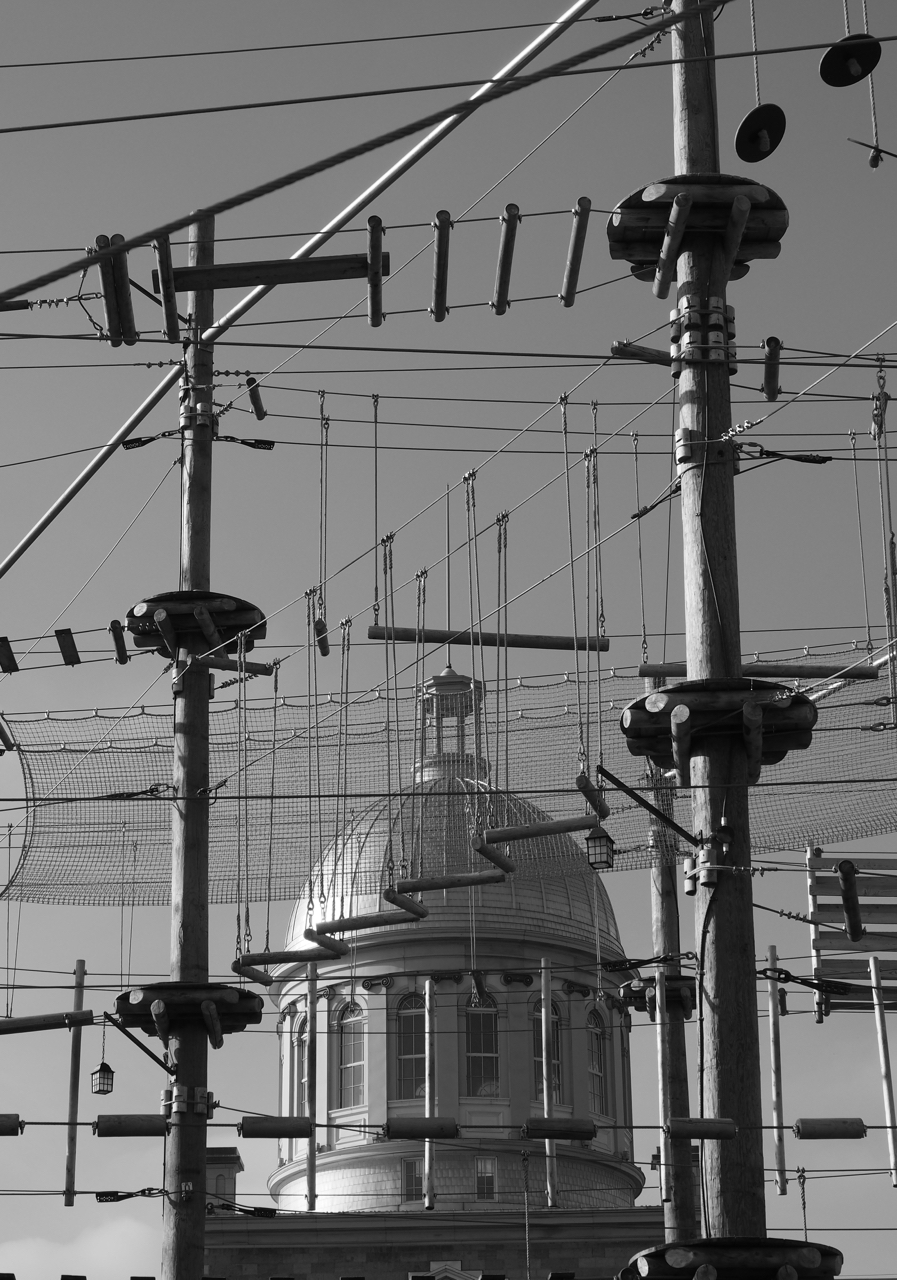
Olympus M.Zuiko 14-42mm @ 42mm, 1/125sec F5.6 ISO200 Monochrome
There is the ones who are searching for the minimal deep-of-field and there is the others that are looking for a maximum deep-of-field. Portraits, sports, fashion are part of the first category and landscape, architectural, illustration are dedicated in the second type of photography. And to get such results within the traditional optical limitations i.e. maximum aperture in one case and less light diffraction in the other way you have to rely on specific cameras or/and lenses that may be expansive and far less versatile.


Panasonic Lumix G Vario 12-32mm @ 32mm, 1/125sec F5.6 ISO200
Since I am not very fond of big and costly photo equipment my answer to that challenge is simply the following. Why not exploring more abordable photo material and discover how to get image results that will fulfil those special tasks regarding the amount of deep-of-field (DOF) that will satisfy yours needs. Is it possible by using very basic optics such as so-call "kit" lenses? In my modest examples I have tried to outreach the usual standard imposed to these products.And dont forget in this digital world of wonders that most of the time "what you see is what you get" usually apply!

How can we definite mid-range deep-of-field (Mid-DOF)? Anything between two extreme: almost no deep-of-field or about infinite deep-of-field like in landscape photography. So Mid-DOF can be assimilated as an intermediate area between the closest and the longest(or infinite) distances. Most lenses for compact camera format (M4/3, APS-C and 24 X 36mm called wrongly "full-frame") if not all have the ability to do mid-range deep-of-field by using their smaller aperture settings such as F4.0, 5.6, 8,0 or 11.

Panasonic Lumix G Vario 35-100mm @ 100mm, 1/800sec F7.1 ISO 200 Monochrome
The safety gap
If you are facing many various picture taking conditions it is good to rely on a certain deep-of-field margin. This "safety gap" ensure you that critical focusing is at least obtained for the principal subject  especially considering its volume aspect for example on a face, on objects with incrustations, etc. Sometimes you won't be able or you will simply forget to double check the full clarity of your subject. This is why a mid-range deep-of-field will play as an insurance for your final image results.

Optical quality pick of the lens
Rarely you will get the optimum quality of your image by using the maximum aperture available on the lens. Furthermore we know already that the diffraction phenomena for an optics will appear by using its minimum aperture. So the best output will be registered in selecting the medium aperture such as F4.0, F5.6 or F8.0 on many lens model or even at F2.8 with lenses doted of a larger maximum aperture (F1.7, F1.8, F2.0).

Compactness
Lens models that are designed with a more moderate or modest maximum aperture are reckoned to be more compact and lighter package a big advantage if you have to carry them extendely. Their smaller size mean also more discretion or less intimidating aspect. All these consideration of better mobility and less carrying fatigue will be fully appreciated for your street or traveling photo projects or any other situation that required an additional effort from your part.

Good pricing on your part
Many moderate maximum aperture lens models are far less expensive compare to their "Pro" counterparts. Often they are available on special selling package with the camera at a ridiculous add-on price tag. I can recommend you without any doubts the Olympus M.Zuiko 14-42mm F3.5-5.6 II R & 12-50mm F3.5-6.3 EZ or the Panasonic Lumix G Vario 12-32mm & 12-60mm both F3.5-5.6 OIS or the Fujifilm Fujinon XF 16-50mm F3.5-5.6 & 18-55mm F2.8-4.0 both OIS which are all excellent optical tools.

Panasonic Lumix G Vario 12-32mm @ 32mm, 1/320sec F5.6 ISO200
What you loose? Essentially a larger maximum aperture for a minimal DOF, a higher quality design and construction and often a better sealing protection for using the lenses in adverse conditions. But you will double or triple your price tag to get them. And you will have to bring them with you...

A picture should tell a story and that story can be very limited when you are selecting a very narrow deep of field or on the contrary the story can be very long (translate boring) if you choose an infinite deep of field. Something in between could be the best thing to do... The choice is yours but a mid-range deep of field choice is certainly on your side. And the beauty of this is already available on the most affordable (kit) zoom lenses.


09 mai 2017

The Holy Classical Lens: The Olympus M. Zuiko 25mm F1.8

During the so-call 35mm film era we use to call it the "normal" lens. The one optic that came almost the facto with any camera model ... and the most economical one too! If you are looking through it (via you viewfinder) it respect roughly our eye sight for the proportion of the subject. So it was and still is a very previsible lens. Parts of the Olympus fine lens line-up there are two versions of this normal lens: the M. Zuiko 25mm F1.8 and the Pro 25mm F1.2 the latter has been introduced lately. Their angle of view are similar (47 degrees for the F1.8 version) but the big differences are mainly their specific construction and their respective maximum aperture available. If you are planning to use your 25mm very extendedly in adverse external condition or for many studio mandates it can be wise to privilege the F1.2 Pro version. But for a more casual use the basic F1.8 will do the job without any losing quality expense. This is the version that I will briefly review.


Legendary Belgian World Champion Eddy Merckx at the finish
 line of the 1974 Montreal World Cycling Championships.
This shot was done only with anticipation and has succeeded !

( Photo Daniel Marchand)
A "normal" lens on sports assignment !!!

Typical 1974 Photo Press Release of the photo finish lane
( Picture source from Cycling Week Web site )


Memories: Some years ago (let say few decades) my first 35mm SLR camera (a modest Argus Cosina STL1000) was coupled with the economical standard Cosinon 50mm F1.7 lens, a package available for 249 $CAN which was a lot of money from a yesterday point of view. And I remember "covering" the World Cycling Championship in Montreal in 1974 with a few black & white rolls of film and this minimal combination of camera and lens. The results of that improvised assignment had just convinced me to poursuit my photographic dream of a career which finally happened about ten years after. And that story along many others is proving the great versatility of a so-call normal focal fixed lens such as the 25mm in M4/3 format.


Other photo extracts of that day of the 
1974 Montreal World Cycling Championship.
( Photos Daniel Marchand)


(Let's return to our regular program...)

Physically the Olympus M.Zuiko 25mm F1.8 is a small package considering its relatively large maximum aperture. This compact design will match nicely the camera dimensions of most M4/3 format models. A large focus ring is surrounding the 25mm which is a strong permanent tentation to select manually by yourself your focus point. It is really a creative prime lens, an academic optic as should add the traditional photographic teachers.

A polymer made lens hood is part of the accessories included with the lens. It is a nice addition offer with a none too much perturbing size. And it is bayonet mounted and very easy to put in or pull out.


With an angle of view of 47 degrees the Olympus 25mm F1.8 is a very confortable optic to work with. All perspective aspects of the image respect your own view of the subject. By moving yourself you can control the cropping of your picture without surprise. So it is really a pro-active tool in that sens.


No subject is out of the reach of the Olympus 25mm although it can ask to reframe in some cases when you finally edit your picture for diffusion. Very close focus subjects can be photograph with this "normal" lens. As for subjects with minimal deep of field study. And you can do portrait assuming that there is always the possibility to crop afterward the picture.


The Olympus M. 25mm F1.8 is a fine lens. The quality output of its picture results is high for its modest price compare to "pro" counterpart such as the Olympus Pro M.Zuiko 25mm f1.2 optic. Most of the time I have selected the largest apertures available ranging from F1.8 to F5.6 without suffering any lost of definition. Moreover I suspect that the lens has been primarily designed to be used within that range of apertures. Focus final selection can be easily performed by configuring the camera with the option allowing the combination of auto-manual focusing. The more you will explore your subject with it the more you will learn to appreciate its abilities.


Is the 25mm lens can be assimilated as a "one and only" lens to bring option? May be depending what type of photographer you are. For sure for contextual street photography into urban area its angle of view can be perceive a bit too much narrowed compare with the Olympus 17mm f1.8 for example. But remember that guys like Henri Cartier-Bresson have done very fine and emblematic  pictures with that angle of view (translated by the 50mm focal length in 24X36mm film format).


Finally if your are more oriented "zoomer" photographer by choice or by necessity, the Olympus 25mm F1.8 is a nice back-up lens for on-the-spot replacement and its useful maximum aperture in low light conditions or even for its smaller less intrusive size and it can be slip in your pocket.

Yes the Olympus M.Zuiko 25mm F1.8 is another affordable gem part of the nice Olympus M.Zuiko line-up.


08 mai 2017

Olympus OM-D E-M5 Mark II: The Caméléon Camera!

(Lastly edited May 8, 2017) (First parution November 15, 2016)

Back in 2012, Olympus has announced and preview its first OM-D  a sort of digital emulation of the classical SLR film camera series originally named OM. Apart the general aspect and dimension of the E-M5 model presented it was a complete new design very different from the other digital M4/3 Olympus line, the PEN series. Since the beginning of digital cameras as the new photographic mass media Olympus has been innovative and very productive of different concepts and model series. The Camedia and E-X series can be rightfully reckoned as one of the most serious effort to produce very effective photographic digital tools.


The first OM-D E-M5 declination has been a true success story among photographers and reviewers that simply salute Olympus with a very strong endorsement of the product. Furthermore the E-M5 has been also one of the first M4/3 format model really used on a professional base around the world although it was remaining more an exception and a curiosity. Olympus eventually have responded by offering a new OM-D E-M1 for a more specific pro use.

In 2015 Olympus issued the second version of the E-M5 tagged Mark II with is an upgraded product in many ways (with the exception of its menu interface presentation...!).

Rotative LCD Screen (versus Tilt-able original version): A video reminiscence imported to OM-D
The LCD screen of the EM5 Mark II is a beauty to use ether as a live "full" scale viewfinder or as a reviewing tool. As a live viewfinder (LVF) it is a better choice for evaluate exposure and color rendition of the picture. If the situation allow you to do so the LVF will be a very productive option. I am not a big fan of LVF at the beginning but more and more especially with the "mobile" device event the photographer ... and the subjects are getting used to it and felt more comfortable now than by holding the camera the traditional way.

Electronic Viewfinder (EVF): Shut down (or rotate back) that LCD screen!
The Olympus OM-D E-M5 Mark II is doted of a very fine Electronic ViewFinder (EVF). Fine details can be easily observed and all the infos are present (but without the automatic vertical rotation feature for the infos). Manual focusing can be done accurately through the EVF with the loupe option and dont prevent yourself to do it.
In strong lightning context the EVF may seem to be more contrasty than for low light subject. This caracteristic has been addressed from the early EVF and tend to be corrected gradually but there is still place for improvement. As for the delay between the image seen on EVF vs real-time situation. For action photography I will suggest you to stay and rely on EVF in preventing misinterpretation of the "pic" of the image or subject action.
The presence of the LVF (LCD screen viewfinder) couple with the automatic switch over option between EVF and LVF can be annoying for people who mainly EVF users. By entirely rotating back the LCD screen you will facilite the exclusive EVF use with a better battery life (at the expensive of the fast access to the LCD screen I must add...).

Enhanced Dials
One of the most noticeable difference between the original E-M5 and the new E-M5 Mark II version are the dimension and the nature of the direct control dial that are now bigger and offer better adherence. Adding the optional grip will give you the same arrangement for front handling but in vertical holding you will recover the "old" dial design which is a disappointment in my sens even if the original controls stay efficient in every way.
The Olympus OM-D E-M5 Mark II is a small ILC compact camera and because of that all fonction buttons and dial are accordingly cramped for this type of device. You may accidentally change setting and falsely working with a non voluntary configuration. So the best way to counteract these effects is to verify time to time all the basic information showed on the viewfinder EVF or LVF.

New "more" grip ( More proimenent front hand grip for secure and confortable handling and appreciable vertical shooting ability)
The Olympus HLD-8 grip &battery holder combination is an upgrade version of the previous HLD-6 model offered for the original E-M5. Dimensions and control dial of the grip by itself (HLD-8G) have been revised ans a earphone plug for monitoring the recorded sound has been added. Using the HLD-8 with or without the additional battery had a lot of confort to the handling of the E-M5 Mark II.

In using the complete grip kit you can alternate a two batteries turn around (with one battery always full load in camera) without removing the unit .
Vertical shooting is more secure and easier. Weight and dimension distribution between camera and lenses are better served when you are working with bigger lenses such as the "Pro" series. If you anticipate doing action or outdoor photography the extra battery autonomy will be an appreciated advantage. And it stays a relatively compact package compare to the similar D-SLR combos. Finally having an additional power unit with the extra battery can be a precious help for intensive shooting sessions.

Lot of Personnalisation ... if you remember their functionalities...!
Since the event of the first OM-D (E-M5 original version), Olympus has always offer to the user  extended possibilities of camera personnalisation. Again with the E-M5 Mark II there is a lot of different setting available though the various dials and push (function) buttons present on the camera. For sure you will have to memorize all these personal setting but that can be a real advantage to fine-tune a product configured for "your" specific needs. It add speed and convenience for those who are willing to invest on learning the system.

Mini Flash (less bits and parts, marginally better height, orientable bounce and side-tilt options)
Many photo enthusiasm over the years are knowing already that Olympus has been a pioneer of TTL flash metering since the seventies especially with the original OM-2 24X36mm film camera model. Commun sense dictate the manufacturer to offer a very sophisticated dedicated flash system starting with the mini unit FL-LM3 which is part of the accessories included in the box and that can act as a master unit for controlling multi-flash (from Olympus) arrangement.
The diminutive FL-LM3 unit can be consider as a good fill-in flash option for on the spot situations. Thanks to Olympus to have simplify the attachement of the flash to a single flash  hot shoe port (no more multi-fonction bottom port) since I am not a big fan of potentially losing parts to protect these ports. The addition of the bounce and side-tilt head orientation option is another good value but you have to kept in mind the limited power of the unit. As a master remote flash indirect lightning is a welcome feature.
Olympus pro photographers on assignation like wedding, journalism even sport are considering  the flash option as a obligatory feature to compensate deficient or uneven lightning over the subject. Olympus has just release (October 2016) a new FL-900R powerful unit addressing that demand.

Vintage Flash unit arrangement using PC sync cord and camera sync port.
PC Sync Port ("The" studio vintage feature!)
A PC outlet has been added to the Olympus OM-D E-M5 Mark II. It is a past feature seen in most ancient film and traditional SLR and other camera models. For studio or flash work the use of a PC (trigger) sync outlet is inducing that you accept to use flash devices and camera/lens combination over their manual setting without relying on the automated TTL functionalities present into the E-M5 Mark II. In my sens it stays a curiosity more than a practical advantage. Yes you can still do flash photography by using a flash meter for balancing your light units but more and more professionals will prefer to rely on interface setting devices or by using the in-board camera fonctionalities.

Extensive but complex menu settings are an Olympus trademark.
Olympus Interface Presentation or "Learn your lessons!"
What can I add to the many "pro" reviewers that have already point out so many times for almost every new Olympus models that their interface presentation is hard to comprehend and assimilated. The E-M5 Mark II is not a different beast and will ask you to get use to the many aspects of the extended menu options. A quick menu option available by pressing the OK button is may be the best way to access to the fondamental parameters of the camera.

Lens combinations: Prime's vs Pro Zoom Optic Battle: Small & Discrete Size vs Focal Versatility
By nature there is always the question of the lens choice when you decide to work with ILC (Interchangeable Lens Camera). In general the Olympus prime (fixed focal length ) lenses will give the best optical quality result. Furthermore the fixed focal lens are faster (larger maximum aperture) less bigger and heavier than the zoom lenses. For better results when you are selecting zoom lenses Olympus offer you their "Pro" line but with the expense of a more modest maximum aperture, larger dimensions, more weight and for...more $$$! These Pro lenses will appeal to photographers that are working on assignations, in rapid action photographic situations including intensive studio shooting and specific outdoor subjects. If you like to contextual photography you may prefer the prime lenses selection.

Same not the same 16MP Image Captor
Every manufacturer has its distinctive image "signature" that will translate with an overall specific color reddition, contrast, accentuation and exposure distribution identity. Yes you can alter in many ways the original bias of the camera that will invalid the first setting but it remains sometimes a very tedious exercice for non initiate people like many actual camera users. The Olympus color palette is very distinctive with slight blue tonal (or cold color temperature) color imagery representation.

Zig Zag Over Dome (Olympus OM-D E-M5 Mark II)
Olympus B&W own interpretation
It is now a standard feature over the mirrorless camera offer to get easy access to a monochrome B&W option along with the different color palette interpretations. For those who have first learned photography by using B&W material or simply by consulting the classic B&W works of earlier photographers it always a pleasure to be able to produce monochrome imagery right from the camera and because of the EVF feature you can get the final result right from the start on screen. Another interesting direct functionality is the possibility to adjust the High and Shadow Light curves on the spot although it has certain limitations compare to post processing treatment. With strong lightning I will usually cut down the exposure by 1 to 2 EV factor (stop) to privilege the highlight detail over the shadow area. For sure it is up to each photographer to find its own setting bias.

Apple Eye taken with Olympus OM-D E-M5 Mark II / M.Zuiko 12-40mm F2.8
About cropping
Dont prevent yourself to do extensive cropping of your original picture if the camera image sensor can maintain an acceptable photographic quality. And dont forget that it is the nature of the human sight (i.e. eye view) to select portion area of the total pano view to be able to register a partial composition of the entire picture. You can assume that the Olympus OM-D E-M5 II will deliver you pleasant result even with a pronounced crop.

OM-D E-M5 Mark II compact outfit configuration recall
 the original OM series of the film era
A discrete and versatile camera
The Olympus OM-D E-M5 Mark II is a discrete compact ILC camera with its small size and smoothness of operation. Its All-Weather construction allow you to use it with more confidence in many various situations with moderely adverse conditions but dont forget to select a lens model that have the same feature. Furthermore it is common knowledge that some professional photographers are choosing the mirrorless cameras for different manners such as the overall size of the system, or the lens selection, the interface, the video possibilities, etc. The "Pro" involvement of these manufacturers like Olympus, Panasonic, Fujifilm and Sony is just proving the serious of them.

The Olympus OM-D E-M5 Mark II is a very modular camera with grip and power options.
The shutter release of the Olympus OM-D E-M5 Mark II is exceptionally smooth. It is always a great pleasure to do photography with such discretion and elegance. The environnemental sealing of the camera body is another serious advantage for all condition utility of the OM-D E-M5 Mark II. I also salute the modularity of the model with or without the HLD grip combo option which is transforming the E-M5 II into a small "E-M1" of its own. Flash system is well deserved with the in-house TTL system and none-wired external flash units control via the FL-LM3 mounted unit.

The Olympus OM-D E-M5 Mark II is not cheap as for many Olympus products. If you are intend to keep the camera model for a short period of time you will lose a significant amount of money but on a long run (3 years +) it wort the expense. Otherwise you can wait to end-of-life deal like it has been observed in the case of the original version of the E-M5. For a professional use, you may also consider the new OM-D E-M1 Mark II option but keep in mind that it will required a significant larger budget.

If you intend to do street photography the Olympus OM-D E-M5 Mark II alone coupled with one small prime lens will give you a very "petite" camera. In action photography the camera will behave on the average level asking from you a good preparation and a sense of anticipation. In that field (Action) it is more a pro-active than a reactive camera like the big D-SLRs.

Out-In Light (OM-D E-M5 Mark II / M. 45mm F/1.8)
About the Future of M4/3
At first you have to consider that the primary 4/3 digital format has been set in 2006 as new standard endorsed by various major photographic compagnies such as Kodak, Fujifilm , Leica among others. Two years later the original format has been evolve into the new Micro 4/3 especially designed for more compact mirrorless camera. In the battle to survive into the classical photo market the M4/3 format has been mainly supported by the combine effort of Olympus and Panasonic production. For Panasonic their strong video knowledge has been successfully  incorporated into their flagship GH4/5 models that have been adopted by many. Olympus really intend to design cameras firstly for their still photography capabilities. Both Olympus and Panasonic have developed a very fine line of interchangeable lenses in a smaller package compared to the Canon and Nikon bigger production for example. In this small mirrorless world with Fujifilm (and Canon) APS-C format and Sony so-called "full" format (ancient 24X36mm mini film size) the long term future viability of these alternatives stays on balance.

For sure the user loyalty may be part of the answer but more than that the dedication of the camera manufacturers can make the final outcome. And Olympus even considering their recent internal difficulties never really downplay their contribution. As a fan, a user and an appreciator of their line of products (both cameras and lenses) I hope they will successfully maintain their dedication for the M4/3 format for a long time.

Final Note: Since the venue of the E-M5 Mark II Olympus had also upgraded their E-M1 (Mark II) & E-M10 (Mark II) models and extended their lens offer by adding short, long and Pro lens models.


iPhoto Manon Paquette


18 avril 2017

Doing photography with personnal or professional assignation

Photo Manon Paquette


Doing photography on purpose whatever it is is to be "on assignation" meaning there is a task (subject), there is a medium (photo), there is a follow up (by diffusing and sharing your pictures). So be on assignation is not a so call professional or strictly journalistic affair. It can involve everybody under some specific circonstances. This is why every types of photographic devices are pertinent to use on assignation assuming the fact they are available and fully operational. For sure the final purpose of your pictures may dictate some technical considerations in doing the choice of your equipment.

But at the end the importance to have a photo result to share is paramount and more pertinent than every other technical aspects. On assignation, "Get a picture first" must guide you in your preparation and execution of your task. And keep in mind that a camera is simply a tool helping you to produce your imagery.
The challenge to produce suitable pictures that answer a specific need can be exhilarating for certain people or simply frightening for others. Yes the pressure is there but it is important to lower as much as possible the "bad" pressure and keep the motivation involved in the production of your project.

Working with photojournalists during several years I had the chance to observe, develop and apply a personal approach regarding on assignation mandates. During the film era it was almost impossible to verify on place your production output except in using small low resolution instants photographs done with Polaroid tests. Now digital photography allows us to do post-check on the spot and to correct  or repeat your results almost instantly. On the other side the time between picture taking session and transmitting them has been reduced considerably and post-production opportunities are less available to photographers. Many automated photo correction softwares are now designed to respond to that new demand but often with the prejudice of preventing more original creativity.

Here are some mottos that I have develop over the years when I am planning a photo project:

Be prepared (materially) meaning be in shape, wear the right clothing and equipment including your back up material;

Be introduced by having the contact, the good credential and by assuming the right follow up with people involved;

Be documented, knowing your subject and its last development may be capital for your approach;

Be smart and stay aware of the context of your subject;

Be result oriented by acknowledging your needs or the needs of your mandate;

Be persistent and make sure to plan some back-up production;

Be aware especially about any security manner about the context you are working;

Be versatile to any in place adaptation or change of your planning;

Be systematic and make sure you follow most if not all your requirement;

Be sensitive about your subject since it can oriente your creativity to new directions.

And be prepared to invest yourself again and again because you will have the opportunity to learn, try and achieve new ways to fulfil an assignation. Even after these past years to have a certain amount of different assignations I am still ressenting the excitation (and by extension the insecurity) of doing a new assignation or photo project.


At the end what is left of your picture is simply its own impact to the viewer and
this is the most relevant aspect of it.

Lastly every photograph can develop its own style or signature from its own experiences. It is only a matter of believing on his or her ability to do so. Creativity is not an "elite" prerogative of the few but a basic characteristic of all the humanity and others living things.

We do photography on purpose (even for ourself) and doing photo projects may be one of the best way to illustrate that simple fact.

02 avril 2017

Fix our attention on focal fixed lenses. Mix with the Fix(es)!


Panasonic Lumix G 42.5mm F1.7
It is a matter of fact that I have a basic tendency to privilege the focal fixed lenses over the zoom (or vari-focal) ones when it comes to qualify them as creative photographic tools. In every formats prime lenses are usually faster, often smaller, seem better built, less intrusive, nicely balanced and easier to handhold and control. The good zoom lenses and more the "Pro" ones are often bigger units with natively smaller maximum aperture but yes their respective variation of focal length represent by itself a big advantage in term of versatility and handling speed. But even considering this specific factor the focal fix lenses are still strongly alive and popular among photographers from professionals to simply amateurs.

Fujinon XF 60mm F2.4 Macro

One of a beauty of the compact format is that the most serious manufacturer players, Fujifilm, Olympus and Panasonic, have really invested on focal fixed lenses as major part of their line-up right from the start. One of the best early example was the Olympus M.Zuiko 12mm F2.0 an equivalent of the 24mm in 35mm film format. We are still waiting for a similar lens offer in APS-C format from Canon and Nikon D-SLR which represent in my sens a mesure of the non-committement from those two camera majors manufacturers for a compact format. And wide angle zoom lenses cannot be fully comparable to a good focal fix doted with a better maximum aperture.

Olympus M.Zuiko 45mm F1.8
Compaticity is another factor in favour of fixed focal lenses. Lighter and more discrete they are a serious tool for non-intimidating "on-the-spot" photography. Their larger maximum aperture give a greater latitude when you are facing low light condition. Moreover this advantage translate also by the availability of a shallow deep-of-feild that is helping you to better discriminate your principal subject from the foreground/background. With less optical distortion (or stronger in-body camera post-treatment) and less visible chromatic aberration the prime lenses will ask less post-editing treatment to get a finer picture.

And focal fixed lenses can be more spontaneous photographic tools in same case being less intrusive for the main subject as already mentioned.

Compare to the zoom optics, the focal fixed lenses will ask you more effort to apprehend your subject, prepare yourself and your equipment and take finally the picture. But the result will be very often more precise, more creative on your part and at the end more rewarding.

Olympus M.Zuiko 17mm F1.8
Panasonic Lumix G 42,5mm F1.7
Panasonic Lumix G 42.5mmF1.7
Panasonic Lumix G 20mm F1.7
Olympus M.Zuiko 75mm F1.8