15 juin 2022

The good “kompromises” or how to be clever not follower!


 I have often the impression that people are now buying (digital) photographic gear not for themselves but for others even if that phenomenon is not new since many wants to impress or get the approbation of those who are thinking that they are detaining the “holy” knowledge. It is sad, it is highly counterproductive, and it is a waste of energy, of money and, at the end, of motivation to do what we really should devote ourselves to, i.e., do photography at the first place.

What you want to photograph? What will you do with your picture (image post-processing)? Where and how you will present your picture? What is your real expectation in terms of picture quality? All those questions should be considered as for the search for a comfortable camera to work with, and a camera that the design and the interface attract us and inspire us to bring with us.


In fact, there are no real compromises if you choose a photographic tool that fit your need and pleasure to use it. For example, having a “pro” labelled camera model without the very need to own one, it can be simply a big turpitude and a great annoyance over the simple joy to do photography. Believe me, I have discovered and rediscovered this verity many times in the past. And you don’t need to spend a lot of money to get a reliable camera model that can be also interesting in its ergonomic, interface and body design.

If you are a curious photographer that is traveling all over the planet or all over your country or all over your neighborhoods or all over your apartment, it is always interesting to get a handy camera coupled with a versatile optic (prime or zoom lens) and be able to take pictures to document, create or experiment in photography. After all, this is why we love photo. Small (compact) camera models are numerous to satisfy all sort of their future owner tastes and they shouldn't cost you a whole monthly rent to get them.


Such compact affordable cameras are still existing. Sure, Olympus (OM-D E-M10 Mark III), Panasonic (GX85 officially discontinue but still available), even Canon and Nikon offer some valid options. Fujifilm use to do so (X-T200, X-M and X-A series) but seems to phase down these opportunities. In doing a short search on Web, you will be able to locate good deals around.

Between us only, many so-called "independent» photo gear reviewers can be now more define as nonofficial photo manufacturer marketers that love very high-end equipment. It's becoming a pity when you remember that a few years ago their good advice were interesting and self-uninterested. The other fact is that over the latest years, there has been a significant price increase for the newest camera introductions from manufacturers. Simply put producing an expensive and sophisticated product is easy if money is no object but creating an affordable, reliable. competent one is much more intelligent and cleverer ***. There is no reason to penalize the photo enthusiasms for satisfying the “pro” reviewers of the Web planet, don’t you agree?

Good shopping!

*** This is why I have always hated big cars; big trucks and I don’t understand the need to produce electric cars that have so much luxury “electrical” accessories at the first place!

Photos Daniel M: Lumix GX85 / G Vario 35-100mm F4-5.6; Lumix G85 / G Vario 12-60mm F3.5-5.6; Olympus OM-D E-M10 Mark II / M.Zuiko 40-150mm F4-5.6 R 

04 juin 2022

Release the pressure!


 Pressing the shutter release button in photography can be a frenetic final action but, why not stay a bit longer with your subject, a lesson that have learned from my analog-film age (Oh boy! It was yesterday in my blown mind). Because when you give the order to your finger to press it there is a small delay even after the moment "you think" the picture has been taken. Therefore "anticipation" has become a key success word for many renowned photographers and for the none-renowned ones 😉. 

Be ready is a thing but staying calm and concentered is important too. We live in a constant moving world which we are learning that everything are not really staying still in place because there is always some kind of on-going replacement, or a growing (or its invert) or a changing in aspect, etc. So, taking a picture is not really finished the moment you have decided to press the shutter release button.


There is a technical prolongation to that initial shutter release action, and we must respect and cope with that fact. If you start exiting your attention of the subject just after you have pressed the button, you may provoke a blur or simply miss the peak moment of your subject.

Old cameras use to have a noticeable "shutter release delay" for mechanical reasons and the manufacturers have reduce it substantially over the years. Today and especially with electronic shutter release that delay is almost forgotten but still, there is also what we may call the "mind decision delay" between your anticipation and the very moment the picture is taking. We used to say: if you can see it with your eye, it is already too late to be register in the camera, and it is true. To counteract this phenomenon, some cameras have the option to record continuously pictures before you trigger it (In fact, the moment you half press the shutter, you activate a kind of prior picture buffer). That's a cute trick but it won't prevent that your subject peak action will happen between two pictures! (OK you can take 50 pictures/sec to prevent that and fill up your memory card or, at this point, why not doing cinematography instead?).

At the end, what we are trying to underline here is this: instead of hammering your camera shutter release button, rather do introduce more fluidity in the way you are interacting with it. Hold your lens with the palm of your left hand and liberate the pressure of your right hand. In doing so you will feel more comfortable and confident to get good, steady, and interesting moments to photograph. Photography may be relaxing too!

Photos Daniel M: Fujifilm X-H1 /XF18-135mm R LM OIS WR

01 juin 2022

My best journalistic picture may be my first one!


Life is full of surprises and inconstancies and can be fulfilled with upside down funny stories. Because we think that life is a linear one direction progression, it is difficult to us to recognize when it happens that we are already at the pinnacle of a situation or a context and then, thereafter, we can only contemplate the apex of the past. Yes, we invest all we can to improve ourselves and our material condition, but the photographic right moment won’t necessarily repeat itself forever and it may never repeat, period!

In fact, you need more than learning, experiences, creativity, audace, photographic gear, special access credentials, to be able to registrar the magic moments of life, you need to be lucky. I know that some people don’t like to admit they have been lucky but the whole life is an unpredictable thing, and you need to be lucky that all every element of success will reunite for a specific fugitive instant.

This short episode of the 1974 World Cycling Championships in Montreal may have defined a good part of my upcoming living road at this very point of time. In September 1974, waiting the beginning of my first college year and following a good earning for my work summer, I finally bought my first single lens reflex camera (SLR), an Argus Covina STL 1000 combined with a Cosinon 50mm F1.7 standard lens and few accessories (lens hood, filter, shutter release cable, table tripod) not forgetting some 35mm black and white films (Ilford HP 4 - 400ASA). In brief, I was finally introduced to the “major league” of photographers (at least, it was my thinking of the moment).


A friend of mine had a sister that was living in an apartment in front of the start-finish line of the road competition of the World Cycling’s Championship in Montreal and it provided us a direct access to the entire site of competition without credentials (This was a time where security concerns were lower). So, all day of this final day of racing, we were running around the urban temporary circuit trying to illustrate the mood and the crowd excitement of the competition. Frankly, it was simply magic, and I hope that the few pictures that have survived the passage of time can still give you a glimpse of these moments.


Near the end of the race, I foolishly thought that it may be a good idea to get the picture of the winner crossing the finish line (good journalistic reflex, Daniel) and to position myself among the “pro” by earning my small place with some elbow fighting. After that, I pre-focused my 50mm Cosinon lens, set my shutter speed to 1/1000 sec, checked my exposure metering accordingly, and anticipated without really seeing Eddie Merckx coming into his final sprint and shuttered blindly my Argus/Cosina. Listening to the sound of the crowd gradually elevating may have been the key to this successful picture. It was electric like the moment we finally have processed the film and the negative, the contact sheet and the first 8 X 10 inches enlargement.


What I never suspected is that picture may be the zenith of my sporting event photo-reporter career without having really starting it ten years after. Life is something strange. It is impossible to predict what will happen to us and to the universe surrounding us. The fact that picture survived after more than 47 years is also a mystery considering that I have almost lost all my analog-film archives years ago. It may be an eye wink saying to me to relax and enjoy the rest of my photographic life, who knows!


 © Photos Daniel M: Argus/Cosina STL 1000 / Cosinon 50mm F1.7

18 mai 2022

Eight Miles High, 56 years later...


 56 is exactly my age inverted. But there was a time, during the nineteen-sixties, that I was only a nine-year-old youngster listening to this new age of music that was so fulfilling by itself. The musical pop group The Byrds was personifying just that, the young generation liberating from the constraining age of the past. Yes, there was also that Britain group, the Beatles, but, eh! you know, we are North Americans (U.S.A. + Canada), don't you forget! And we have poets too, don't you remember Bob Dylan that has also inspire ... The Byrds!

Yes, there was a lot of Turn, Turn, Turn that our generations have taken over the years and the decades and our basic naive simplicity of thinking have vanished under all these many material preoccupations that doesn't mean anything today in that ambitious empty world of no future. And yes, there is always a time to heal. The spirit of these sixties has been succeeded by the hard rock of the seventies and thereafter the punk and the new wave ones of the eighties so, the voyage can go over and over again with different people who all want themselves not only to heal but also to repent from their lost dreams.

Eight miles high *** yes, in spirit surely but with a body still in the ground level of a difficult life of love searching.

*** Eight Miles High, The Byrds (1966)

© Photo Daniel M: Fujifilm X-S10 / XC50-230mm OIS II

17 mai 2022

YEL-LO


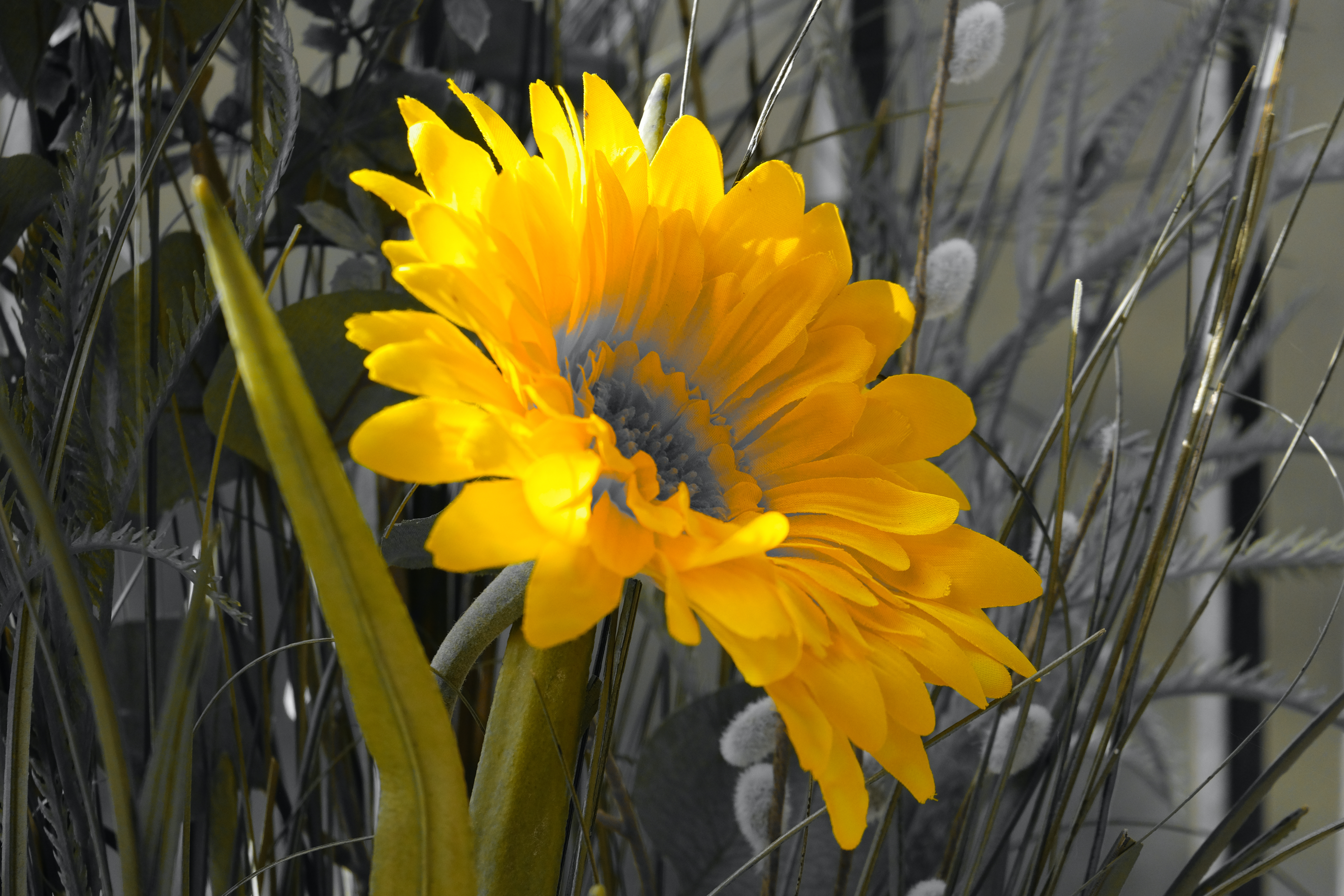
 Yellow  is the official color of the sun, at least when we were children and want to draw one (sun). It is also the color of many types of flowers. In fact, it is a very dynamic color, mostly positive in many different human cultures. True that it has another significance by inducing danger warnings of all sorts, a kind of "beware" visual frequency. Today other fellow colors have become "beware" sign like the “fluo” ones, lime-green, orange, or red for more extreme contexts. Yellow won't suit to everybody taste especially for those who have a more "gothic" point of view. 


In photography, yellow is a basic primary color in the subtractive color synthesis alongside with the cyan (sky blue) and magenta (red purple) and are represent by the CMY or CMYK (K for the black in the printing processing) logos. Combined with each other, they reproduce all the color variations we can observe in nature around us.

Yellow is symbolizing many different aspects of our everyday life but there is not a lot of people that will wear on a regular base, maybe because of its flashy apparency. Often use more as an accent color than a complete one, your eyes will be easily attracted by its presence even the more subtle one. In black and white photography, yellow will be represented by an almost white renderer and will create strong contrasts with other cold colors like the green for example. Finally, we can also take note about the multiple yellow tints that are part of your surroundings.

Yellow, a yelling color, may be for some but for others, a "bright" one!


© Photos Daniel M: Fujifilm X-S10 / XC50-230mm OIS II; Fujifilm X-T20 / XF18-55mm OIS; X-S10 / XC50-230mm OIS II

15 mai 2022

Green-On-Top


 If there is one color that personifies a state of mind, it is the green. Green signifies the nature growing, life, appeasement. It is the color of hope, and it is a very rich color in all its different tonal interpretations. Green has even become a renown political color symbolizing the pro-ecologic movement. Sure, there has been others green symbolisms like for some revolution factions in the past. Green has been also the infantry garment color although since the Vietnam war, that tendency has been replacement with camouflage patterns.

For many people, green is a favorite among the other colors. Green clothing may be unnoticeable or very flashy proving that green never said its last word in the matter. Each spring we assist at an explosion of green and the optimism replace the last depressive impressions of a never-ending winter.

For sure, green is a very pleasant color!

© Photo Daniel M: Fujifilm X-S10 / XC50-230mm OIS II

11 mai 2022

Affordable long range creativity with the Fujinon XC50-230mm F4.5-6.7 OIS II zoom lens.


 The Fujinon X-Mount lens line-up is renowned for its construction and optical qualities and has been a precious asset into the success of the Fujifilm APS-C ILC (Interchangeable Lens Camera) system. Some of those optics are almost legends of their own and have already a lasting durability over years of intense use. Alongside their XF optics which represent their finest lenses, Fujifilm have developed a less expensive XC series affordable (at a comparable half selling price) that retains most of the optical quality level in a lighter construction (mainly polymer material) and less functionalities (such as a dedicated aperture ring, or a focus or stabilization switches).


The Fujinon XC50-230mm F4.5-5.6 OIS II is the second version of the same zoom lens that has been developed as a companion optic of the XC16-50mm OIS standard (kit) zoom lens. Since that introduction, the XC50-200mm OIS II has been reviewed many times and have gotten an interesting, good feedback from these tests. The long-range affordable zoom lens is not a big and heavy optic, thanks for very modest maximum aperture of F 4.5-6.7 and its obvious construction mainly in polymer (including its lens mount). The physical barrel extension when you are selecting its longest focal length is, I must admit, impressive (It almost double its physical length). Accessory filter diameter is limited to 58mm, a very reasonable and less expensive size to cope with.

Two large control ring for setting the focal length and the manual focus are available on the Fujinon XC50-230mm OIS II. The rest of the zoom lens is exempt of other switch or button and give to it a distinctive spartan look. A usual for this kind of telephoto optic, a big lens hood is thankfully furnished by Fujifilm. Close focusing is limited by a minimum distance of 1.1m (43 inches) which is manageable for subjects like flowers or animal close ups. At 230mm, we will obtain a magnification of more than 6,5 times compare to the normal view of a 35mm prime lens.

The Fujinon XC50-230mm OIS II is often compare with the venerable Fujinon XF55-200mm F3.5-4.8 R LM OIS which use to be the companion optic of the other venerable Fujinon XF18-55mm F2.8-4 R LM OIS standard zoom kit lens. The XF55-200mm OIS is noticeably a bigger lens, much metal construction with extra control ring for the aperture, an OIS switch and a larger maximum aperture that gives you more than one stop of light gain. For the newest and lighter Fuji-X mount camera models, it is an heavier optic to handle and bring with you (and heavier also on your gear budget!). As far I am concerned, I have found the optical rendition of the two zoom lenses (XC50-230mm OIS II vs XF55-200 R LM OIS) very similar. The absence of the aperture ring on the XC50-230mm OIS II shouldn't bother you since if you are using it in conjunction of the Fujifilm X-S10 model for example ***. In the field, none of these two zoom lens models are offering the Weather Resistant (WR) certification from Fujifilm although, with a minimum attention, you can safely use them outside in most circumstances.


The autofocus is working with efficiency but can be slower in dim light context or with less constrasted subject. Action photograph should be performed with bright light although you can pre-focus manually the zoom lens in some specific situations as we use to do during the manual focus only analog-film era. Even in regard of its modest maximum aperture (F4.5-6.7), you can expect shallow deep of field from the Fujinon XC50-230mm OIS II and be able to isolate your main subject, especially in shorter distances.

Optical performances from the Fujinon XC50-230mm OIS II are on the same level in comparison with the other X-Mount lenses. Color, texture, and contrast are crisp and accurate, no surprise to be expected. The optical stabilization system (OIS) is a must in my view for a zoom lens of this type. Please note that the OIS can be deactivate only via the camera menu (No lens side switch to do so). 


A specific future article published in this blog will discuss about the "birder" qualities of the Fujinon XC50-230mm OIS II.

Long range telephoto zoom lens are a delight for details and for more graphical photographic projects. You can really explore, experiment and discriminate your subject with multiple variations in term of composition. They are great creative tool that help to isolate and emulate a particular interest of the image context. Sure many photographers are using them mainly in action, sport or animal photography but there is a lot more to do than that to do with the long telephoto zoom optics.


The Fujinon XC50-230mm OIS II zoom lens is not a perfect optic considering its very modest variable maximum aperture and its lighter construction compared to the Fujinon XF55-200mm OIS for example. But at half the price of the latter, it cannot be disregard as an affordable but performing optic that respond to photographers that don't want to spend too money for an experimenting long range zoom lens. Furthermore, there is no reason to leave the Fujinon XC50-230mm OIS II at home and to transform it as a good and always available travel companion.

_______________________________________

*** An additional grip accessory such as the Metro Case Fuji X-S10 Grip can be a good help for a better and a more secure handling of the camera/lens combination.

©Photos Daniel M: X-T20 / XF18-55mm OIS (XC50-230mm OIS II illustration); X-S10 / XC50-230mm OIS II

04 mai 2022

A, B C(amera)!

 There are the photographers that use solely one and only one camera (body) and they use it with serenity and outstanding competence like H.C.B., the late and famous Henry Cartier-Bresson. There are the others that have on hand multiple camera bodies that correspond as many different visual approaches of their subjects, like all those famous "Vietnam war" photographers. At the end, no specific rule will dictate to the potential photographers of this world how much photo gear they need to better master their art.

There can be many reasons to have more than one camera at our disposal. To have a back-up camera body, to have an instant availability for different focal length lenses, to be able to switch rapidly from different image formats or rendering (especially with analog cameras), etc. So, no justification is needed in that sense.

Which "B" camera to choose, that is the question (assuming that, for the "A" one, you have already selected)? Some will prefer to use camera models with the same interface, the same configuration profile, the same accessories. Others will be looking to expand the versatile of their photo equipment with different camera models that will be adaptable to specific photo projects or subjects. Again, there is no golden rule for choosing a "B" camera model.


We are all different sorts of photo travelers, but our individual various destinations can differ a lot. Travelers over the world, travelers over our countryside, our city, our neighborhood, our house and so on. Most photographers now like to carry less photo equipment which is almost a general universal trend observed since the last few decades. Big camera gadget bags have gradually almost disappeared of the photographic scenery except, may be, during the sport events or for photojournalists that are looking for credibility... There is also the lens evolution that the amount needed have been reduced over the years by the development of more flexible and good quality zoom optics. Today having more than two or three lenses alongside of one or two camera bodies is rare if not more exotic than useful.

From my modest experience none of my two camera models can be specifically called an "A" camera (priority) from the "B" one (back up) since they are different in their handling, interface, and configuration. I select each of them depending on the subject or the context I anticipate photographing. More precisely, my "action" camera model (Fujifilm X-S10) * is most of the time associated with a long telephoto zoom lens (Fujinon XC50-230mm OIS II) and the "contextual" camera (Fujifilm X-T20) may be combined with a standard zoom optic (Fujinon XF18-55mm OIS) or a "normal" prime lens (XC35mm F2). This can change over time since we are always looking for different visual experiences.

Do we need to have all this photo gear? Certainly not but why restrained our pleasure to try and experiment something else? Because each specific photographic tool can generate an original visual experience and, so, watch out, wallet and photo bag!
_____________________________

* As it is in May 2022.

30 avril 2022

A Neutral Filter can be a See-through Permanent Protective Front Lens Cap!

 Had the privilege to be part of the photography business domain (as corporate and freelance photographer), I have developed a strong aversion over the years about the use of front lens caps. Why? Simply because they (lens caps) have the malicious habit to be in place at the wrong moment and they (lens caps) have the highest ability to lose themselves in too many occasions. Very early in my visual creator life, the neutral filters have been a critical equipment for my psychologic comfort and the one of my precious optics.

It is preferable that the neutral and protective filters are manufactured with very good quality optic glasses ***. Their construction should also be strong and refined so, you can screw and unscrew then with ease and confidence. These modern filters are now available with sophistic coating that prevent undesirable light reflections and, in some cases, act as a water repellent which is very useful in adverse condition photographic contexts.

The use of a neutral (protective) filter that act as a permanent fixed protective front lens cap can be combined with the mounting of a dedicated lens hood which is further prevent unwanted light flair phenomena. All these lens accessories (filter, lens hood) are not an obligatory requirement to get better picture results but for the photographer, they are a very fine reassurance about the sustainability of their precious photo gear without speaking about the enhanced ability to be able to photograph instantly.
_______________________________________

*** Yes, high quality filters can be expensive...

Photo Daniel M: Fujifilm X-S10 / XF18-55mm F2.8-4 R LM OIS


20 avril 2022

Stories behind the pictures

We know this adage saying "A picture is worth a thousand words" and everybody agrees about the impact and the multiple signifiants contained in a photograph. But there is also a story behind all these visual testimonies that were not possible without a personal involvement and a contextual set-up. And it goes as far as the final presentation of the picture in including its sharing support and its specific audience. 

In reality there is no picture that can be sustained by itself because many circonstances have or will definite its (temporary) lasting impact. Without these fundamental factors, photographs cannot simply existed. 

So, what about these "off the record" or "between lines" stories that may explain more extendedly the context of the photographer's quest. There is a lot of these stories telled in books, articles, interviews done by the photographer itself or by third party interested people. The approch can be academic, journalistic or even literary for some and many are almost if not more fascinating than the picture it is based from. Yes, a picture is worth a thousand words but it can also provoke more thousands of words that will enrich the subject and its purpose. 

Here are few short memories extracted from my personal modest collection:

A racing weekend with Manon (July 1992)
Over my "racing" years of photography, many weekends were spent to motorsport assignations and my future and still beloved wife had eventually get frustrate to stay behind when I had these wonderful opportunity of enjoying the glamorous atmosphere of the world of motor races (with the charming girls and the splendid after-race afternoon gatherings!). Although I have mentioned to her that the reality of being a photo-reporter under these circonstances may be in reality a bit different, the doubts had been always there.

So, exceptionally, for one of those three days event, Manon served me as an assistant-photographer into the beautiful (and very scenic) Mont-Tremblant mountain circuit site which can be compare to similar from Spa (Belgium) or Nurburing (Germany) in Europe. And as usual, we have encounter the usual mix of extreme temperature changes (sun, warm, rain. wind, cold). And although we had lot of fun, Manon never ask me again to be assistant and preferred to stay into the full services spectator areas!

Photos Daniel M: Nikon F3 HP / Nikkor AI 300mm F4.5


A German interest (May 1997)
1997 was a big year in my life! I have get married to Manon in previous September 1996 and I started a brand new job on the road for several different photo equipment Canadian distributors as an agent for the Eastern part of the country. As a Leica representative, I had to follow a special seminar about their products and visit their German manufactory at Solms near Wetzlar. As a North-American individual, Germany was a fascinating country considering the recent past history of the second World war and the cold war. The lands, the buildings and the German society have been completely regenerated since forty years but it seems that further past heritage has been also revisited as there were not a lot of in situ testimonies left about the considerable war material and human damages. It proves simply that humanity is a lot stronger than we first think of.

Photo Daniel M: Leica Minilux 


The analog days are almost over *** (Key West, August 1997)
*** and I didn't know it!
During a three weeks road trip along the USA east coast, we had finally reached its southest point, Key West. I was still an "analog-film" photographer at that time although I cannot remember exactly which specific camera I have used to do this slide (probably a Nikon F90X / Nikkor AIs 35-70mm F2.8). This picture illustrate my ever interest to do graphic composition with a humanity zest and obviously show the limitations of the analog-film dynamic compare to the digital modern sensors but the special blend of the color rendition and the grain texture of the film was unique by itself. For the record, it will take, at least, another seven years before I definitively adopt the digital gear wave.

Photo Daniel M: Nikon F90X / Nikkor AIs 35-70mm F2.8 (to my best recollection)


A strange new world (Tulum, March 2006)
We were visiting the fascinating Tulum Temple remains and we did record all those antique assembled and sculpted rocks but there was something missing which appeared to be the human essence this new world for the "conquering" Europeans that we were at the time (and not very respectful I must add). Suddenly, I decided to go further near this small beach and I was seduced by its different atmosphere when I saw this mother with her youngsters spending time in the Atlantic breeze. Recording that moment was the highlight of the entire visit.

Photo Daniel M: Nikon D70S / AF-S DX 18-70mm F3.5-4.5


Frames over Frames (Montréal, August 2012)
A snap shot is always a snap shot but without a sharp eye and a sense of anticipation, it is rarely a strong storytelling picture. Picture frames are like small cells of life that contain their own universe and drama. Humanity can be framed into infinite possibilities, contexts and situations. And sometimes these frames are melting themselves or collides in various and interesting ways that photographs can record for posterity. This moment happened just through my beautiful office windows in Old Montreal.

Photo Daniel M: Nikon 1 V1 / VR 10-30mm F3.5-5.6


Cat People (September 2018)
We are "cat people", no doubt about it but, by far, not the first ones, egyptology can attest! And the real question behind this fascination about cat is "what they (the cat) are really thinking of us"? (beside the proven fact that we are their best servants). And why there are so many "cat pictures" all over the Web planet? Yes, we, humans, love them but is it a  mutual feeling? 
From all the cats that have decided to share their life with my wife and I, we never have received a clear answer. May be they, the cats, kindly decided to tolerate us as a philosophic and a practical point of view. May be they, the cats, want to educate us to a better living manner. May be they, the cats, simply want to enjoy life with our company. May be...

Photo Daniel M: Lumix GX9 / G Vario 12-60mm F3.5-5.6


Golden Light (September 2021)
We are facing difficult times since a few years despite the fact that many of us are still privileged with life but we cannot ignore that many others fellow human are encounting a substantial degradation of their material and psychologic situation. We are searching for hope and a better future far less scary from what many are predicting for us, the kind of "golden" future that will enlighten our universe. 

Photo Daniel M: Fujifilm X-Pro2 / XF 50mm F2 WR

16 avril 2022

Unexplored Perspectives (in photography)


 This question (if not this quest) is often evoked by all these artistically photo-philosophers of this small world: why not trying new perspectives, meaning often new visual interpretations of our surrounding places, things, and people? But it is easier to say especially considering the obvious and vastly already existing diverse artistic material produced and presented over the years, the decades, and the centuries!


When we speak about perspectives, we speak often about our "own" perspective more than about a larger academic point of view. As creators of our own imaging universe, it is already challenging to overcome our natural habit to reproduce something familiar and reassuring. Trying something else is not only demanding but also highly insecure for us. On a larger scale, it introduces controversy and sometimes deep lacks understanding even from our closest friends.


Transgressing our usual is in fact opening a new road to renewable creativity. That introduces an uncertain but fresh visual interpretation of our universe that can lead to something different, interesting, and indicative and it largely worth the effort and the uncertainty.

Photos Daniel M: Lumix G95 / G 25mm F1.7 ASPH